
Payroll / EOR · Last reviewed September 22, 2026
EOR vs Contractor of Record for SaaS Founders
An Employer of Record (EOR) becomes the legal employer of a worker in a country where you do not have an entity—employment contract, payroll taxes, and statutory benefits included. A Contractor of Record (COR / CoR) keeps the worker classified as an independent contractor while a third party manages contracts, payments, and contractor compliance paperwork. For SaaS teams hiring cross-border, use EOR when the role is employee-shaped; use COR only when the work is genuinely contractor-shaped. COR does not erase misclassification risk if day-to-day control looks like employment under IRS common-law factors or applicable labor tests.
Quick comparison: EOR vs Contractor of Record (2026)
Takeaway: EOR creates employment; COR administers a contractor relationship—they are not interchangeable labels for the same hire.
| Dimension | Employer of Record (EOR) | Contractor of Record (COR / CoR) |
|---|---|---|
| Legal status of worker | Employee of the EOR | Independent contractor (not an employee of the COR) |
| What the provider becomes | Legal employer in-country | Contracting / payment / compliance administrator for IC engagement |
| Contract type | Employment agreement | Contractor agreement / SOW |
| Taxes & benefits | Withholding, employer contributions, statutory benefits | Contractor generally handles own tax; no employee benefits package |
| Misclassification risk | Employment path removes IC misclassification for that role (other compliance still applies) | Reduced paperwork risk; does not fix a relationship that is employee-like in practice |
| Typical public fee band (example) | Often hundreds of USD per employee / month + employer load | Lower platform fees than EOR; COR tiers cost more than basic contractor payments |
| Best when | Long-term, integrated, directed roles without a local entity | Genuine project / multi-client contractor work needing compliant ops |
What an Employer of Record actually does
Takeaway: You still manage the person’s work; the EOR owns the employment relationship on paper in that country.
An EOR lets a SaaS company hire full-time (or otherwise employed) talent abroad without incorporating a local subsidiary first. The EOR runs onboarding, local employment contracts, payroll, tax remittance, and statutory benefits. You direct day-to-day work, goals, and tooling access. This is why EORs show up whenever founders want a senior engineer or support lead in another country before entity setup is worth the cost.
EOR is a poor fit when the person truly operates as a business-to-business contractor with multiple clients, their own equipment, and deliverable-based control. Forcing contractors onto EOR can be unnecessary cost; leaving employee-like roles on contractor paperwork is the opposite risk.
What a Contractor of Record actually does
Takeaway: COR is compliance infrastructure for real contractors—not a loophole to avoid employment law.
A Contractor of Record (sometimes overlapping marketing language with Agent of Record) engages or administers independent contractors on your behalf: local contractor agreements, payment routing, tax forms guidance, and documentation that helps if a classification question arises. The worker remains an independent contractor. No employment relationship is created with the COR in the EOR sense.
Use COR when you already believe the classification is legitimate and you want operational guardrails—especially across many countries and currencies. If the person works full-time exclusively for you under your hours and supervision for 18 months, buying COR on top of that fact pattern does not make the risk disappear.
Misclassification risk: IRS and labor-law framing
Takeaway: Authorities look at economic reality and control—not at whether your SaaS stack says “contractor.”
For US federal employment taxes, the IRS explains that worker status follows common-law rules grouped into behavioral control, financial control, and type of relationship (see IRS, “Independent contractor (self-employed) or employee?” and Topic No. 762, pages reviewed in 2026). If status is unclear, businesses or workers may file Form SS-8 to request an IRS determination (processing can take many months).
Separately, wage-and-hour classification under the Fair Labor Standards Act uses an economic-reality analysis administered by the US Department of Labor. Rule text has shifted in recent years (including a 2024 rule and later 2026 proposed changes discussed by practitioners)—founders should not DIY FLSA conclusions from a blog table. The durable point for product teams: contracts and COR paperwork cannot override how the working relationship actually operates.
Cross-border hires add local labor statutes on top of US tax logic when the worker or company has US ties. Treat this section as a map to advisors, not as a classification engine.
2026 cost bands with a worked example
Takeaway: Compare all-in monthly cost (platform fee + employer burden or contractor rate), not headline seat prices alone.
Public vendor pages give useful order-of-magnitude signals. On deel.com/pricing (accessed September 2026), Deel lists illustrative figures including roughly $599 per EOR employee per month, $49 per contractor per month for contractor management, and $325 per contractor of record per month for COR. Other EOR vendors publish different bands—Remote’s EOR has commonly been cited near $699 per employee per month in public materials used in prior FounderCompliance comparisons; always re-check the live pricing page and whether employer social costs are extra.
| Scenario (illustrative) | Rough monthly stack | Notes |
|---|---|---|
| 1 overseas IC, project-based, multi-client | Contractor rate + ~$49 management tier (example) | COR ($325 example) only if you need that compliance layer |
| 1 overseas full-time IC who looks like staff | Do not “save” with COR—budget EOR or entity hire | Misclassification cost dwarfs platform fees |
| 1 overseas employee via EOR | ~\$599–\$699 platform example + local employer load + gross pay | Platform fee is rarely the largest line |
| 5+ employees in one country | Model entity + local payroll vs ongoing EOR | Break-even depends on country and counsel |
Gusto remains a strong US payroll default and partners internationally in ways that differ from a full global EOR footprint—details live in Deel vs Remote vs Gusto.
When COR fits SaaS hiring
Takeaway: COR fits specialist, deliverable-based, autonomous contractor work—not “full-time teammates we have not admitted are employees.”
- Defined SOW with milestones (brand site redesign, penetration test, short data migration).
- Worker serves multiple clients or markets themselves as a business.
- You need unified payments, invoices, and contractor docs across countries.
- You are willing to avoid employee-like control (set hours, exclusive service, deep org integration).
When EOR fits (and when to open an entity instead)
Takeaway: EOR is the bridge before a local entity; it is not always cheaper than incorporating once headcount concentrates in one country.
- Role is ongoing, core to the product, and managed like an employee.
- You lack an entity in the worker’s country and need speed.
- Benefits, IP assignment via employment, and termination rules need a local employer of record.
- Consider entity setup when several hires cluster in one jurisdiction or investors expect local employment infrastructure—formation context sits in Stripe Atlas vs doola vs Firstbase and LLC vs C Corp for SaaS. Foreign-owned US LLC filing duties (e.g. Form 5472) are separate issues covered in Form 5472 for foreign-owned LLCs.
Founder decision tree
Takeaway: Ask “employee-shaped or contractor-shaped?” before you ask “which vendor logo.”
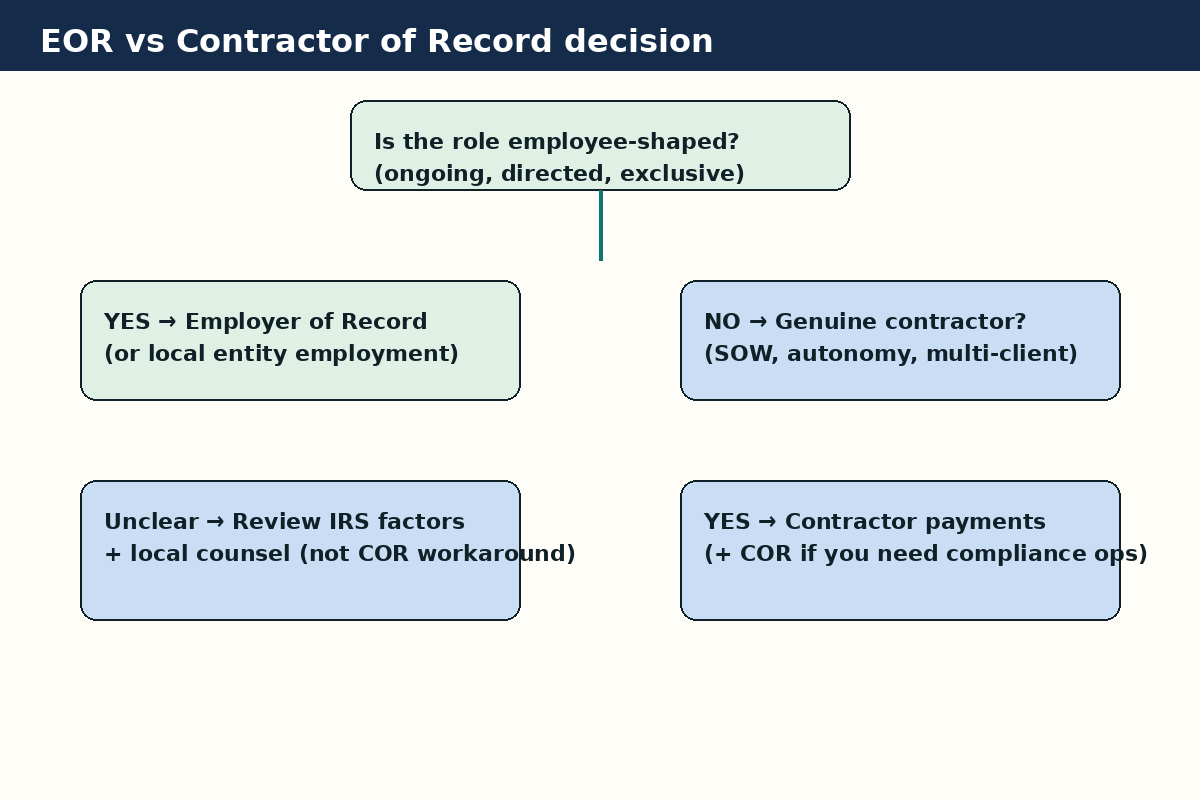
- Is the person doing ongoing, directed, exclusive work on your product? Prefer employment via EOR (or your entity). Skip COR as a workaround.
- Is the work a scoped project with contractor economics? Contractor payments; add COR if you need the compliance/payment layer across borders.
- US-only W-2 hire? Domestic payroll (e.g. Gusto) may beat global EOR products.
- Already 3+ employees in one foreign country? Model local entity cost vs stacked EOR fees with counsel.
- Unsure on US classification? Review IRS common-law factors; consider professional advice or Form SS-8 rather than guessing from a pricing page.
How this pairs with Deel vs Remote vs Gusto
Takeaway: Vendor bake-offs assume you already know whether you are buying EOR seats or contractor infrastructure.
Deel and Remote compete heavily on global EOR coverage and contractor tooling; Gusto anchors US payroll and connects internationally through partners. Before comparing UI and credits, lock the hiring model: EOR vs COR vs domestic employment. Then use Deel vs Remote vs Gusto for product-level differences. Keep classification decisions on your compliance checklist—see SaaS founder compliance checklist.
Operational checklist before you pick a vendor
Takeaway: Write down the role shape and country constraints before you book a sales demo.
- Write a one-page role brief: hours expectations, exclusivity, tools access, manager, and expected tenure.
- Mark the engagement as employee-shaped or contractor-shaped using that brief—not using desired cost.
- List countries involved (worker tax residence, where work is performed, where the company is incorporated).
- Ask counsel whether local “permanent establishment” or payroll registration issues appear if you hire without EOR/entity.
- Decide IP assignment path (employment agreement vs contractor IP clause) with a lawyer who knows the relevant countries.
- Set a review date (e.g. 90 days) to revisit classification if scope drifts toward full-time exclusive work.
- Align accounting: EOR invoices and employer costs need clear GL accounts; contractor invoices need 1099/local reporting workflows.
US-only vs cross-border: different default stacks
Takeaway: Domestic W-2 payroll and global EOR solve different problems even when the job description looks identical.
If the hire is a US employee and your company is already a US employer, a domestic payroll provider is usually the straight path—EOR marketing aimed at “hire anyone anywhere” is unnecessary overhead. If the hire sits in another country and you have no local entity, EOR (for employees) or contractor infrastructure (for real ICs) becomes relevant. Mixed teams often run Gusto (or similar) for US staff and an EOR/COR vendor for everyone else; that hybrid is normal, but it creates two compliance calendars and two invoice patterns your bookkeeper must understand.
Indie founders sometimes try to keep every overseas contributor on informal PayPal invoices forever. That can work for tiny sporadic work; it scales poorly once someone becomes a critical path teammate with production access and weekly standups. At that point the COR-vs-EOR question is overdue.
What “good documentation” looks like (without pretending it is a silver bullet)
Takeaway: Documentation supports a true classification; it cannot invent one.
- For contractors: SOW with deliverables, payment tied to outputs, contractor-provided tools where realistic, right to subcontract if genuine, multi-client evidence when it exists.
- For EOR employees: clear job description, local employment contract through the EOR, onboarding to statutory benefits, manager training on local working-time norms.
- For either path: access reviews, device policies, and offboarding checklists that match how sensitive your SaaS production systems are.
If your only “documentation” is a Slack thread saying “we’ll 1099 you,” you are improvising. If your documentation says contractor while your calendar says full-time staff meetings with PTO approvals, you are improvising with better fonts.
Common mistakes
Takeaway: The expensive mistake is using COR to paper over an employee relationship.
- Calling someone a contractor while setting hours, stacking exclusivity, and managing them like staff.
- Assuming COR indemnifies every misclassification claim worldwide.
- Buying EOR for a two-week design sprint that should have been a simple SOW.
- Ignoring local termination and notice rules when ending an EOR employment.
- Skipping IP / confidentiality hygiene because “the platform has a template.”
- Comparing only platform fees while forgetting employer social contributions on EOR.
Indie founder scenarios (educational examples)
Takeaway: Same title on LinkedIn can require opposite hiring stacks depending on control and exclusivity.
- Scenario A: You hire a designer in another country for a six-week marketing site rebuild with fixed milestones and their own studio tools. Contractor payments fit; COR is optional glue if you want centralized contracts across many freelancers.
- Scenario B: You hire a backend engineer who joins daily standups, holds production keys, works your hours exclusively for a year, and is managed like staff. That is employee-shaped—budget EOR (or a local entity), not a COR sticker.
- Scenario C: You have four support agents in one country on EOR and investors ask about long-term cost. Model entity setup versus continued EOR with finance and counsel; do not assume either answer is universal.
These sketches are not case studies of real clients; they are decision templates so you ask better questions before signing a vendor order form.
FAQ: EOR vs Contractor of Record
1) Is Contractor of Record the same as Employer of Record?
No. EOR employs the worker. COR administers a contractor engagement without creating that employment relationship.
2) Does COR eliminate misclassification risk?
No. It can improve documentation and payment compliance for genuine contractors. It does not convert an employee-like relationship into a safe contractor hire.
3) When should a SaaS startup use an EOR?
When you need an employee in a country without an entity—especially long-term, integrated roles—and entity setup is not yet justified.
4) How much does EOR vs COR cost in 2026?
Vendor-specific. Deel’s public pricing page (Sep 2026) lists example figures around $599/mo per EOR employee, $49/mo contractor management, and $325/mo COR. Re-verify live; employer burdens and benefits add cost on EOR.
5) Can I move a contractor onto EOR later?
Often yes operationally, but treat it as a classification and local-employment change with counsel—not a silent toggle in settings.
6) What US forms relate to contractor vs employee questions?
Businesses issue Form W-2 for employees and typically Form 1099-NEC for many US contractors when thresholds apply. Form SS-8 requests an IRS determination of worker status for federal employment taxes. Confirm current instructions on IRS.gov.
7) Is Gusto an EOR?
Gusto is primarily US payroll/HR. International paths differ from a classic multi-country EOR footprint—compare options in our Deel vs Remote vs Gusto guide.
8) Should indie hackers care about COR?
Only once you regularly pay overseas contractors and need structured contracts/payments. A single occasional invoice may not justify COR fees; exclusive full-time “contractors” may need EOR instead.
Bottom line
EOR vs Contractor of Record is a classification architecture choice first and a vendor choice second. Use EOR when you are hiring employees without a local entity. Use COR when contractors are real contractors and you want operational compliance. Do not buy COR to hide an employee. Price the full stack, read IRS / local rules with advisors, and pick tools after the model is clear.
Next step: Compare providers in Deel vs Remote vs Gusto, then place hiring controls on your SaaS founder compliance checklist. New here? Start at Start Here or browse the tools hub.