Checklist · Last reviewed September 26, 2026
SaaS Founder Compliance Checklist
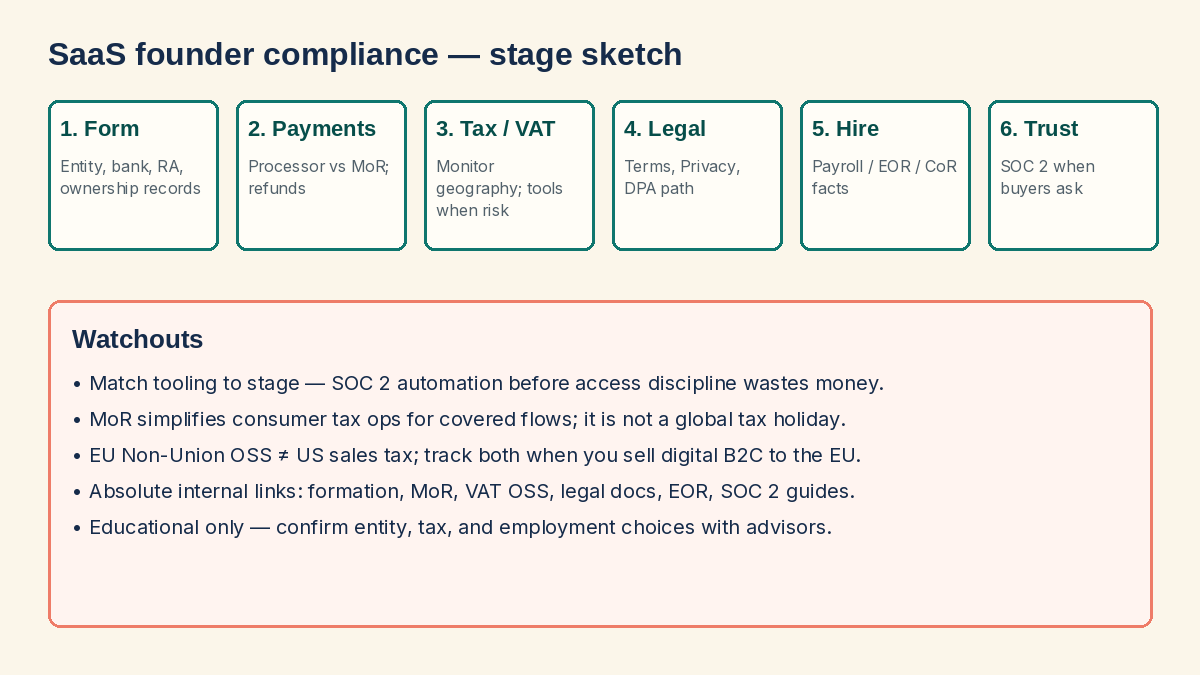
A SaaS founder compliance checklist is a stage-ordered list of company setup, payments, tax monitoring, legal docs, hiring, and trust work—not a day-one SOC 2 program. Before first revenue, prioritize entity and banking readiness, a payment path (direct processor vs Merchant of Record), and baseline Terms and Privacy. As MRR and customer geography grow, add sales-tax and VAT monitoring (tools when nexus or filing risk is real), contractor and payroll discipline, then enterprise-ready contracts and SOC 2 readiness when buyers ask. Use this 2026 refresh as the map; open the linked deep guides when a stage becomes active.
Who this checklist is for
Takeaway: Use this if you are moving from product building into real commercial operations and need an order of operations—not a GRC encyclopedia.
This guide is for SaaS founders, indie hackers, and remote-first operators who are asking questions like:
- Do I need a US LLC, a Delaware C-Corp, or a Wyoming LLC yet?
- Should I use Stripe or a Merchant of Record?
- When does sales tax software or EU VAT OSS actually become necessary?
- Can I hire contractors first, or do I need payroll / an EOR?
- Which legal documents should exist before larger customers ask?
If you want a curated reading path across the whole site, start at Start here and browse the tools hub.
Stage map: what matters now vs what can wait
Takeaway: Match spend and process weight to stage—pre-revenue teams that buy enterprise compliance stacks usually waste money and attention.
| Stage | What usually matters now | What usually can wait |
|---|---|---|
| Pre-revenue / beta | Entity choice, banking path, payment readiness, Terms, Privacy, cookie basics | Sales tax automation, payroll platform, SOC 2 tooling |
| First paying customers | Payment ops, refunds, invoices, basic tax geography tracking, customer-facing legal pages | Complex multi-entity structures, full vendor security stack |
| Growing MRR / multi-state or multi-country | Sales tax / VAT review, bookkeeping discipline, contractor agreements, contract workflow | Heavy governance tools unless sales or hiring demands them |
| First employee or global teammates | Payroll, classification review, EOR vs entity path, benefits basics | Public-company style controls |
| Enterprise sales motion | DPA / MSA process, security questionnaire workflow, trust materials, SOC 2 readiness | Large audit stack before customer demand exists |
1. Company setup and formation
Takeaway: Your first compliance decision is usually operating structure—can you sell, get paid, and open accounts cleanly?—not “how compliant can we look on LinkedIn.”
Founders typically need to decide:
- LLC vs C-Corp (and whether VC fundraising is a near-term path)—see LLC vs C-Corp for SaaS
- State of formation tradeoffs (Delaware vs Wyoming privacy/cost/VC norms)—see Wyoming LLC vs Delaware LLC
- Whether a formation vendor bundle helps (EIN, registered agent, banking intros)—see Stripe Atlas vs doola vs Firstbase
- Foreign-owned LLC reporting themes (for example Form 5472 educational overview)—see Form 5472 for foreign-owned LLCs
Keep ownership records, registered agent contacts, and banking KYC documents in one place. Formation is not “done” when the Articles file—banking and payment underwriting are where incomplete paperwork shows up.
Practical formation hygiene founders skip:
- Store Articles, EIN letter, operating agreement / bylaws, and cap table in a shared folder with version dates
- Confirm registered agent renewals before the state dissolves you for a missed annual report
- Align the legal name on Stripe/MoR underwriting with bank and IRS records
- If you are foreign-owned or have foreign owners, put Form 5472 / related reporting on a calendar with your CPA—do not discover it in April
Entity choice is reversible only with cost and distraction. If you expect institutional fundraising within 12–18 months, model Delaware C-Corp norms early; if you are bootstrapping a privacy-sensitive LLC, Wyoming vs Delaware cost/privacy tradeoffs matter more than Twitter lore.
2. Payments and Merchant of Record
Takeaway: Choosing a direct processor vs a Merchant of Record changes who faces the customer as seller and who carries much of the consumer tax ops load.
Early founders usually choose among:
- A direct processor (commonly Stripe) where you remain the merchant
- A Merchant of Record (Paddle, Lemon Squeezy, Polar, and similar) that sells as the merchant of record
- Hybrid setups (self-serve cards + enterprise invoices/wires)
Answer these before you lock a stack:
- Do you want to own tax calculation, invoicing, and refunds directly?
- Is simplifying VAT / sales tax ops worth MoR fee economics?
- How likely is verification friction from country, entity type, or product category?
Deep dives: Stripe vs Paddle vs Lemon Squeezy, Merchant of Record vs payment processor, Paddle vs Lemon Squeezy vs Polar, and Stripe Managed Payments vs Paddle.
Operational checklist once payments are live:
- Document who can issue refunds and how chargebacks are answered
- Separate test-mode keys from live keys; restrict who can export customer payment data
- Map which SKUs are self-serve card checkout vs sales-assisted invoices
- Know whether tax is calculated at checkout by you, by Stripe Tax, or by an MoR
Fee math matters, but so does support load. MoR platforms often reduce consumer-tax ops at a higher take rate; direct Stripe keeps control and puts more compliance ownership on you. Re-read fee tables yearly—2026 list fees move, and “we picked it once in 2023” is not a strategy.
3. Sales tax, VAT, and OSS monitoring
Takeaway: Monitor customer geography early; buy tax software when nexus, volume, or multi-jurisdiction filing risk is real—not because a Twitter thread scared you.
Stage-based framing that still holds in 2026:
- Very early: track where customers are, keep clean invoices/receipts, avoid guessing taxability
- Rising multi-state or multi-country revenue: review US economic nexus themes and international VAT/GST exposure with an advisor
- Filing risk is real: evaluate tools such as Stripe Tax, TaxJar, Avalara, or Anrok
- EU B2C digital services from a non-EU company: understand Non-Union OSS as a filing simplification—not a US sales-tax substitute
Related guides: When a SaaS startup needs sales tax software, VAT OSS for US SaaS companies, Anrok vs Avalara, and Avalara vs TaxJar vs Stripe Tax.
Dated rule pointer (educational): EU Non-Union / Union OSS returns are generally quarterly, with file-and-pay timing described by the European Commission as the end of the month following the calendar quarter—confirm on Commission OSS declare-and-pay pages before you calendar anything.
US sales tax for SaaS is state-specific: economic nexus thresholds, product taxability, and marketplace rules differ. Do not assume “software is always taxable” or “SaaS is never taxable.” Keep a simple geography spreadsheet until volume justifies a tax engine. For EU B2C digital services, Non-Union OSS (when it fits) is about filing simplification after you understand who the customer is—B2C vs B2B with VAT ID is a different operational path.
Tooling comparison shortcut:
- Stripe Tax: convenient if you already run Stripe and remain the merchant
- Avalara / TaxJar: broader filing ecosystems; evaluate cost vs volume
- Anrok and similar SaaS-native engines: often discussed when subscription tax ops are the main pain
- MoR: shifts much consumer tax collection to the MoR for covered flows
4. Legal documents and privacy basics
Takeaway: Publish accurate Terms, Privacy, and billing language before a serious buyer redlines you into improvisation.
Most SaaS companies should review at least:
- Terms of service / subscription terms
- Privacy policy that matches actual processors and analytics
- Cookie / CMP practices appropriate to your traffic (EU/US framing differs)
- Refund and billing language aligned with how you actually charge
- Contractor agreements and a basic order form / MSA path for custom deals
- DPA readiness when you process personal data for business customers
You do not need a Fortune 500 legal library on day one. You do need docs that match the product. Start with SaaS legal documents checklist and compare CMP/policy tooling in Termly vs Iubenda vs Termageddon.
Minimum viable trust packet for early B2B:
- Public Privacy + Terms that name real subprocessors
- A DPA template you can send without reinventing each deal
- Security one-pager (hosting region, encryption in transit/at rest themes, access control basics)—even before SOC 2
- Subprocessor list you can update when you add analytics or support tools
Cookie and CMP choices should match where your traffic and ads run. US-only marketing sites and EU-heavy B2C funnels are not the same problem. Update policies when you add AI features, new processors, or new data fields—stale privacy pages are an easy diligence miss.
5. Payroll, contractors, EOR, and Contractor of Record
Takeaway: When you leave solo-founder mode, classification and who carries employment risk matter more than which payroll logo looks modern.
Core decisions:
- Contractor vs employee (facts over title)
- US payroll vs global payroll
- Employer of Record (EOR) vs opening a local entity
- Contractor of Record (CoR) patterns when you intentionally keep contractor relationships with more scaffolding
- How founder salary, equity paperwork, and reimbursements are handled
Compare stacks in Deel vs Remote vs Gusto and clarify roles in EOR vs Contractor of Record. International “quick contractor” arrangements are where informal SaaS teams get expensive surprises.
Before the first international offer letter:
- Write down the role, hours, and who directs the work (classification facts)
- Decide whether the person should be an employee somewhere or a true contractor
- If EOR: understand who is the legal employer and what your company still owns (IP assignment, access, offboarding)
- If contractor: use a real agreement, IP assignment, and payment terms—not a Slack DM
- Turn off access on the last day; collect devices and revoke SaaS seats
US domestic first hires still need payroll registration, withholding, and clear PTO/expense policies. “We’ll fix HR later” is how founders create both compliance and culture debt.
6. Accounting hygiene (so diligence does not panic you)
Takeaway: Clean books and a plan for prepaid subscriptions beat buying every SaaS metrics tool before you have a CPA close process.
Even a lean team should:
- Pick an accounting system your advisor will actually use—see best accounting tools for SaaS founders and QuickBooks vs Xero for SaaS
- Reconcile payment processor / MoR payouts to the bank
- Separate owner draws, payroll, and operating expenses
- Know whether you are on cash-basis tax reporting vs accrual statements investors expect
If annual prepaid plans are growing, learn how deferred revenue shows up on accrual books before a fundraise data room asks. That topic pairs with this checklist; keep the ops map here and open the accounting deep dives when numbers get serious.
Founder-level accounting controls that prevent diligence drama:
- Monthly bank + processor reconciliation (even if a bookkeeper does the entries)
- Clear chart of accounts for revenue, refunds, payment fees, and tax collected
- Receipt retention for material expenses
- A written note on whether management reports are cash or accrual
When prepaid annual plans become material, deferred revenue on accrual statements is a normal SaaS liability—not a crisis. Align with your CPA before investors ask why cash jumped but revenue did not.
7. When B2B trust and SOC 2 start to matter
Takeaway: Do not buy SOC 2 automation because Twitter said so—start readiness when enterprise procurement is blocking or about to block revenue.
Signals that more structured compliance is near:
- Security questionnaires stall deals
- Customers request a DPA, pen-test summary, or vendor review packet
- You store sensitive customer data or connect to production systems of large buyers
- Larger deals repeatedly ask for SOC 2 Type 1 or Type 2
Read next: SOC 2 readiness checklist, SOC 2 Type 1 vs Type 2, and Vanta vs Drata vs Secureframe.
Readiness work that is useful even before an auditor:
- Inventory systems that hold customer data
- Enforce SSO/MFA on admin and production access where available
- Centralize vendor list and DPAs
- Define incident response contacts and a basic runbook
- Decide Type 1 vs Type 2 timing based on buyer asks, not vendor upsell calendars
Automation platforms (Vanta, Drata, Secureframe, and peers) help collect evidence; they do not replace access discipline or a real security owner.
Common mistakes founders make
Takeaway: Most expensive mistakes are stage mismatches—too much tooling too early, or too little process right when a deal or hire lands.
- Optimizing for legal perfection before there is a sales and refund workflow to protect
- Assuming a payment provider or MoR removes all tax obligations everywhere
- Using international contractors without reviewing classification and local rules
- Waiting until an enterprise prospect appears to invent privacy and contract basics
- Choosing tools because they are popular rather than because they match stage and geography
- Treating EU VAT OSS and US sales tax as the same problem with one dashboard click
- Buying SOC 2 before access control, logging, and vendor inventory exist
Practical one-page founder checklist
Takeaway: Print this, assign owners, and only deepen a line when the stage trigger is real.
- Choose entity and banking path that fits the sales plan (LLC/C-Corp, state, formation vendor if needed).
- Stand up payments: processor vs MoR vs hybrid; document refund and dispute handling.
- Publish Terms, Privacy, and billing language that match the live product.
- Track customer geography monthly; schedule a tax review when multi-jurisdiction volume appears.
- Decide contractor vs payroll vs EOR/CoR before the second international hire.
- Keep books reconcilable; know cash vs accrual story for prepaid plans.
- When enterprise asks start, assemble DPA/MSA process and SOC 2 readiness plan—not a panic purchase.
- Revisit this checklist quarterly as MRR, countries, and headcount change.
FAQ
What is a SaaS founder compliance checklist?
It is a stage-based list of operating, legal, tax, payments, hiring, and trust tasks so founders do the right work at the right time instead of copying an enterprise GRC program on day one.
Do early SaaS startups need sales tax software?
Not always. Many should monitor customer locations and invoices first, then buy software when transaction volume, geographic spread, or filing risk becomes meaningful. See when a SaaS startup needs sales tax software.
Does a Merchant of Record remove all tax work?
No. MoR often simplifies consumer tax ops for covered checkout flows because the MoR is the seller of record, but you still need to understand scope, enterprise invoice paths, and parallel obligations. Compare in MoR vs payment processor.
Should I use an EOR before setting up payroll?
It depends on where you hire, how fast you need to hire, and whether opening a local entity is realistic. Compare Deel vs Remote vs Gusto and EOR vs CoR.
Do I need SOC 2 before I have enterprise customers?
Usually not. Understand when buyers start requiring stronger evidence, then prepare. Type 1 vs Type 2 timing is covered in SOC 2 Type 1 vs Type 2.
Wyoming LLC or Delaware LLC for a SaaS?
It depends on privacy preferences, cost, and whether VC-standard Delaware C-Corp mechanics are in your near-term plan. See Wyoming LLC vs Delaware LLC.
Where does EU VAT OSS fit on this checklist?
Under sales tax / VAT monitoring when you sell digital B2C services into the EU without an EU establishment. Non-Union OSS is a filing simplification described by the European Commission—not a substitute for US sales tax. See VAT OSS for US SaaS.
What should I read next after this checklist?
Pick the active stage: formation comparisons, payments/MoR, tax tooling, legal documents, hiring stacks, or SOC 2 readiness. The Start here page orders the journey.
Next step
Use this checklist as your quarterly ops review, then open the deep guide for the stage that is currently blocking revenue or creating risk. Start with Start here, scan the tools hub, and if enterprise trust is the bottleneck jump to the SOC 2 readiness checklist or the SaaS legal documents checklist.