Legal / Privacy · Last reviewed October 11, 2026
SaaS Legal Documents Checklist for Founders
Most SaaS founders do not need a giant legal library on day one. They need the right documents at the right stage: Terms of Service and a Privacy Policy that match the real product before public launch; contractor and IP-assignment paperwork before anyone else touches the code; and a DPA / MSA / order-form workflow before serious B2B sales. Use this checklist to decide what to create now, what can wait, and when a generator is a draft—not a finished answer.
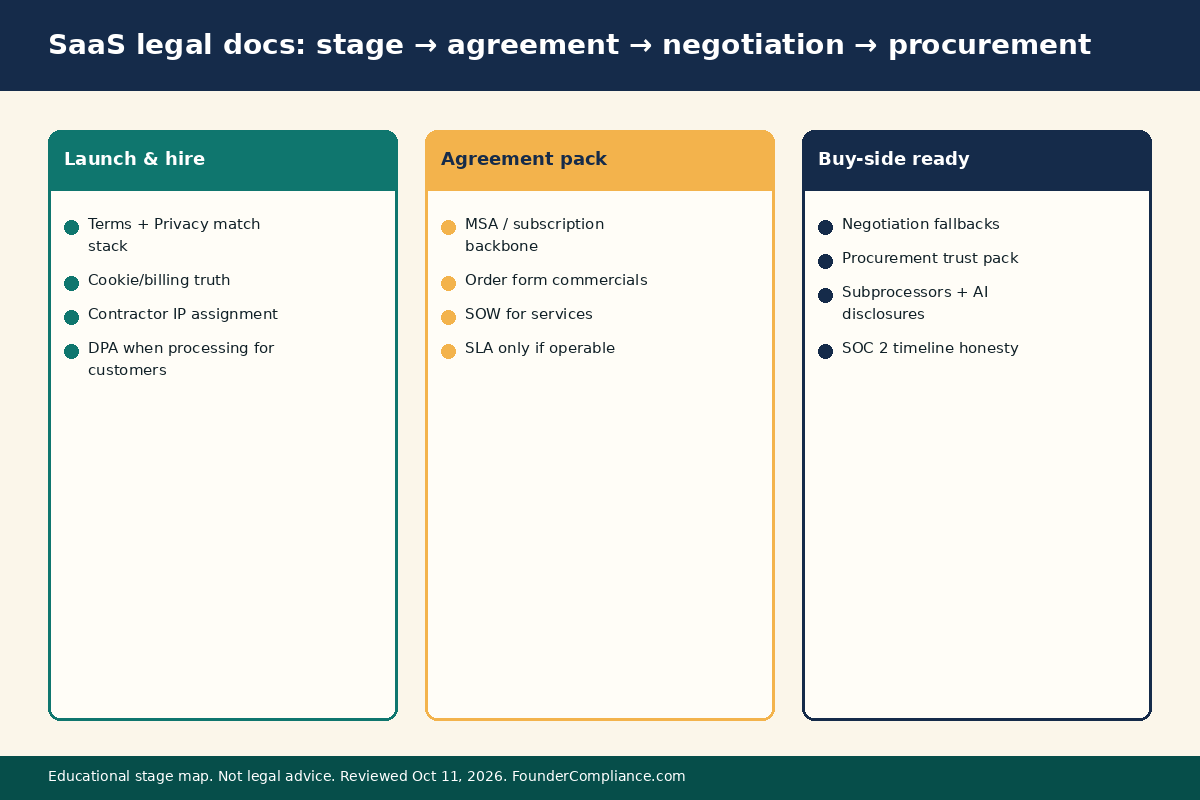
Stage-based document map (2026)
Takeaway: Prioritize documents by the risk you are about to take—launching publicly, hiring help, or signing B2B—not by copying an enterprise playbook on day one.
| Stage | Prioritize now | Usually can wait |
|---|---|---|
| Pre-launch / public beta | Terms of Service, Privacy Policy, cookie notice if you use non-essential cookies/trackers, Acceptable Use Policy (AUP) where misuse risk is real, billing/refund language | Full MSA package, custom SLA, SOC 2 exhibits |
| First paying customers (mostly self-serve) | Clear subscription/billing terms, support policy, accurate privacy disclosures for analytics/payments/support tools | Heavy redline workflow, insurance certificates for every deal |
| Contractors / agencies / early collaborators | Contractor agreement, confidentiality, IP assignment / work-made-for-hire language, access and data-handling rules | Full employee handbook (unless hiring employees) |
| B2B sales motion | Data Processing Agreement (DPA), Master Services Agreement (MSA) or subscription agreement, order form, security questionnaire pack | Overbuilt legal-ops tooling; unique contract per small deal |
| Enterprise procurement | SLA (if you promise uptime), security exhibit, subprocessors list, insurance evidence, vendor onboarding forms | Custom terms for every SMB that will accept your paper |
For the operational side of this roadmap (tax, payroll, SOC 2 timing), pair this page with the SaaS founder compliance checklist.
What each core document is for
Takeaway: A Privacy Policy tells end users what you do with data; a DPA is a contract with a business customer about processing their personal data—do not treat them as interchangeable.
| Document | Primary audience | Job it does |
|---|---|---|
| Terms of Service / Terms of Use | Users / customers | Rules of use, accounts, IP, liability limits, dispute process, acceptable use |
| Privacy Policy | Users / regulators / buyers reviewing trust | What personal data you collect, why, retention, sharing, rights, contact path |
| Acceptable Use Policy | Users | Prohibited misuse (abuse, scraping, illegal content) when Terms alone are too dense |
| DPA / Data Processing Addendum | B2B customer (often controller) | Processor obligations, security, subprocessors, breach notice, deletion/return |
| MSA + Order Form | B2B customer | Commercial relationship: fees, term, IP, warranties, liability, governing law; order form locks commercial specifics |
| SOW / Statement of Work | Services / implementation deals | Scoped deliverables, timelines, acceptance—usually under an MSA |
| SLA | Customers buying uptime promises | Availability targets, credits, exclusions, maintenance windows |
| Contractor + IP assignment | Founders / company | Confidentiality and ownership of code, designs, content created for the company |
1. Pre-launch core: Terms, Privacy, cookies, billing
Takeaway: Publish Terms and a Privacy Policy that match your actual stack before you collect personal data at scale—not after the first enterprise questionnaire.
Before a public marketing site or product signup, most SaaS teams need:
- Terms of Service covering accounts, subscriptions, IP ownership of the software, user content licenses, prohibited use, suspension, limitation of liability, and how disputes are handled.
- Privacy Policy covering categories of personal data, purposes, legal bases where GDPR/UK GDPR apply, cookies/trackers, processors/service providers, international transfers at a high level, retention, and how people exercise rights.
- Cookie / tracking notice when you use non-essential analytics, ads, or similar technologies—especially for EU/UK visitors.
- Billing and refund language that matches what Stripe, Paddle, or your MoR actually does (proration, trials, chargebacks).
Accuracy beats length. A Privacy Policy that lists “we may share with partners” without naming payment, analytics, email, and support vendors is a common failure mode in security reviews. If you use a policy generator, treat the output as a draft you map to your real subprocessors. For generator comparisons aimed at founders, see Termly vs iubenda vs Termageddon. Template pages for “privacy policy template” or “terms of service template” can seed wording, but they are not a substitute for product-truth edits.
2. Contractor agreements and IP assignment
Takeaway: Get written IP assignment before a freelancer ships code—ownership disputes are harder and more expensive than a short agreement.
Many early SaaS products are built with contractors, agencies, or part-time collaborators. Before access to repos, design files, or customer data, prioritize:
- Contractor or consulting agreement (scope, fees, termination)
- Confidentiality / NDA obligations
- IP assignment or work-made-for-hire language for deliverables
- Rules for using company devices, customer data, and AI coding tools if relevant
This is separate from entity choice. If you are still forming the company, pair legal hygiene with formation tooling notes in Stripe Atlas vs doola vs Firstbase and structure notes in LLC vs C Corp for SaaS.
3. Data Processing Agreement: when it matters
Takeaway: If you process personal data on behalf of a business customer, expect a DPA—under GDPR Article 28 a written processor contract is required for that relationship; many US enterprise buyers demand one anyway.
A DPA (sometimes called a Data Processing Addendum) usually sits beside your MSA or Terms. It typically addresses:
- Controller vs processor roles (and when you are a joint controller or independent controller—facts matter)
- Documented instructions and confidentiality
- Security measures (often mapped to Article 32-style themes)
- Subprocessor authorization and an up-to-date list
- Assistance with data-subject requests and breach notification timelines
- Deletion or return of personal data at the end of the engagement
- Audit / information rights in a workable form
Educational reference: the official GDPR text sets out processor-contract requirements in Regulation (EU) 2016/679 (GDPR), Article 28. US state privacy laws (for example California’s CCPA/CPRA framework via the California Attorney General CCPA page) add notice and contract pressure even when you are not “doing EU.” Do not invent “we are GDPR certified” claims; certification marketing language is often misleading. For tooling that helps operationalize GDPR obligations (DSAR workflows, consent, mapping), see GDPR compliance software—software does not replace a DPA, but it can reduce evidence gaps during buyer reviews.
4. MSA, order form, SOW, and SLA (how the stack fits)
Takeaway: Use an MSA (or subscription agreement) as the stable legal backbone, an order form for commercial specifics, an SOW for scoped services, and an SLA only when you can operationally support the uptime you promise.
Founders often confuse these labels:
- MSA / Master Services Agreement — ongoing legal terms between you and a B2B customer (payment, IP, warranties, liability caps, termination, governing law).
- Order form / Order schedule — products, quantities, prices, term length, start date; incorporates the MSA.
- SOW — implementation, professional services, or custom deliverables under the MSA.
- SLA — measurable service commitments and remedies (usually service credits), not a marketing uptime boast.
Self-serve PLG teams often start with online Terms + Privacy + DPA-on-request, then graduate to MSA paper when ACV and procurement require it. Sales-led teams usually need MSA + order form earlier.
5. SaaS agreement checklist (what to have ready)
Takeaway: A practical SaaS agreement checklist is a reusable pack—MSA/subscription terms, order form, DPA, and support/security annexes—not a one-off PDF per deal.
Use this as a working SaaS agreement checklist before you send paper:
- Parties and product schedule — legal names, bill-to, products/SKUs, seats or usage metrics, start date, initial term, renewal mechanics.
- Fees and payment — currency, invoicing cadence, late fees, taxes, true-up for overages, refund policy (or “no refunds” if that is your model).
- License / access grant — SaaS access rights, restrictions, and who owns customer data vs software IP.
- Customer obligations — account security, acceptable use, lawful use of content uploaded to the product.
- Warranties and disclaimers — what you actually warrant (and what you do not).
- Limitation of liability and indemnities — caps, carve-outs (IP infringement, confidentiality, data breach—facts and counsel dependent).
- Confidentiality — mutual NDA-style terms or a standalone NDA for early diligence.
- DPA / privacy schedule — roles, subprocessors, breach notice, deletion/return.
- Term, suspension, termination — for convenience vs for cause; wind-down and data export windows.
- Governing law / venue / dispute process — consistent with how you actually sell.
If most deals are still clickwrap self-serve, keep this pack printed and versioned so sales does not invent forks when the first mid-market buyer asks for “your MSA.”
6. SaaS contract negotiation checklist (redlines that matter)
Takeaway: Negotiate the handful of clauses that change risk or cash timing; do not burn cycle time polishing style edits that do not change outcomes.
When a buyer returns a redline, walk this SaaS contract negotiation checklist with counsel or an experienced founder-operator:
- Liability cap — multiples of fees vs fixed floors; carve-outs that effectively remove the cap.
- Unlimited indemnities — especially broad IP or “any third-party claim” language you cannot insure.
- Security / audit rights — annual questionnaire + SOC report vs on-site audits with short notice.
- Breach notification timing — align to what your incident process can actually meet; do not invent 24-hour promises without on-call coverage.
- Subprocessor consent — prior written consent for every change vs notice + objection window (common modern pattern).
- Service credits / SLA — exclusivity of remedies; exclusions for customer misuse and planned maintenance.
- Auto-renewal and termination for convenience — cash predictability vs buyer flexibility.
- Most-favored-nation / public reference — rarely worth early-stage drama unless ACV is large.
- Assignment / change of control — fundraising and acquisition paths.
- Non-solicit / non-compete overlays — often overreaching for a SaaS subscription; push back when they block ordinary hiring.
Document your fallback positions once (green / yellow / red). That turns negotiation into a repeatable process instead of reinventing the company on every DocuSign.
7. SaaS procurement checklist (what enterprise buyers ask for)
Takeaway: Treat procurement as a parallel track to commercial negotiation—security and privacy packs stall deals even when pricing is agreed.
A founder-facing SaaS procurement checklist usually includes:
- Current Privacy Policy URL and Terms URL
- Signed or signable DPA + subprocessors list (dated)
- Security overview / trust-center summary
- SOC 2 report or a truthful readiness timeline (Type I vs Type II)
- Penetration-test executive summary or vulnerability management narrative
- Insurance certificates when required (cyber / E&O)
- Vendor questionnaire responses (SIG-lite style or custom)
- W-9 / tax forms and banking details for AP onboarding
- Order form + MSA (or clickwrap path) ready for legal review
- Implementation / support contacts and escalation path
Build a reusable folder once. Rewriting answers per RFP is how small teams lose weeks. If SOC 2 is still ahead of you, use the SOC 2 readiness checklist for SaaS startups and never promise a report date you cannot staff.
8. Enterprise procurement: security exhibits and trust packs
Takeaway: Enterprise buyers often ask for security evidence before they finish commercial negotiation—prepare a reusable pack instead of rewriting answers per RFP.
Common asks beyond the procurement checklist above: security exhibits attached to the MSA, business continuity summaries, and (for regulated buyers) additional questionnaires. Keep one system of record for signed order forms so AP and legal share the same version.
9. AI features, training data, and subprocessors
Takeaway: If the product sends customer content to an AI model provider, say so in Privacy/DPA/subprocessors and decide training-use terms before enterprise legal review finds the gap.
In 2025–2026 procurement, AI addenda show up more often. At minimum, document which AI vendors are subprocessors, whether customer content trains models, retention of prompts/outputs, and human review / abuse monitoring where relevant. Update Privacy and DPA when the architecture changes—not six months later during a failed security review.
10. Tool categories worth evaluating
Takeaway: Generators accelerate first drafts; counsel is for high-risk clauses, enterprise paper, and anything you do not understand.
- Policy / Terms generators — useful starting points; verify against real data flows (Termly vs iubenda vs Termageddon).
- E-sign + contract repository — version control for MSA/order forms so sales does not invent forks.
- Trust center / security questionnaire tools — reduce repeat RFP labor once you have real controls.
- GDPR / privacy operations software — DSAR and mapping workflows that back your DPA claims (GDPR compliance software).
- Outside counsel — formation nuances, fundraising, international employment, healthcare/finance verticals, or custom enterprise liability.
Foreign-owned US structures may also need IRS Form 5472 workflows; see Form 5472 for foreign-owned LLCs if that applies.
11. 30-day legal hygiene checklist
Takeaway: A short monthly hygiene pass prevents Privacy/Terms drift more effectively than an annual panic rewrite.
- List live signup paths and confirm Terms + Privacy links are reachable.
- Reconcile Privacy “categories of data” with your actual analytics, auth, payments, support, and AI vendors.
- Publish or update a subprocessors list if you sell B2B.
- Confirm contractor IP assignments exist for everyone with repo access.
- Download your current DPA template and note the last review date.
- If you promise uptime publicly, confirm monitoring can support an SLA.
- Store signed order forms in one system of record.
- Flag any AI feature that changed data flows since last review.
Common mistakes
Takeaway: The expensive mistakes are mismatched Privacy disclosures, missing IP assignment, and SLAs you cannot operate—not missing a rarely used exhibit on day one.
- Publishing a Privacy Policy that does not match the product stack
- Skipping IP assignment for contractors or early collaborators
- Promising enterprise-grade uptime before operations can measure it
- Letting each customer create a new contract version with no source of truth
- Treating a generator PDF as finished legal judgment for high-risk deals
- Calling a Privacy Policy a “DPA” in sales emails
- Ignoring AI/subprocessor changes after launch
- Entering procurement without a reusable security pack
FAQ: SaaS legal documents checklist
1) What legal documents does a SaaS startup need before launch?
Typically Terms of Service, a Privacy Policy aligned to real data practices, cookie/tracking notices where required, and clear billing/refund language. Add IP assignment before outside developers contribute.
2) Do SaaS startups need a lawyer for Terms and Privacy?
Not every early draft requires a large legal project. Legal review is wise if you handle sensitive data, sell internationally, hire contractors at scale, or negotiate enterprise paper.
3) What do enterprise SaaS customers ask for first?
Common requests include Privacy Policy, DPA, MSA/order form, security documentation, subprocessors, and sometimes an SLA or insurance evidence—see the procurement checklist above.
4) Can I use a legal document generator?
Yes as a starting point. Verify that outputs match your product, data flows, billing terms, and risk profile before you rely on them in a dispute or enterprise deal.
5) When do I need a DPA?
When you process personal data for a business customer as a processor—and practically whenever serious B2B buyers require one. GDPR Article 28 frames written processor contracts for EU/UK personal data processing relationships.
6) What is the difference between an MSA and an order form?
The MSA holds reusable legal terms; the order form locks commercial specifics (products, price, term) and usually incorporates the MSA.
7) Do I need an SLA on day one?
Usually no. Add an SLA when customers pay for uptime commitments you can monitor, credit, and operationally support.
8) How often should founders update legal docs?
After material product, vendor, pricing, geography, or AI-data-flow changes—and on a scheduled review (for example quarterly) so documents do not silently drift.
Bottom line
Build legal documents in stages. Launch with honest Terms and Privacy. Lock IP when you hire help. Add DPA/MSA/order-form muscle for B2B. Use the agreement, negotiation, and procurement checklists so sales and security reviews share one pack. Add SLA and security exhibits when enterprise procurement arrives. Keep subprocessors and AI disclosures truthful. Then operationalize the rest on your compliance roadmap.
Next step: Walk the broader ops list in the SaaS founder compliance checklist, tighten EU buyer readiness with GDPR compliance software, compare privacy-policy tooling in Termly vs iubenda vs Termageddon, and use Start Here or the tools hub if you are mapping the full founder stack.