Sales tax & VAT · Last reviewed September 25, 2026
VAT OSS for US SaaS Companies
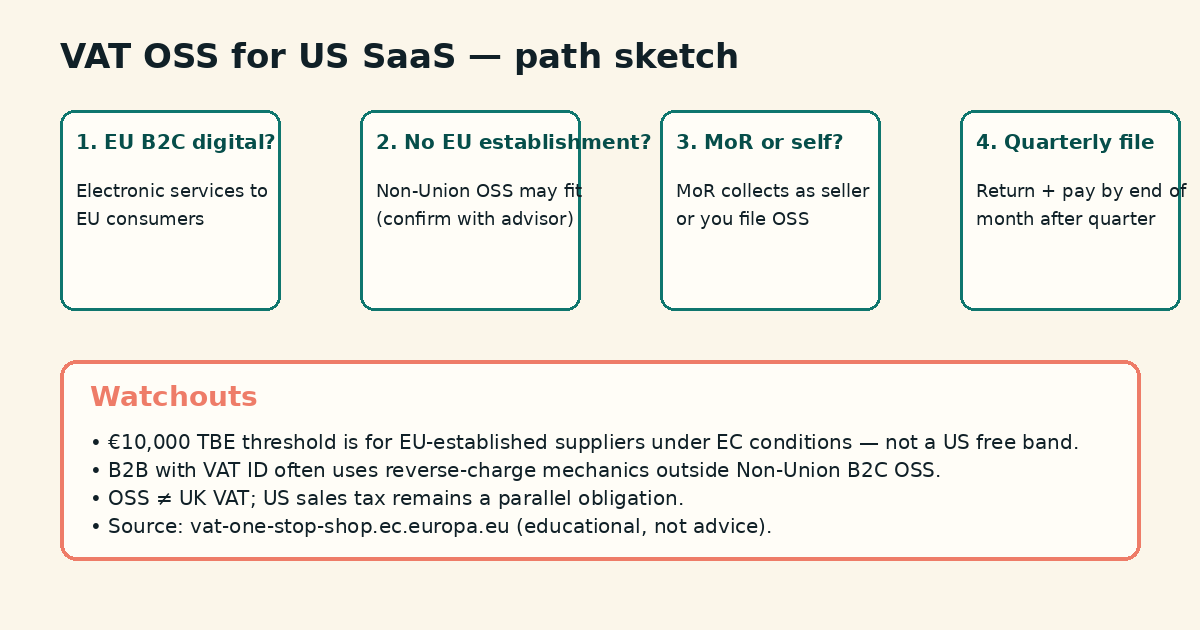
US SaaS companies with no EU place of business or fixed establishment that sell electronically supplied services to EU consumers (B2C) can use the EU Non-Union One Stop Shop (OSS) to register in one Member State of identification, charge VAT at the customer’s Member State rate, and file one quarterly OSS return instead of registering separately in every Member State of consumption. Per the European Commission’s One Stop Shop pages, Non-Union OSS is aimed at taxable persons not established in the EU; the popular €10,000 TBE/distance-sales threshold is built for EU-established suppliers meeting strict conditions—it generally does not give a non-EU supplier a “first €10k VAT-free” runway. OSS does not replace US sales tax, and B2B digital supplies often follow different VAT-ID / reverse-charge mechanics outside the Non-Union B2C scheme.
What Non-Union OSS is (in one paragraph)
Takeaway: Non-Union OSS is an optional EU simplification: one identification Member State, one quarterly return and payment covering eligible B2C services across the EU, instead of many local VAT registrations.
Since 1 July 2021, the former Mini One Stop Shop (MOSS) for telecom, broadcasting, and electronic (TBE) services expanded into the broader One Stop Shop with three schemes: non-Union, Union, and import. For a typical US SaaS selling software subscriptions from the United States with no EU fixed establishment, the relevant scheme for B2C electronic services is usually the non-Union scheme. You still charge the VAT rate of the customer’s Member State; the OSS portal routes declared VAT to the Member States of consumption.
Who this guide is for (and who should stop here)
Takeaway: This is for US-incorporated digital service sellers without an EU establishment; it is not a goods IOSS manual or a domestic EU Union-OSS playbook.
- In scope: US LLC/C-Corp SaaS, info products, and similar electronically supplied services sold to EU private consumers
- Often out of scope for Non-Union services logic: you have an EU fixed establishment; you only sell B2B with valid VAT IDs; you ship physical goods (look at distance sales / import scheme themes instead)
- Still need human review: marketplaces that are “deemed suppliers,” hybrid goods+software bundles, and any local payroll or office that might create a fixed establishment
If you are still deciding whether you even need automated tax tooling in the US, start with when a SaaS startup needs sales tax software.
Non-Union vs Union vs Import (scheme map)
Takeaway: US SaaS digital B2C usually maps to Non-Union; Union is the EU-established scheme; Import (IOSS) is about low-value imported goods—not your pure SaaS subscription.
| Scheme | Typical user | What it simplifies | Return cadence (EC overview) |
|---|---|---|---|
| Non-Union OSS | Taxable person not established in the EU (no place of business / fixed establishment there) | B2C supplies of services in the EU declared via one MSI | Calendar quarter; file/pay by end of following month |
| Union OSS | EU-established taxable persons (services + certain goods themes) | Cross-border B2C services where not established in the consumption state; certain distance sales of goods | Calendar quarter; same timing theme |
| Import scheme (IOSS) | Distance sales of imported goods ≤ EUR 150 (non-EU sellers need an intermediary) | Low-value goods import VAT collection simplification | Monthly (import scheme) |
Source framing: Commission OSS introduction and Register to OSS. National portals (for example Germany’s BZSt pages on Non-Union OSS) implement the electronic registration step.
B2C digital services vs B2B: why founders mix them up
Takeaway: Non-Union OSS is built around supplies to non-taxable persons; B2B with a valid VAT ID often uses reverse-charge / invoice rules outside that B2C OSS return.
SaaS checkout flows freely mix consumers and companies. Operationally:
- B2C (private consumers): place-of-supply for TBE/electronic services is generally where the customer is established / resides; Non-Union OSS is designed so non-EU suppliers can declare those B2C services centrally
- B2B (taxable customers with VAT ID): many digital B2B supplies are invoiced under reverse-charge mechanics when rules are met—customer accounts for VAT—rather than you collecting consumer VAT through OSS
- Evidence: you need a defensible process for customer location and (for B2B) VAT ID validation; “they typed a company name” is not a control
Your billing tool should separate tax treatment by customer type. Guessing at checkout is how you get both under-collection and angry enterprise buyers.
Does the €10,000 threshold help US SaaS?
Takeaway: The €10,000 cross-border TBE / intra-EU distance-sales threshold is for suppliers established in only one Member State under the Commission’s conditions—not a free band for non-EU US companies.
The Commission’s OSS materials explain an annual EUR 10,000 (ex-VAT) threshold under which, when all conditions are met, certain cross-border TBE services and intra-Community distance sales can remain taxed in the supplier’s Member State. Conditions include establishment (or residence) in only one Member State. The same materials note that suppliers established outside the EU with fixed establishments in the EU cannot use that threshold logic the same way, and the threshold does not apply to every service type.
Practical founder reading: if you are a US company with no EU establishment selling electronic services into the EU, do not assume “we are under €10k so we can ignore VAT.” Many non-EU digital suppliers must register and charge from early eligible B2C sales—OSS exists to make that registration lighter, not to create a US startup exemption. Confirm your fact pattern with a VAT professional; Stripe’s public Non-Union OSS help pages similarly stress that non-EU digital sellers may need to register from the first eligible sale.
Registration and the Member State of identification
Takeaway: Pick/follow the legal rules for one Member State of identification, register electronically, and apply the scheme to all covered supplies—not a cherry-picked country list.
Commission guidance emphasizes:
- OSS schemes are optional, but if you opt in you must use the scheme for all supplies that fall under it across Member States
- You register in a single Member State of identification (MSI) and submit returns there
- Member States collect registration data electronically via their portals
- Being VAT-identified in the EU for some purpose does not automatically block Non-Union use for a non-established person (see Commission definitions)—but fixed establishment analysis is where DIY breaks
Popular MSI choices among non-EU digital sellers historically include jurisdictions with English-language portals and established non-Union processes (Ireland and others are often discussed in practitioner guides). Choose based on advisor guidance and portal operability—not a Twitter poll.
Some platforms (for example Stripe Tax registration assistance for Non-Union OSS) can help file the registration packet; that is a service wrapper around the same EU scheme, not a different tax.
Quarterly returns and payment timing
Takeaway: Non-Union/Union OSS returns are quarterly; submit and pay by the end of the month after the quarter—even if the quarter’s EU B2C sales were nil.
| Tax period (Non-Union) | File & pay by (end of) |
|---|---|
| Q1 (Jan–Mar) | 30 April |
| Q2 (Apr–Jun) | 31 July |
| Q3 (Jul–Sep) | 31 October |
| Q4 (Oct–Dec) | 31 January |
Per Declare and pay in OSS: file electronically for each period whether or not you made supplies; use a nil return when appropriate; payment accompanies the return reference. The MSI transmits data and VAT to Member States of consumption. OSS returns are additional to any domestic VAT return obligations you might separately have if you are established somewhere—US-only companies without EU establishment mainly care about the OSS return itself, but advisors still check for other footprints.
Customer location, rates, and records
Takeaway: Charge the consumption Member State’s VAT rate and keep evidence of customer location—OSS does not erase record-keeping duties.
- Maintain billing address / geolocation / payment proxy evidence consistent with electronic-services rules your advisor applies
- Map SKUs to correct VAT rates (standard vs reduced is rarely relevant for pure SaaS, but rate tables still change by country)
- Keep records available for audit timeframes described in OSS record-keeping guidance
- Correct prior returns through the OSS correction mechanisms your MSI portal supports—do not “net it silently” next quarter without a process
MoR vs self-OSS vs tax engines
Takeaway: Merchant of Record can operationally collect/remit consumer taxes for you; self-OSS keeps you as the seller on the hook for registration and filing; tax engines help calculation/filing but do not change who the supplier is.
| Approach | Who faces the customer as seller | EU B2C VAT ops theme | Read next |
|---|---|---|---|
| Self-serve + Non-Union OSS | Your US company | You register, collect, file quarterly OSS | This guide + VAT advisor |
| Stripe Tax (+ optional registration help) | You (Stripe is usually not MoR) | Calculation/collection tooling; registration assistance may wrap Non-Union OSS | Avalara vs TaxJar vs Stripe Tax |
| Specialized SaaS tax (Anrok, Avalara, etc.) | You | Determination, filings, multi-jurisdiction ops | Anrok vs Avalara |
| Merchant of Record (Paddle, Lemon Squeezy, Polar, etc.) | MoR | MoR often handles consumer tax as seller of record | MoR vs payment processor; Paddle vs Lemon Squeezy vs Polar; Stripe Managed Payments vs Paddle |
MoR is not “VAT optional”—it changes who performs seller-side tax duties. Self-OSS keeps strategic control (and compliance burden) on your entity. Compare checkout economics in Stripe vs Paddle vs Lemon Squeezy before you pick a path for EU consumer growth.
How EU OSS sits next to US sales tax
Takeaway: EU VAT OSS and US sales/use tax are parallel obligations driven by different nexus and place-of-supply rules—solving one does not close the other.
A Delaware or Wyoming SaaS can owe:
- US state sales tax collection where economic nexus and product taxability apply
- EU VAT on eligible B2C digital services into Member States
- Other country GST/VAT regimes as you expand
Tax engines and MoRs package different subsets of that map. Keep US and EU workstreams on the same compliance calendar as the rest of the founder compliance checklist.
Founder checklist: Non-Union OSS readiness
Takeaway: Do not wait for a random enterprise invoice—stand up location evidence, rate maps, and filing owners before EU B2C volume spikes.
- Confirm you have no EU fixed establishment (advisor sign-off if borderline)
- Segment checkout: B2C vs B2B (+ VAT ID validation)
- Decide MoR vs self-collect for EU consumers
- If self-collect: choose MSI / registration path (DIY portal vs Stripe/advisor-assisted)
- Configure billing to charge correct Member State rates
- Store evidence of customer location and invoices
- Calendar quarterly OSS return + payment deadlines
- Reconcile tax collected vs tax remitted in your GL monthly
- Document who owns filing (founder, bookkeeper, firm)
- Revisit if you hire EU employees or open an EU office (scheme eligibility can change)
Common mistakes
Takeaway: The costly mistakes are assuming the €10k threshold covers US companies, treating all EU buyers as B2C, and letting MoR vs self-collect stay ambiguous in the contract and checkout.
- Ignoring EU B2C VAT until a large refund request arrives
- Applying the €10,000 EU-establishment threshold to a pure US entity
- Charging one “EU average” rate instead of Member State rates
- Missing nil returns and getting portal / compliance noise
- Assuming Stripe Tax means Stripe is MoR (usually it does not)
- Opening an EU hub without re-checking fixed establishment and scheme choice
- No reconciliation between billing tax collected and OSS remitted
FAQ
What is VAT OSS for a US SaaS company?
It is the EU One Stop Shop framework. For most US SaaS without an EU establishment, the relevant path for B2C electronic services is the Non-Union scheme: one registration, quarterly EU-wide B2C service declarations.
Do I need Non-Union OSS if I use Paddle or Lemon Squeezy?
Often the MoR collects and remits consumer taxes as seller of record under its own registrations. Read the MoR’s tax docs and your agreement; you still need to understand what appears on customer invoices and what your company must not double-charge.
Is OSS required or optional?
The schemes are optional simplifications. Without them, the alternative for multi-country B2C obligations can be registering in each relevant Member State. Optional does not mean “VAT optional.”
Does the €10,000 threshold mean I can sell tax-free into the EU?
Do not assume that as a US non-established supplier. The Commission describes the threshold for suppliers established in only one Member State under set conditions. Get advice for your facts.
How often do I file Non-Union OSS?
Each calendar quarter, by the end of the following month, including nil returns when you had no covered supplies.
Can Stripe register me for Non-Union OSS?
Stripe documents assistance registering eligible non-EU digital businesses for Non-Union OSS through its tax registration flows. That is help with the EU scheme—not a substitute for understanding B2C vs B2B treatment.
Does OSS cover UK VAT after Brexit?
The EU OSS schemes address EU Member States. The UK has separate VAT rules for digital services. Do not treat OSS as a UK filing system.
Where should I read the official rules?
Start with vat-one-stop-shop.ec.europa.eu (introduction, register, declare/pay, records). National MSI portals publish the electronic registration steps.
What to do next
Takeaway: Decide MoR vs self-OSS, then implement checkout evidence and a quarterly filing owner before EU consumer spend scales.
Map US tooling timing in when a SaaS startup needs sales tax software, compare engines in Anrok vs Avalara and Avalara vs TaxJar vs Stripe Tax, and if you want the seller-of-record path read Merchant of Record vs payment processor. Fold the decision into the SaaS founder compliance checklist or Start Here.