
Sales Tax · Last reviewed September 21, 2026
Anrok vs Avalara for SaaS Founders
Anrok is an end-to-end sales-tax compliance platform aimed at software and digital businesses: exposure monitoring, real-time calculation, registration support, filing and remittance, and certificate workflows, with public Starter pricing at $100 per market per month for non-ecommerce companies (and $50 per market per month for Anrok’s ecommerce plan) as listed on anrok.com/pricing. Avalara AvaTax is the broader enterprise tax engine used across many product types and ERPs; Avalara’s calculations page describes simplified plans starting at $699 per state per year, with pricing that also scales by tax-calculation transactions (one API call ≈ one transaction), and Returns / other modules often purchased alongside calculation. Pure SaaS teams usually shortlist Anrok first for predictability; mixed goods catalogs, deep ERP landscapes, or purchase-side use-tax needs usually favor Avalara.
Quick comparison: Anrok vs Avalara (2026)
Takeaway: Anrok sells per-market SaaS-shaped compliance; Avalara sells a general tax engine plus modular compliance services.
| Dimension | Anrok | Avalara (AvaTax + ecosystem) |
|---|---|---|
| Primary buyer | Software / digital / modern commerce teams wanting calculate + file in one motion | SMB through enterprise across software, goods, marketplaces, and complex ERPs |
| Public pricing signal (2026) | Starter: $100 / market / month (non-ecommerce); ecommerce Starter $50 / market / month; Custom for scale (Anrok pricing) | AvaTax plans described from $699 / state / year; usage tied to calculation transactions; SST options may apply for qualifying businesses (Avalara calculations) |
| Filings & remittance | Included in Starter feature list (filing and remittance called out explicitly) | Often a separate Returns / compliance module stacked on calculation—confirm in quote |
| Taxability strength | Strong SaaS / digital product orientation in positioning | Broad product taxability via tax codes across many industries |
| ERP / stack depth | Modern billing and SaaS-centric integrations; Custom adds advanced connectivity | Deep ERP coverage (NetSuite, Dynamics, SAP, Oracle, and many others historically) |
| When founders usually pick it | Multi-state SaaS nexus with desire for predictable per-market math | Complex catalogs, physical goods mix, AP/use tax, or ERP-centric finance teams |
Pricing models with a worked example
Takeaway: Convert both quotes into “all-in Year-1 for N markets including filings,” or you will compare the wrong numbers.
Anrok (public Starter math). Anrok defines a “market” as a jurisdiction where you have a tax obligation and need to register and file—each U.S. state registration counts as one market; international rules differ (for example, EU OSS can count as one market per Anrok’s pricing FAQ). At $100 per market per month for non-ecommerce Starter:
- 5 markets → about $500 / month (~$6,000 / year)
- 8 markets → about $800 / month (~$9,600 / year)
- 15 markets → about $1,500 / month (~$18,000 / year)
Anrok states Starter includes global exposure monitoring, real-time calculation, filing and remittance, exemption certificate management, and physical nexus tracking, with possible additional fees for very high transaction volumes on Starter—confirm contract language. Custom pricing scales with volume and adds enterprise features (e-invoicing, advanced integrations, multi-entity, audit-ready reporting, SSO, and more).
Avalara (public AvaTax framing). Avalara’s calculations materials describe simplified plans starting at $699 per state per year and explain that AvaTax pricing is based on annual tax-calculation transactions, where one API call equals one transaction (an invoice with many lines still counts as one transaction in their explanation). Qualifying businesses may access Streamlined Sales Tax (SST) supported services in some states, sometimes at reduced or no cost for eligible sellers—eligibility is fact-specific. Returns filing is commonly a separate commercial conversation; do not assume “AvaTax” alone equals “returns done.”
Worked contrast for an illustrative SaaS with 8 U.S. states registered:
- Anrok Starter sketch: 8 × $100 × 12 ≈ $9,600 / year platform math before any high-volume adders, with filings included per Starter marketing.
- Avalara sketch: 8 × $699 ≈ $5,592 / year as a state-plan floor illustration plus transaction-tier charges plus Returns/certificate modules as quoted. Depending on invoice volume and modules, all-in can land below or well above Anrok—only a paired quote settles it.
Third-party deal databases publish medians that bounce around because Avalara customers include retailers and enterprises far outside SaaS. Use them as noise checks, not as your budget.
What Anrok optimizes for
Takeaway: Anrok is built so SaaS finance teams stop stitching a calculator to a separate filing vendor.
Anrok’s public story emphasizes exposure monitoring (where you may owe), calculation at transaction time, registration support as you expand markets, filing/remittance, and certificate handling. Customer narratives on Anrok’s site feature software companies that want tax ops measured in hours per month rather than a growing headcount. Starter is positioned for founders who want compliance handled end-to-end from early sales; Custom targets teams at higher market counts or with enterprise controls (MSA, SSO, advanced APIs).
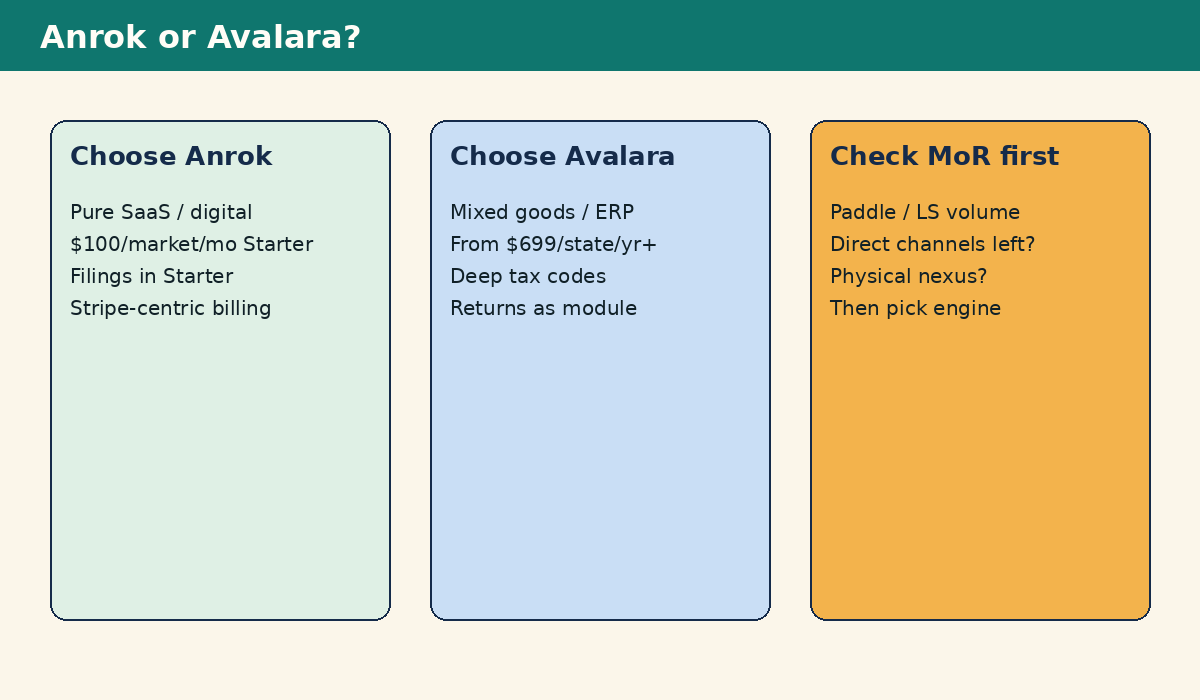
Choose Anrok when:
- Your catalog is primarily SaaS / digital services with relatively coherent taxability
- You want per-market predictability more than per-API metering
- Filings and remittance belonging in the same platform matters operationally
- Your billing stack is modern (Stripe and similar) rather than a heavyweight multi-ERP estate
Validate in demos: taxability mapping for your exact SKUs, credit-note behavior, multi-entity needs, and how physical nexus (office, employee, inventory) is flagged versus economic nexus.
What Avalara optimizes for
Takeaway: Avalara is the generalist tax platform finance teams already know how to RFP.
AvaTax focuses on real-time rate and rule determination across a very large set of U.S. jurisdictions, with taxability driven by tax codes and configurations that support many industries. Avalara’s wider product family historically covers returns, certificate management, cross-border content, and more—useful when your world is bigger than “B2B SaaS seats.” Migration messaging on Avalara’s site explicitly contemplates switches from other engines (including naming Anrok among examples), which tells you how Avalara sees competitive displacement.
Choose Avalara when:
- You sell mixed goods + software, hardware bundles, professional services, or marketplace flows
- Finance lives in NetSuite / Dynamics / SAP / Oracle-class ERPs and wants native tax connectors
- You need purchase-side / use-tax determination and broader indirect-tax tooling
- Procurement already standardized on Avalara elsewhere in a parent company
Insist on an itemized quote: calculation tier, included states, expected transaction volume, Returns, CertCapture (or current certificate product), onboarding, and sandbox validation time.
Filings, remittance, certificates, and nexus monitoring
Takeaway: Calculation without filing still leaves calendar risk; filing without correct taxability creates refund and audit risk.
Anrok markets filing and remittance inside Starter, alongside exemption certificate management and physical nexus tracking. That packaging is a major reason SaaS teams compare Anrok against “AvaTax + Returns” stacks rather than against AvaTax alone.
Avalara’s strength is depth and configurability, but modular packaging means two Avalara quotes can describe different products. Ask explicitly whether returns, payments, notices, and certificate collection are in scope for Year 1. Also ask how economic nexus thresholds are monitored and how you are alerted before registration deadlines—process matters as much as the rate engine.
For whether you even need dedicated software yet, use our stage guide: When a SaaS startup needs sales tax software. Many teams wait too long after crossing multi-state economic nexus; a smaller set buy software before they have a filing calendar worth automating.
Integrations: Stripe, billing, and ERPs
Takeaway: Your billing system of record decides half the bake-off before features do.
SaaS companies billing on Stripe (or similar) should demo live tax calculation on subscriptions, seat changes, prorations, and refunds. Compare how each vendor handles:
- Customer exemption certificates and tax-exempt checkout paths
- Invoice PDFs and tax line display
- Multi-currency and cross-border expansion plans
- Export quality for your accountant (and tools like A2X/Synder if relevant later)
If you already compared calculator-centric options, keep Avalara vs TaxJar vs Stripe Tax open beside this article. Stripe Tax can be enough for calculation in some early stacks; it is not automatically a full register-and-file replacement for every team. Anrok and Avalara compete higher on compliance operations.
When Merchant of Record changes the decision
Takeaway: MoR can remove some sales-tax operational burden for covered transactions—but it is a payments architecture choice, not a free tax holiday on every flow.
If you sell through a Merchant of Record such as Paddle or Lemon Squeezy, the MoR often acts as the seller of record for those transactions and handles many indirect tax obligations on the covered volume. That can delay or shrink the need for a full Anrok/Avalara deployment on those channels. It does not magically clean up:
- Direct Stripe (or other processor) channels you still operate yourself
- Physical nexus created by people, offices, or inventory
- Non-covered products, services, or regions
- Historical liabilities from before you switched
Read Merchant of Record vs payment processor and the fee/fit comparisons in Stripe vs Paddle vs Lemon Squeezy and Paddle vs Lemon Squeezy vs Polar before you assume MoR deletes the tax-software line item.
Founder decision tree
Takeaway: Start from catalog + nexus count + system of record, not from brand familiarity.
- Pure SaaS, 3–15 U.S. markets, Stripe-centric billing, want filings included: Shortlist Anrok; still get an Avalara all-in quote for leverage.
- Mixed goods / complex taxability / ERP-centric finance: Shortlist Avalara; confirm Returns and certificates in Year-1 scope.
- Most revenue already on MoR: Model residual direct channels first; you may only need lightweight calculation (or nothing new) until direct volume grows.
- Only need rates on Stripe invoices and filings are still manual/outsourced: Revisit Stripe Tax / TaxJar / Avalara before buying a full compliance suite.
- International expansion (VAT/GST/OSS): Ask each vendor for a written matrix of countries/modes in your next 12 months; do not assume U.S. strength equals EU coverage.
Common mistakes
Takeaway: Wrong taxability mapping is more expensive than paying a higher platform fee.
- Comparing AvaTax list math to Anrok Starter without including Returns. Normalize scope.
- Ignoring employee/office physical nexus while obsessing over economic nexus thresholds.
- Assuming “SaaS is untaxable everywhere.” State treatment varies; map SKUs.
- Buying software before you know where you have nexus. See the when you need sales tax software checklist.
- Forgetting historical exposure. Automation going forward does not erase prior periods—ask advisors about voluntary disclosure options when relevant.
- Skipping sandbox validation on your real invoice samples (refunds, credits, annual plans, free trials converting to paid).
How this pairs with TaxJar and Stripe Tax
Takeaway: Anrok and Avalara sit above “rate API only” tools when filings and multi-state operations dominate your calendar.
Founders often bounce between four names: Stripe Tax, TaxJar, Avalara, and Anrok. A practical layering:
- Stripe Tax: Convenient calculation when Stripe is the system of record and your team still files manually or via a light partner.
- TaxJar (Avalara family context): Historically popular for automated filing workflows tied to online sales; evaluate current packaging carefully because product lines consolidate over time.
- Avalara AvaTax (+ Returns): Enterprise-capable engine when taxability and ERP depth matter.
- Anrok: SaaS-shaped calculate-and-file platform with transparent per-market Starter math.
If your pain is “I do not know whether I need software yet,” start with nexus triggers and hours-per-month filing load in when a SaaS startup needs sales tax software. If your pain is “which calculator,” use Avalara vs TaxJar vs Stripe Tax. This Anrok vs Avalara page is for teams already sure they want a serious compliance layer and choosing between SaaS-native all-in-one versus generalist tax platform.
Also sanity-check payments: if more than half of revenue could move to a Merchant of Record within a quarter, run MoR fee math in parallel so you do not sign a 25-market tax contract the week before you route checkout through Paddle or Lemon Squeezy.
FAQ: Anrok vs Avalara
1) Is Anrok only for SaaS?
Anrok markets strongly to software and digital businesses and also offers ecommerce-oriented pricing. If you are a complex multi-category retailer, Avalara’s broader engine is often the safer default—validate with demos either way.
2) Does Avalara AvaTax include returns automatically?
Not safely assumed. Avalara’s calculations product is the rate/rule engine; returns and remittance are commonly scoped as additional products. Require an itemized quote.
3) What counts as an Anrok “market”?
Per Anrok’s pricing FAQ, a market is a jurisdiction where you have a tax obligation and need to register and file. Each U.S. state registration counts as one market; international counting follows how authorities structure compliance (with examples such as EU OSS counting as one market). Confirm your footprint with Anrok during scoping.
4) Can Stripe Tax replace both?
Sometimes for calculation on Stripe-hosted flows. It may not replace full multi-state registration, filing, remittance, and certificate operations. Compare using our Avalara vs TaxJar vs Stripe Tax guide.
5) Does using Paddle or Lemon Squeezy remove the need for Anrok or Avalara?
MoR can cover tax on MoR-processed transactions. Direct channels, physical nexus, and non-covered products can still require your own compliance stack. See our MoR guides linked above.
6) Which is cheaper at 5 states vs 25 states?
At low market counts, Anrok’s $100/market/month Starter math is easy to spreadsheet. At high market counts or high API volumes, Avalara’s transaction tiers plus modules—or Anrok Custom—can win or lose depending on volume. Quote both at your 12-month forecast.
7) Is this tax advice?
No. Educational comparison only. Engage a qualified tax professional for nexus, taxability, and filings.
8) Do you use affiliate links for Anrok or Avalara here?
No approved tool-affiliate URLs for Anrok or Avalara are used in this article. CTAs point to internal educational guides. Affiliates used elsewhere on the site are disclosed where applicable.
Bottom line
Anrok vs Avalara is mostly a packaging and architecture decision. Anrok gives many SaaS teams a clear per-market, filings-included path. Avalara gives broader tax-engine depth for complex catalogs and ERP-centric finance. Normalize Year-1 scope (calculation + filings + certificates + onboarding), validate taxability on real invoices, and decide whether Merchant of Record already covers the channels that create your pain.
Next step: Confirm whether you have crossed the need threshold with When a SaaS startup needs sales tax software, then compare adjacent calculators in Avalara vs TaxJar vs Stripe Tax. If payments architecture is still open, read MoR vs payment processor. Related: Tools and Start here.