
Payments · Last reviewed September 27, 2026
Stripe vs Paddle vs Lemon Squeezy for SaaS Founders
Stripe is usually a payment processor (you stay merchant of record): US domestic cards are commonly priced at 2.9% + $0.30 on Stripe’s public pricing page, with optional products such as Stripe Tax and Billing. Paddle and Lemon Squeezy are classic Merchants of Record with a public headline near 5% + $0.50 per transaction and tax remittance included in that MoR model. Stripe also sells Managed Payments, an MoR path that adds 3.5% on top of standard Stripe processing fees. Choose by liability, effective global fee, and how much checkout/tax ops you want to keep in-house—not by brand alone.
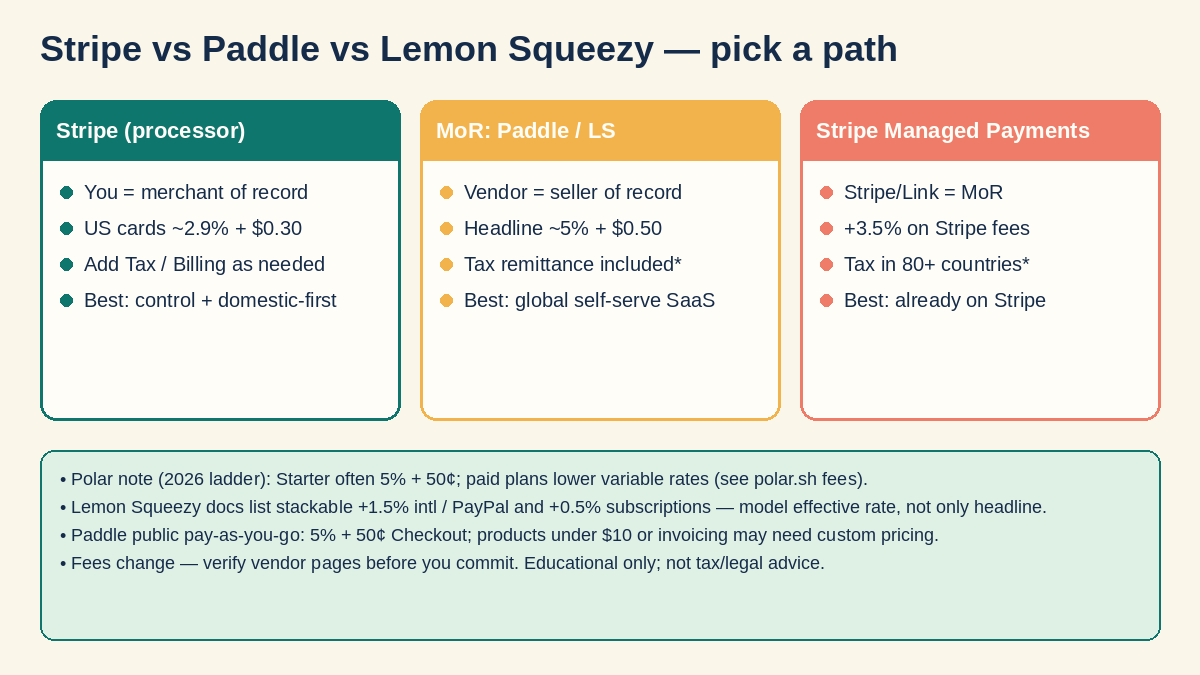
What is a payment processor vs a Merchant of Record?
Takeaway: A processor moves money while you remain the seller of record; an MoR becomes the seller to the end customer for those checkouts and typically takes on much of the indirect-tax remittance work in its covered model.
With a classic Stripe Payments setup, your company is usually the merchant named on the customer’s receipt and statement descriptor logic. You (or your tax tools and advisors) own sales tax, VAT, and GST registration, collection, filing, and audit risk in the jurisdictions where you have obligations. Stripe can calculate and help collect tax through Stripe Tax, but public Stripe materials still frame tax liability as remaining with the business when you are not using an MoR product.
With Paddle or Lemon Squeezy, the platform markets itself as Merchant of Record: it sells your software or digital product to the buyer, collects payment, and handles much of the global indirect-tax workflow inside its MoR offering. You receive net proceeds under a commercial relationship with the MoR. That shift is why headline fees are higher than raw card processing—and why founders compare “effective rate + ops saved,” not sticker percentage alone.
For a deeper definition pair, read Merchant of Record vs payment processor. Cross-border VAT context for US SaaS teams also shows up in VAT OSS for US SaaS companies.
Stripe vs Paddle vs Lemon Squeezy: 2026 fee and feature table
Takeaway: Compare dated public bands—Stripe processing, Stripe Managed Payments (+3.5%), Paddle’s blended 5% + 50¢ Checkout, and Lemon Squeezy’s 5% + 50¢ plus documented stackable surcharges—then stress-test your mix of domestic vs international volume.
| Topic | Stripe (typical processor) | Stripe Managed Payments | Paddle | Lemon Squeezy |
|---|---|---|---|---|
| Model | Payment processor (you MoR) | MoR (Stripe via Link) | Merchant of Record | Merchant of Record |
| Headline fee (public, as of Sep 2026 review) | ~2.9% + $0.30 US domestic cards (stripe.com/pricing) | +3.5% on standard Stripe processing (Managed Payments) | 5% + 50¢ per Checkout transaction (paddle.com/pricing) | 5% + 50¢ per transaction (lemonsqueezy.com/pricing) |
| Common add-ons / stack | Stripe Tax, Billing, Radar tiers, intl/FX schedules vary by product | MoR fee includes global indirect tax, fraud, dispute responses, Link support per Stripe; Billing/LPMs may be separate | Marketed all-inclusive Checkout rate; under-$10 products / invoicing may need custom pricing | Docs list +1.5% international, +1.5% PayPal, +0.5% subscriptions; marketing feature fees exist |
| Indirect tax remittance | Usually you (tools help) | Stripe handles in supported countries (docs cite 80+); elsewhere you remain responsible | MoR handles in its model | MoR handles in its model |
| Best fit (typical) | Developers, domestic-heavy, complex custom billing | Teams already on Stripe who want selective MoR | Scaling B2B/self-serve SaaS wanting blended MoR rate | Indie / digital-product speed; watch stacked fees |
Bands above are educational snapshots from public vendor pages and docs reviewed for this 2026-09-27 refresh. They are not quotes, volume contracts, or guarantees. Always re-open the live pricing URL for your country and product catalog before you migrate subscriptions.
What does the 2026 fee reality check look like?
Takeaway: At small global mix, Stripe-as-processor often wins on percentage; as VAT/sales-tax registrations multiply, MoR premiums can be cheaper than hiring the compliance calendar—if your effective MoR rate stays honest.
Work a simple spreadsheet with your last 90 days of volume:
- Split domestic card vs international card vs PayPal (or local methods).
- Estimate Stripe processing + any Tax/Billing line items you actually enable.
- Estimate Paddle at 5% + 50¢ on Checkout volume (confirm invoice/custom exceptions).
- Estimate Lemon Squeezy at 5% + 50¢ plus the surcharges that apply to your mix per Lemon Squeezy fee docs.
- Estimate Stripe Managed Payments as standard Stripe fees + 3.5% MoR add-on on those transactions you route through it.
Founders often discover Lemon Squeezy’s headline matches Paddle’s while the international/PayPal/subscription stack pushes effective rate higher on a global indie SaaS. Paddle’s public messaging emphasizes a blended Checkout rate without separate international card add-ons on that pay-as-you-go page—useful if most buyers sit outside the US. Stripe stays cheapest when you sell mostly domestic and can run tax with Stripe Tax or another engine without drowning in filings.
For a side-by-side focused on Stripe’s MoR product vs Paddle, see Stripe Managed Payments vs Paddle.
What changed after Stripe acquired Lemon Squeezy?
Takeaway: Lemon Squeezy was acquired by Stripe (announced 2024) and still operated as its own MoR product into 2026; treat ownership as context, not an automatic shutdown or fee freeze.
Comparison pages that still say “independent Lemon Squeezy forever” are stale. Equally wrong is assuming Lemon Squeezy disappeared the day the deal closed. For founders, practical questions are: Can new merchants still onboard? Are fee docs current? Do you want a second MoR brand inside the Stripe corporate family when Managed Payments exists? Re-check Lemon Squeezy’s live signup and pricing pages at decision time; do not rely on a screenshot from last year.
If you already standardized on Stripe APIs and want MoR only in some markets, Managed Payments’ selective routing may matter more than keeping a separate LS storefront. If you like LS’s product UX and your effective rate still works, ownership alone is not a reason to rip out checkout this quarter.
When should you choose Stripe, Paddle, or Lemon Squeezy?
Takeaway: Match the seller-of-record model to your tax bandwidth and buyer mix; then pick the vendor whose fee math and B2B features fit the next 12 months.
- Choose Stripe (processor) when engineering wants deep API control, most volume is domestic or you already staff tax registrations, or enterprise deals need custom billing flows that MoRs constrain.
- Choose Paddle when you want a mature MoR with a marketed all-in Checkout rate, global self-serve SaaS, and less appetite for stacking surcharges—confirm invoicing and sub-$10 SKUs against Paddle’s custom-pricing notes.
- Choose Lemon Squeezy when speed and creator-style digital commerce matter and you have modeled the international/PayPal/subscription add-ons honestly.
- Consider Stripe Managed Payments when you are already on Stripe and want MoR coverage without leaving the Stripe dashboard—especially as a hybrid for new countries.
- Look at Polar when you are indie/devtool-oriented and want a public fee ladder (Starter often 5% + 50¢, with paid plans that lower variable rates per Polar’s fee docs). Details: Paddle vs Lemon Squeezy vs Polar.
How should founders decide by stage?
Takeaway: Pre-revenue teams optimize for launch speed; post-PMF teams optimize for effective rate, B2B invoicing, and migration risk.
| Stage | Common pattern | Watch-outs |
|---|---|---|
| Pre-revenue / first 10 customers | Stripe Payment Links or a fast MoR | Don’t paint yourself into a corner on seat-based enterprise billing |
| ~$5k–$50k MRR, global self-serve | MoR (Paddle/LS) or Stripe + Tax | Re-run fee math quarterly; VAT registrations sneak up |
| Heavy US domestic + custom plans | Stripe processor | Budget for tax tooling and filings |
| Already on Stripe, expanding abroad | Managed Payments hybrid | +3.5% MoR add-on vs classic MoR headline |
| Fundraising / diligence | Clean revenue map + MoR gross-vs-net story | See deferred-revenue / MoR booking notes with your CPA |
Accounting presentation differs when an MoR—not you—is the seller. Pair this comparison with Deferred revenue for SaaS in QuickBooks so net payouts do not get booked as naive gross SaaS revenue without CPA input.
Who owns sales tax and VAT responsibility?
Takeaway: On processor Stripe, assume you own remittance unless a specific MoR product says otherwise; on Paddle/LS/Managed Payments, read the covered-country list and product category limits.
Stripe’s Managed Payments documentation states it handles indirect tax compliance on sales to customers in more than 80 countries for supported classifications, and that you remain responsible where it does not. Classic Stripe Tax helps calculate/collect while you stay merchant of record. Paddle and Lemon Squeezy market end-to-end MoR tax handling inside their platforms—still subject to their acceptable-use, product, and geography rules.
None of these products removes corporate income tax, payroll, or your home-country obligations. MoR is about the checkout transaction’s indirect tax and seller-of-record role, not a substitute for entity compliance. Stage map: SaaS founder compliance checklist.
Is Polar a useful indie alternative in 2026?
Takeaway: Polar is a real MoR option with a published fee ladder (Starter 5% + 50¢; Pro/Growth/Scale lower variable rates per polar.sh docs)—strong for simple developer/digital products, not an automatic Paddle replacement for complex B2B.
Polar’s public fees page (reviewed for this article) lists Starter at 5% + 50¢, optional Pro at $20/mo with 3.8% + 40¢, Growth at $100/mo with 3.6% + 35¢, and Scale at $400/mo with 3.4% + 30¢, plus notes such as +1.5% for international cards. Early-member rates may differ for orgs created before Polar’s stated cutoff. Treat Polar as part of the same decision tree when your checkout is simple and you care about transparent ladder pricing. Full trio write-up: Paddle vs Lemon Squeezy vs Polar.
What common mistakes should founders avoid?
Takeaway: The expensive mistakes are comparing headline % only, ignoring MoR gross-vs-net in the ledger, and migrating annual subscribers without a refund/tax story.
- Picking Lemon Squeezy on “same 5% as Paddle” without modeling intl/PayPal/subscription stack
- Assuming Stripe Tax equals MoR remittance liability transfer
- Enabling Managed Payments everywhere without checking the +3.5% math vs Paddle
- Booking MoR consumer checkout totals as your GAAP/saas gross without CPA guidance
- Skipping a migration plan for tax invoices, dunning, and customer statements
- Forgetting enterprise PO/invoicing constraints on some MoR plans
How should you evaluate checkout UX, payouts, and B2B features?
Takeaway: Fees get you shortlisted; checkout conversion, payout timing, invoicing, and subscription ops decide the winner for your motion.
Ask each vendor (or read current docs) for:
- Checkout: hosted vs embedded, localization, tax-inclusive pricing, trials, and seat upgrades
- Payouts: cadence, currency, and cross-border payout fees (Lemon Squeezy docs describe different payout fee patterns for US vs non-US bank rails)
- B2B: invoices, net terms, VAT IDs on receipts, and whether sub-$10 SKUs need custom pricing (Paddle calls this out on pricing)
- Support: who answers “where is my invoice?” — you or the MoR/Link support path
- Data: export quality for your accountant; withheld-tax columns on Managed Payments reports per Stripe docs
Indie creators often overweight onboarding speed. B2B SaaS teams overweight invoice legality and procurement. Neither is wrong—just name which buyer you are optimizing for this year.
Worked fee sketch (illustrative, not a quote)
Takeaway: Build a one-page model with your mix; illustrative $10k MRR math only shows direction of travel.
Suppose a US SaaS collects about $10,000 in successful card charges in a month, half domestic and half international, with little PayPal. Educational sketch using public headline bands (ignore FX nuance and volume contracts):
- Stripe processor: domestic slice near 2.9% + $0.30 per charge; international cards often cost more under Stripe’s schedules—pull your Dashboard fee line rather than inventing a single global %.
- Paddle: roughly 5% + $0.50 on Checkout volume if you sit on pay-as-you-go—on $10k that is about $500 + (N × $0.50) before tax withheld from customer totals.
- Lemon Squeezy: start from 5% + $0.50, then add documented +1.5% on the international half (and subscription +0.5% if applicable).
- Managed Payments: Stripe processing on those routed charges plus 3.5% MoR—frequently lands above classic MoR headlines for US-heavy volume, but can still win on ops if you refuse to leave Stripe.
Replace every assumption with your Dashboard or MoR statements. The point of the sketch is discipline: headline equality between Paddle and Lemon Squeezy rarely survives an international SaaS mix.
FAQ: Stripe vs Paddle vs Lemon Squeezy
Is Stripe a Merchant of Record?
Standard Stripe Payments usually leaves you as merchant of record. Stripe Managed Payments is Stripe’s MoR offering (via Link) for supported digital goods flows. Confirm product selection in Checkout/Payment Links settings.
Is Paddle cheaper than Lemon Squeezy?
Headlines are often both ~5% + $0.50. Effective rate depends on international mix, PayPal, subscriptions, and whether Paddle’s blended Checkout rate fits your catalog. Model your volume; do not assume equality.
Does Lemon Squeezy still exist after the Stripe acquisition?
As of this 2026 review, Lemon Squeezy continued to market pricing and MoR services as its own product under Stripe ownership. Verify live signup status when you decide.
What is Stripe Managed Payments’ fee?
Stripe’s Managed Payments page states it adds 3.5% per successful transaction to your standard Stripe processing fees, including global indirect tax, fraud prevention, dispute responses, and transaction-level support through Link, with some optional products separate.
Can I use Stripe in the US and an MoR abroad?
Many teams run hybrids. Managed Payments is explicitly positioned for selective market/product routing. Classic Paddle/LS stores can also sit beside direct Stripe enterprise invoices—reconcile carefully.
Do MoRs handle US sales tax and EU VAT?
Leading MoRs market calculation, collection, filing, and remittance inside their covered model. Coverage lists and product categories matter. Processor + Stripe Tax is a different liability story.
How do refunds and chargebacks differ?
Processors typically leave more dispute ops with you (tools help). MoRs and Managed Payments document more platform-led dispute/support handling—read each vendor’s current dispute fee and evidence rules.
Where should I go next on FounderCompliance?
Start with Start here and the tools hub, then the MoR deep links above.
Bottom line for 2026
Takeaway: Stripe wins on control and often on domestic processing cost; Paddle and Lemon Squeezy win when MoR tax ops are worth ~5% + 50¢ (watch LS surcharges); Managed Payments and Polar widen the MoR menu inside or beside the Stripe ecosystem.
Re-price with your real international mix twice a year. Keep one source of truth for who the customer’s seller of record is—your finance and tax advisors will ask. For the stage checklist that sits above payments, use the SaaS founder compliance checklist.
Next step
If you are torn between Stripe’s MoR add-on and a classic MoR, read Stripe Managed Payments vs Paddle next, then compare indie ladders in Paddle vs Lemon Squeezy vs Polar. When you are ready to map the whole compliance stack, return to Start here.