Formation · Last reviewed September 24, 2026
Wyoming LLC vs Delaware LLC for SaaS Founders
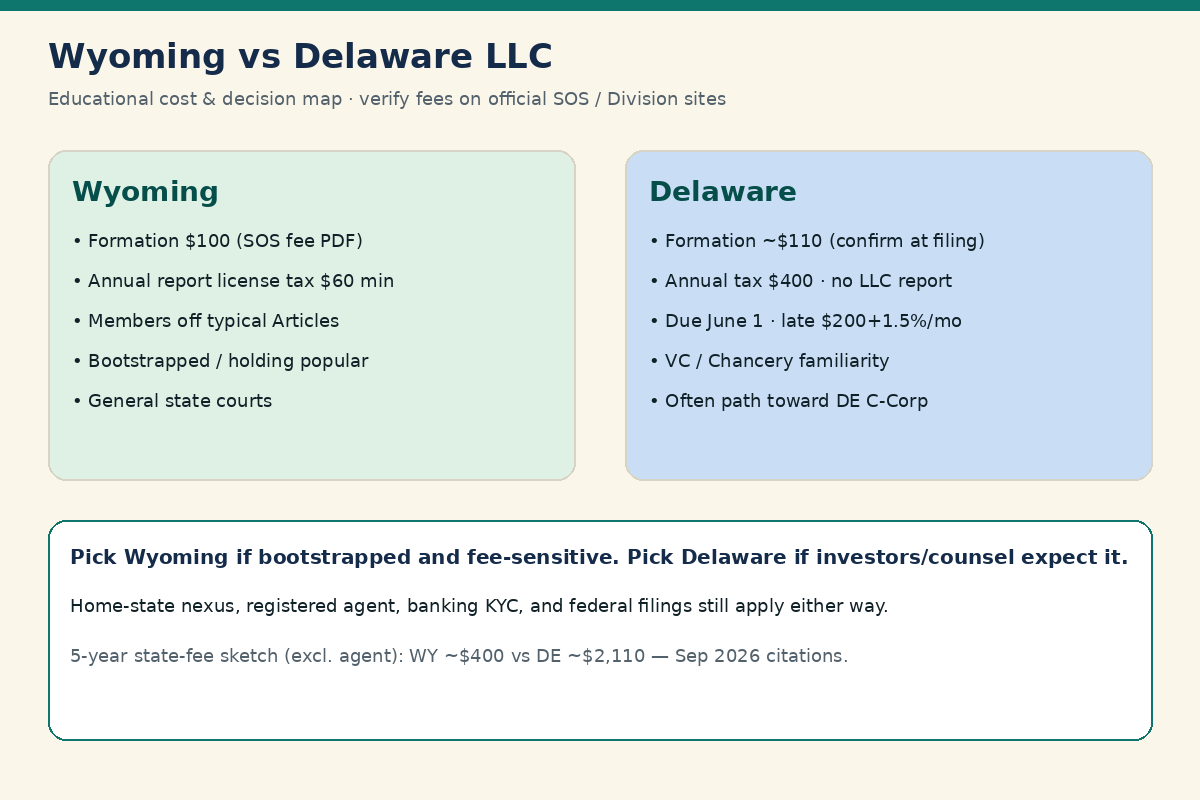
Wyoming is usually the cheaper ongoing domicile for bootstrapped and non-VC SaaS LLCs: $100 Articles of Organization and a $60 minimum annual report license tax on the Wyoming Secretary of State fee schedule (revised June 2026, effective July 1, 2026). Delaware remains the investor-facing default: Certificate of Formation fees are commonly published around $110, then a flat $400 annual LLC tax due June 1 for the prior year with no LLC annual report (Delaware Division of Corporations LLC/LP/GP tax instructions). Pick Wyoming for cost- and privacy-oriented holdings; pick Delaware when counsel or investors expect Delaware law and the Court of Chancery. Forming out of state does not erase home-state tax or foreign-qualification duties.
Quick comparison table (2026)
Takeaway: Wyoming wins on ongoing state cost for most bootstrapped LLCs; Delaware wins when venture counsel wants Delaware governance predictability.
| Factor | Wyoming LLC | Delaware LLC |
|---|---|---|
| Formation filing (state) | $100 Articles of Organization (WY SOS fee schedule, eff. July 1, 2026) | Certificate of Formation commonly cited at ~$110 via Division of Corporations fee materials—confirm at filing on corp.delaware.gov/fee |
| Annual state obligation | $60 minimum annual report license tax (or 0.0002 × WY-sited assets if greater) | $400 flat annual tax; no LLC annual report |
| Typical due timing | Annual report due first day of anniversary month (confirm in WY Biz filings) | Annual tax for prior year due on or before June 1 |
| Late payment (published) | Administrative dissolution risk if neglected (follow SOS notices) | $200 penalty + 1.5% interest per month on tax and penalty |
| State income tax on entity | No WY state income tax; home-state tax still applies to you | No DE income tax on out-of-state LLC income in many cases; $400 tax still due |
| Public privacy theme | Members generally not listed on formation; annual report lists managers (nominee/manager structures used carefully) | Members generally not on Certificate of Formation; no annual report filing for LLCs |
| Court / investor signal | General state courts; popular for holdings / bootstrappers | Court of Chancery + deep case law; common VC expectation for US venture path |
| Registered agent | Required | Required |
Wyoming figures: Wyoming SOS Business Fees PDF (revised June 2026). Delaware annual tax: alt-entity tax instructions (states $400; checked September 2026). Older pages sometimes still mention $300—prefer the tax instructions page over stale how-to copy.
What you are actually choosing
Takeaway: You are choosing a legal domicile and annual compliance calendar—not a passport, a banking guarantee, or a tax-free shield for income earned where you live.
An LLC’s formation state sets the statute that governs internal affairs (member/manager rights, fiduciary defaults, charging-order themes) and the public filing you maintain. It does not automatically mean:
- You avoid tax where you reside or where customers/employees sit
- You can skip foreign qualification if you have nexus or a physical presence in another state
- Banks, Stripe, or payment processors will ignore beneficial-owner KYC
- “Anonymous LLC” marketing equals invisibility to courts, tax authorities, or FinCEN reporting regimes when they apply
For entity type (LLC vs C-Corp) rather than state, see LLC vs C Corp for SaaS. For formation service wrappers, see Stripe Atlas vs doola vs Firstbase.
Cost math: formation and five-year sketch
Takeaway: State fees alone favor Wyoming by roughly $1,700+ over five years versus Delaware’s flat $400 annual tax—before registered-agent fees or home-state costs.
| Sketch (state fees only) | Wyoming | Delaware |
|---|---|---|
| Year 0 formation | $100 | ~$110 |
| Years 1–5 annual | 5 × $60 = $300 | 5 × $400 = $2,000 |
| Formation + 5 annuals | ~$400 | ~$2,110 |
These sketches exclude registered-agent annual fees (often $50–$300+/year depending on provider), expedited filing, certified copies, foreign qualification in your home state, franchise taxes elsewhere, and professional services. Delaware’s $400 is not prorated if you form mid-year; if the entity is active any time in the calendar year, the tax instructions say the annual tax is assessed.
Budget note on the 2026 rate change: Delaware HB 400 raised LLC/LP/GP annual tax from $300 to $400 for the 2026 tax year; the Division’s instructions page now states $400. Payments due June 1 cover the prior calendar year—so founders budgeting 2027 cash should plan $400, not the legacy $300 figure still floating on older articles and even some state how-to pages.
Privacy and “anonymous LLC” claims
Takeaway: Both states generally keep members off the formation document; neither makes you invisible to banks, the IRS, courts, or beneficial-ownership reporting when it applies.
Marketing pages oversell anonymity. Practical privacy differences founders care about:
- Wyoming: Articles of Organization typically emphasize company name, registered agent, and management structure rather than listing every member. The annual report process can surface manager information; some founders use carefully designed manager/nominee arrangements—these have legal and banking consequences and are not DIY “hide forever” tricks.
- Delaware: Certificate of Formation is lean; LLCs pay tax without filing an annual report, which removes one recurring public filing. That is privacy-by-fewer-filings, not secrecy.
Banks still collect beneficial owner information under CIP/KYC. Tax authorities still care about ownership and filing obligations. If you are a foreign-owned US disregarded LLC, read the educational overview on Form 5472 for foreign-owned LLCs—state privacy marketing does not cancel federal information reporting themes.
Annual report vs annual tax: compliance calendars
Takeaway: Wyoming asks for an annual report (with a minimum $60 license tax); Delaware asks for a June 1 tax payment with no LLC annual report—miss it and penalties stack fast.
Wyoming: The SOS fee schedule ties LLC annual report license tax to $60 or two-tenths of one mill ($0.0002) on assets located and employed in Wyoming, whichever is greater. Most remote SaaS LLCs with little or no Wyoming-sited assets hit the $60 minimum. Track your anniversary-month deadline in the state’s business filing system.
Delaware: Per the Division of Corporations: LLCs/LPs/GPs must pay the $400 yearly tax on or before June 1 and are not required to file Annual Franchise Tax reports. Late: $200 penalty plus 1.5% interest per month on tax and penalty. No proration.
Registered agents, nexus, and foreign qualification
Takeaway: Every Wyoming or Delaware LLC needs a registered agent in that state—and you may still need to register where you actually operate.
Both states require a registered agent with a physical address in-state. If you live and work in California, Texas, or another state while holding a Wyoming or Delaware LLC, ask counsel or a CPA whether foreign qualification and local taxes apply. Forming in a “cheap” state while operating elsewhere can mean two sets of filings—not zero. This is the most common surprise for overseas founders who buy formation webinars.
VC preference, Court of Chancery, and the C-Corp path
Takeaway: Delaware’s edge is governance infrastructure and investor familiarity—not cheaper SaaS ops. Many venture-bound startups form (or convert to) a Delaware C-Corp; an LLC state choice is a separate decision.
Venture investors and their counsel often prefer Delaware entities because of the Court of Chancery, predictable corporate/LLC case law, and standardized financing documents. That preference is strongest for priced equity rounds and multi-investor ownership—not for a solo bootstrapped tool with no fundraising plan.
- Stay Wyoming LLC if you are bootstrapping, holding IP/IP-adjacent assets, or running a simple ownership structure without imminent VC.
- Choose Delaware LLC if co-founder agreements, complex membership, or future investor counsel already point there—or if your formation service defaults to Delaware for a reason you accept.
- Plan a Delaware C-Corp when you intentionally pursue US venture. Converting later is common but not free (legal fees, tax analysis, option plan rebuilds). Educational comparison: LLC vs C Corp for SaaS.
Do not form Delaware “for prestige” if you will never raise and you dislike the $400 clock. Do not form Wyoming to “avoid Delaware” if your term sheet will force a flip in six months—price that legal work up front.
Overseas founders: extra practical constraints
Takeaway: State choice is step one; EIN, banking, payments, and US tax filings often dominate the real timeline.
Non-US founders commonly underestimate:
- EIN issuance and ITIN/SSN constraints for some IRS processes
- US business banking or fintech KYC friction
- Payment processor underwriting (Stripe Atlas-style packages exist partly to bundle these steps)
- Federal filing themes for foreign-owned disregarded entities (Form 5472 / related returns when required)
Compare service wrappers in Stripe Atlas vs doola vs Firstbase, then put the entity on the broader founder compliance checklist.
Decision tree: which state should you pick?
Takeaway: Default Wyoming for bootstrapped cost control; default Delaware when fundraising counsel is already in the room.
- Will you solicit US venture capital in the next 12–24 months with standard preferred stock docs? → Bias Delaware (often toward C-Corp, not merely LLC).
- Are you a solo or small bootstrapped SaaS with no investor process? → Bias Wyoming for lower ongoing state fees.
- Do you operate (or live) in a state that will demand foreign qualification anyway? → Model both states’ fees plus home-state cost; sometimes forming in the home state is cleaner.
- Is “privacy” your only reason for Wyoming? → Re-read the privacy section; KYC and tax reporting still apply.
- Is your counsel already Delaware-fluent and drafting the operating agreement? → Follow counsel rather than optimizing $340/year of state fee delta in isolation.
When neither Wyoming nor Delaware is the answer
Takeaway: If you live and sell only in one US state, forming there can be simpler than collecting out-of-state filings.
- Local brick-and-mortar or in-state employees with no investor plan
- You need professional licensing tied to a home state
- Your CPA already runs a clean home-state only compliance calendar
Wyoming and Delaware are popular options, not mandatory rite-of-passage states for every indie hacker.
Common mistakes
Takeaway: The expensive mistakes are ignoring home-state nexus, missing Delaware’s June 1 tax, and confusing LLC domicile with C-Corp fundraising readiness.
- Assuming a Wyoming LLC eliminates tax where you live
- Skipping registered agent renewal and losing good standing
- Paying Delaware late and stacking $200 + monthly interest
- Believing “anonymous LLC” means banks will not ask for owners
- Forming an LLC when your fundraising path clearly needs a C-Corp option pool soon
- Ignoring Form 5472 themes as a foreign owner
- Buying three formation services and filing duplicate entities
Operating agreement and ownership hygiene (both states)
Takeaway: The state filing creates the entity; the operating agreement and IP assignments decide whether co-founders and contractors actually own what you think they own.
Whether you pick Wyoming or Delaware, budget time for:
- A written operating agreement (even for single-member LLCs—banks and future buyers ask)
- Clear manager vs member-managed elections that match how you actually run the company
- IP assignment from founders and contractors into the company
- Cap table hygiene if you issue profits interests or plan convertibles later
State marketing pages will not draft these. Treat formation as the public shell; treat ownership paperwork as the product. If you are still choosing document priorities, the SaaS legal documents checklist covers contractor IP and early commercial paper.
Franchise tax language vs income tax (do not conflate)
Takeaway: Delaware’s LLC “annual tax” is a flat privilege fee—not a calculation on SaaS revenue—while Wyoming’s annual report license tax is likewise not a substitute for income tax where you live.
Founders mix three different ideas:
- State formation / annual entity fees (this article’s table)
- State income or gross-receipts taxes where you have nexus
- Federal income tax on the owners (pass-through) or on a corporation
A Wyoming LLC with a founder living in a high-tax US state does not magically become low-tax. A Delaware LLC earning all revenue from EU customers still has federal US classification questions and possible VAT/sales-tax ops on the product side. Keep entity domicile decisions separate from sales-tax tooling decisions (see sales-tax posts on this site when you reach that stage).
Worked founder profiles (educational)
Takeaway: Match the domicile to the next 24 months of fundraising and location reality—not to Twitter anecdotes.
Profile A — Solo indie hacker in Europe, US LLC for Stripe, no employees. Wyoming often wins on fee math. Budget registered agent + Form 5472 awareness + banking KYC time. Delaware’s $400 is optional prestige you may not need.
Profile B — Two US co-founders in different states, aiming for seed in 18 months. Talk to counsel early. Many end in Delaware C-Corp before a priced round; starting as a Delaware LLC can still require conversion. Wyoming may save fees now and cost legal work later.
Profile C — Holding company for IP above an operating SaaS. Wyoming is a frequent holding-state choice in founder lore; still document intercompany licenses and substance carefully with advisors—holding structures are not a privacy meme.
Profile D — Already incorporated elsewhere and only reading this for curiosity. Do not file a second LLC “just in case.” Duplicate entities create banking and tax chaos.
FAQ: Wyoming LLC vs Delaware LLC
1) Is Wyoming cheaper than Delaware for an LLC?
Usually yes on published state fees: Wyoming $100 formation + $60 minimum annual report versus Delaware ~$110 formation + $400 annual tax. Add registered-agent and home-state costs to both.
2) Do Delaware LLCs file an annual report?
No. Delaware LLCs pay the annual tax without an annual report filing, per the Division of Corporations tax instructions.
3) Did Delaware’s LLC tax rise in 2026?
Yes—the Division’s instructions state a $400 yearly tax (up from the long-standing $300 figure on many older pages). Confirm on corp.delaware.gov before budgeting.
4) Which is better for privacy?
Both keep members off typical formation documents. Wyoming’s annual report can list managers; Delaware has no LLC annual report. Neither hides ownership from banks or tax authorities.
5) Which do VCs prefer?
US venture investors usually prefer Delaware entities—and often a Delaware C-Corp for priced rounds. A Wyoming LLC is rarely a fundraising advantage by itself.
6) Can a non-US founder form either?
Non-residents commonly form both, but expect registered-agent, EIN, banking, and federal filing complexity. Service wrappers exist; they do not replace tax advice.
7) Should I convert later?
Conversions and domiciling changes are possible with legal help. If you know you need a Delaware C-Corp for fundraising, discuss forming the right end-state early instead of paying twice.
8) Where do I verify fees?
Wyoming: SOS business fee schedule PDF. Delaware annual tax: corp.delaware.gov/alt-entitytaxinstructions. Delaware formation fees: Division fee schedule / filing portal at time of submission.
Bottom line
Choose Wyoming when you want lower ongoing state fees and a straightforward bootstrapped LLC. Choose Delaware when investor counsel, complex ownership, or Court of Chancery predictability is part of the plan—and remember fundraising often points to a Delaware C-Corp, not merely a Delaware LLC. Verify 2026 fees on official pages, keep your registered agent active, and map federal and home-state duties before you celebrate the filing receipt.
Next step: Decide LLC vs corporation in LLC vs C Corp for SaaS, compare formation helpers in Stripe Atlas vs doola vs Firstbase, review Form 5472 for foreign-owned LLCs if ownership is non-US, then sequence the rest on the founder compliance checklist or Start Here.