Payroll / EOR · Last reviewed October 1, 2026
Deel vs Remote vs Gusto for SaaS Teams
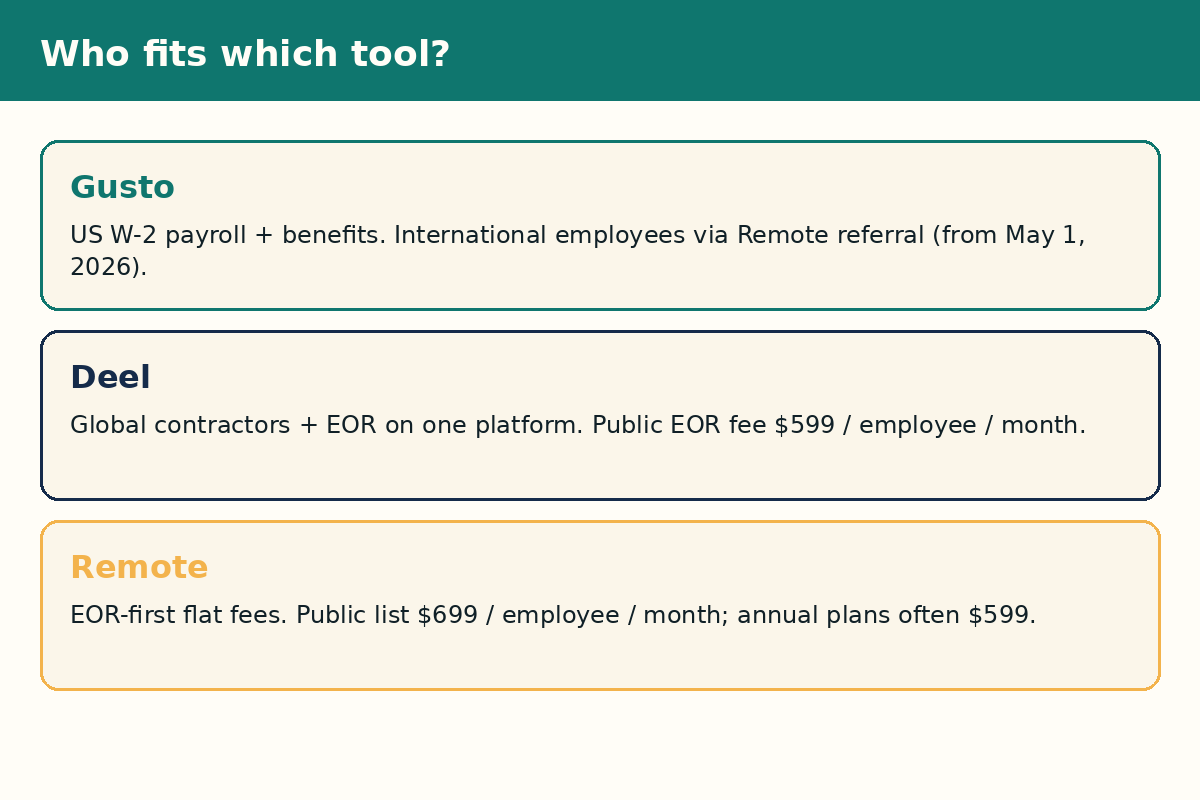
Deel vs Remote vs Gusto is a hiring-stage choice, not a single “best payroll” winner. Gusto is built for US W-2 payroll and benefits (Simple $49/mo + $6 per person through Premium $180/mo + $22). For non-US employees, Gusto’s help center states that from May 1, 2026 new customers are referred to partner Remote rather than an integrated Gusto EOR flow. Deel publishes Employer of Record at $599 per employee/month and contractor management at $49. Remote lists EOR at $699 per employee/month on its pricing page (Remote’s EOR product FAQ also cites $599 on annual plans). Use Gusto when your headcount is mostly US; shortlist Deel when you want contractors and EOR on one platform; shortlist Remote when you want EOR-first flat fees.
Deel vs Remote vs Gusto: 2026 pricing snapshot
Takeaway: Compare the published platform fee and the job each product actually does—US payroll, contractors, or EOR—before you chase a $100 seat delta.
| Topic | Gusto | Deel | Remote |
|---|---|---|---|
| Primary strength | US payroll, benefits, HR | Global contractors + EOR (+ US PEO) | EOR-first global employment |
| Public starting price (Oct 2026) | Simple $49/mo + $6/person; Plus $80 + $12; Premium $180 + $22 | EOR $599/employee/mo; contractors $49; Contractor of Record $325; US PEO $125 | EOR $699/employee/mo on pricing page; contractors $29; CoR from $325; global payroll $29 |
| International employees | Partner Remote; new customers referred directly from May 1, 2026 | Deel EOR in 130+ countries (vendor claim) | Remote EOR in 90+ countries (vendor claim) |
| Contractors | US contractors on plan per-person fees; global contractors: no monthly per-contractor fee, $5/payment to US banks (+ FX/wire rules) | $49/contractor/mo management; CoR $325 | $29/contractor/mo; Plus $99; CoR from $325 |
| Best-fit sketch | US-heavy W-2 teams that want payroll + benefits in one product | Mixed contractor + EOR roadmap on one vendor | Teams prioritizing owned-entity EOR and flat published fees |
Sources verified October 1, 2026: Gusto pricing, Gusto help: hire non-US employees with Remote, Deel pricing, Remote pricing, Remote EOR overview.
The real decision: payroll, contractors, EOR, or a local entity?
Takeaway: Most “Deel vs Remote vs Gusto” regret comes from buying the wrong employment model, not from picking the slightly pricier logo.
Before you compare seats, name the worker type:
- US W-2 employee: You need US payroll tax filings, often benefits brokerage, and state registrations. That is Gusto’s core product (or another US payroll stack).
- Independent contractor (properly classified): You need contracts, invoices, and payouts—not an EOR. Deel and Remote both sell contractor products; Gusto can pay global contractors with per-payment fees.
- Full-time employee abroad without your own entity: You need an Employer of Record (EOR). Deel and Remote compete here; Gusto refers new international-employee customers to Remote.
- Permanent multi-person presence in one country: An EOR can still work, but a local entity (for example a Dutch BV for a Netherlands pod) eventually wins on control and unit economics. See our same-day guide on employer of record Netherlands for that country example.
If you are still unsure whether the person is a contractor or an employee, read EOR vs Contractor of Record before you buy either seat.
Gusto in 2026: strong US payroll, international via Remote
Takeaway: Buy Gusto for US payroll quality; do not assume Gusto still “includes” international EOR for new accounts the way older marketing implied.
Gusto’s public US plans (October 2026) are straightforward:
- Simple: $49/mo + $6 per person — single-state payroll, basic PTO/holiday pay
- Plus: $80/mo + $12 per person — multi-state, next-day pay, time tracking
- Premium: $180/mo + $22 per person — dedicated advisor, performance tools, priority support
- Contractor Only: $35/mo + $6 per contractor (US contractor-focused plan)
Global contractor payments: Gusto states there is no monthly per-contractor fee; it charges $5 per payment to US-based bank accounts, with foreign exchange and wire rules for other payouts.
For full-time employees outside the US, Gusto’s help center is explicit: starting May 1, 2026, new customers onboard directly with Remote at remote.com/partners/gusto. Remote acts as the EOR (legal employer, local payroll, benefits, contracts). Existing customers who already used the pre–May 1 integrated Gusto+Remote experience may stay on that flow per Gusto’s documentation. Practically, if international employees are central to your plan, price Remote (or Deel) on their own pricing pages and treat Gusto as the US half of the stack.
Deel in 2026: contractors and EOR on one roadmap
Takeaway: Deel’s public EOR list price is $599/employee/month; the useful comparison is whether you also need Deel’s contractor and CoR products.
From deel.com/pricing (checked October 1, 2026):
- EOR: $599 per EOR employee per month
- US PEO: $125 per US PEO employee per month
- Contractor management: $49 per contractor per month
- Contractor of Record: $325 per contractor per month
Deel positions EOR as legal employment without opening a local entity, with onboarding, payroll, tax filings, benefits administration, and HR/legal support inside the platform fee. Salary, employer-side statutory contributions, and country benefits still sit on top of the $599. Deel’s pricing FAQ also states month-to-month flexibility with no long-term commitment required—always re-read your order form, because enterprise deals can differ.
Choose Deel when your near-term map includes both contractors and EOR hires, or when you want one vendor spanning contractor → CoR → EOR as classification risk rises.
Watch the product mix on your invoice. Teams sometimes buy Deel EOR for one country and contractor seats elsewhere, then discover FX, deposit, and support SLAs differ by product line. Put every active SKU on one internal scorecard (seat fee, headcount, country, renew date) so finance is not surprised at month three.
Remote in 2026: EOR-first with published flat fees
Takeaway: Remote’s public pricing page lists EOR at $699/employee/month; Remote’s EOR product copy also quotes $599 for annual plans and $699 monthly—confirm the plan you are offered.
From remote.com/pricing (checked October 1, 2026):
- Employer of Record: $699 per employee/month
- Global payroll: $29 per employee/month (for entities you already own)
- Contractor management: $29 per contractor/month (Plus $99)
- Contractor of Record: from $325 per contractor/month
- US PEO: from $99 (separate product; requires US bank account per Remote)
Remote emphasizes owned entities (not partner EOR networks), no platform/onboarding/setup fees for EOR and contractor products, and a transparent price guarantee. FX conversion uses a Remote FX rate shown on invoices when billing currency differs from the employment currency. Remote also notes reserve/deposit collection only in rare high-risk circumstances on its pricing FAQ—still ask for the country-specific quote before you budget cash.
Choose Remote when EOR quality and owned-entity messaging matter more than bundling a large contractor program on day one—or when you are already in the Gusto→Remote referral path for non-US employees.
Sales conversations often turn into “owned entities vs partner network” debates. Remote markets owned entities worldwide; Deel markets broad country coverage and a multi-product platform. For a founder buying one seat, the practical test is narrower: Can the vendor employ this role in this city on the timeline you need, with a written all-in quote? Ask for the employing entity name on the draft contract and the benefits schedule before you argue philosophy.
Cost architecture beyond headline seat fees
Takeaway: The $599–$699 EOR fee is usually the smallest line once salary, employer taxes, holiday pay, benefits, FX, and deposits are included.
Build a one-page TCO before you pick a logo:
- Gross salary in local currency (and whether offers quote monthly or annual).
- Employer on-costs (social security, insurance, pensions, mandatory allowances). Country bands often land roughly in the teens to thirties of percent of salary—get a country quote, do not invent a global average.
- Platform / EOR fee (Deel $599; Remote $699 list / often $599 annual per Remote FAQ).
- FX and billing currency markup on every cycle.
- Deposits / reserves if the country or risk profile requires them.
- Offboarding notice, severance/transition rules, and unused leave payouts under local law.
For a concrete Netherlands walkthrough (8% holiday allowance, notice bands, when a BV beats EOR), use Employer of Record Netherlands.
Founder-stage decision tree
Takeaway: Start from where the worker is employed, then pick the vendor—not the reverse.
- All (or nearly all) workers are US W-2? Shortlist Gusto Plus/Premium (or another US payroll tool). Skip paying EOR fees you do not need.
- Mostly contractors, correctly classified, multi-country? Compare Deel ($49) vs Remote ($29) contractor products; add CoR only if misclassification risk is real.
- Need 1–N full-time employees abroad without entities? Compare Deel EOR ($599) vs Remote EOR ($699 list / annual quotes). If you already live in Gusto for US payroll, Remote’s partnership path is the default international route for new accounts after May 1, 2026.
- Building a durable pod in one country (for example the Netherlands)? Run EOR for speed, then model entity timing. Read the Netherlands guide linked above.
- Still stuck on employee vs contractor? Pause purchasing and read EOR vs Contractor of Record.
Who should NOT buy each
Takeaway: A hard “no” saves more money than a clever discount.
- Skip Gusto as your global EOR strategy if you are a new customer hiring abroad after May 1, 2026—you will be on Remote’s EOR terms and pricing anyway.
- Skip Deel if you only need simple US payroll for a five-person California team and have zero international plans this year.
- Skip Remote if your immediate need is a large, contractor-heavy marketplace payout operation and you already standardized on another contractor stack—unless EOR is the real job.
- Skip all three as “legal cover” for misclassified employees labeled as contractors. An EOR fee does not fix a bad classification decision.
Compliance questions founders should ask every vendor
Takeaway: Ask for country-specific artifacts, not a global sales deck.
- Who is the legal employer on the contract in that country—owned entity or partner?
- What is the all-in quote: salary + employer costs + platform fee + FX + deposit?
- What benefits are statutory vs optional packages?
- How are IP assignment and invention clauses handled for your entity?
- What is the offboarding playbook (notice, garden leave, transition payments)?
- How do equity grants work for EOR employees if you are a Delaware C-Corp?
Then keep a written hiring checklist in your SaaS founder compliance checklist so finance and counsel see the same numbers.
Implementation checklist before you sign
Takeaway: A 30-minute pre-signature checklist prevents most “we bought the wrong stack” tickets.
- Write the worker roster. Columns: country, employee vs contractor, start date, salary currency, manager entity.
- Lock classification. If any role looks like a full-time employee abroad, do not park them on a contractor SKU to “save” an EOR fee. Use EOR vs CoR language with counsel.
- Request country quotes the same week. Ask Deel and Remote for the same role in the same country so platform fee, on-costs, benefits, and deposits are apples-to-apples.
- Decide the US system of record. If Gusto remains your US payroll, document how international employees will appear in finance (Remote invoice vs any legacy integrated path).
- Map IP and equity. Confirm invention assignment and whether equity admin is in-product or a separate process for EOR workers.
- Set an exit trigger. Example: “When we have 5+ employees in Country X for 9+ months, model a local entity.” Write the trigger down so finance reviews it quarterly.
- Pilot one hire. Run a single EOR onboarding end-to-end before migrating a whole pod. Capture time-to-first-payroll and support quality.
Keep artifacts in your company wiki and link them from the tools hub notes you already maintain for vendors.
FAQ: Deel vs Remote vs Gusto
How much does Deel EOR cost in 2026?
Deel’s public pricing lists $599 per EOR employee per month. Salary, employer taxes, and statutory benefits are extra. Source: deel.com/pricing (checked October 1, 2026).
Is Remote $699 or $599 per employee?
Remote’s pricing page shows $699 per employee/month for EOR. Remote’s EOR product FAQ also states $599/month on annual plans and $699 monthly. Use the quote on your order form.
Does Gusto still provide international EOR itself?
For new customers hiring non-US employees after May 1, 2026, Gusto refers you to Remote to sign up directly. Remote is the EOR. See Gusto’s help article.
Which is cheaper for contractors: Deel or Remote?
Public list prices favor Remote contractor management at $29/mo vs Deel at $49/mo. Compare CoR, FX, and support quality—not only the seat fee.
Can I use Gusto for US staff and Deel for abroad?
Yes. Many teams keep Gusto (or similar) for US W-2 payroll and run Deel or Remote for foreign employees. Two vendors means two invoices and two offboarding playbooks—budget the ops cost.
When should I open a local entity instead of EOR?
When headcount, permanence, and benefits complexity in one country make the EOR premium larger than entity + local payroll overhead. Model 12–24 months of fully loaded cost. Country example: Netherlands EOR guide.
Is EOR the same as a PEO?
No. A PEO typically co-employs where you already have (or will have) a US entity. An EOR is the legal employer abroad when you lack a local entity. Deel lists US PEO separately at $125/employee/mo; Remote lists US PEO from $99. Leave deeper PEO vs EOR coverage to its own post.
Where should I go next?
Clarify worker type in EOR vs Contractor of Record, then if your first EU hire is in the Netherlands, read Employer of Record Netherlands.
Bottom line for 2026
Deel vs Remote vs Gusto resolves cleanly when you stop asking “which brand is best?” and ask “which employment job am I buying?” Gusto wins plain US payroll. Deel wins mixed contractor + EOR roadmaps at a public $599 EOR fee. Remote wins EOR-first teams and is the international path Gusto points new customers to after May 1, 2026, with a public EOR list price of $699 (annual quotes often $599). Always add employer on-costs, FX, and deposits before you celebrate a seat-fee win.
Next step: If you are hiring in the Netherlands next, continue with Employer of Record Netherlands: costs, rules, and providers. If you are still choosing between employee and contractor structures, start at EOR vs Contractor of Record, then return to Start here for the wider compliance map.