
Payroll / EOR · Last reviewed October 1, 2026
Employer of Record in the Netherlands for First Hires
An employer of record Netherlands setup lets you hire a Dutch employee without opening a BV: the EOR becomes the legal employer for the local contract, payroll, and statutory filings while you direct day-to-day work. In 2026, public EOR platform fees for major vendors sit around Deel $599, Remote $699 (Remote’s product FAQ also cites $599 on annual plans), and Oyster $699 per employee per month—before salary, employer social costs, and the mandatory 8% holiday allowance (vakantiegeld). Use an EOR to move hire #1 quickly; model a Dutch entity when headcount and permanence make the platform premium harder to justify.
What an employer of record in the Netherlands actually does
Takeaway: The EOR is the legal employer on paper; you still manage the person’s work, performance, and product priorities.
In a typical Netherlands EOR arrangement:
- You select the candidate and agree role, seniority, and target compensation with your EOR’s cost estimate.
- The EOR issues a Dutch-compliant employment contract (and flags any applicable CAO—collective labour agreement).
- The EOR runs monthly payroll, withholds employee taxes/contributions, and remits employer obligations under Dutch rules.
- You supervise day-to-day work; the EOR handles employer-side HR administration and many statutory processes.
An EOR is not a substitute for classifying the role correctly. If the person is truly an independent contractor, read EOR vs Contractor of Record before you force them onto an employment seat—or the reverse.
2026 public EOR fee bands (Deel, Remote, Oyster)
Takeaway: Platform fees cluster in the high hundreds of USD per employee per month; the Dutch on-cost stack usually dwarfs a $100 seat difference.
| Vendor | Public EOR fee (Oct 2026) | Notes from vendor pages |
|---|---|---|
| Deel | $599 / employee / month | Also lists contractors $49; Contractor of Record $325; US PEO $125 |
| Remote | $699 / employee / month on pricing page | EOR product FAQ also cites $599 annual / $699 monthly; contractors $29; CoR from $325 |
| Oyster | USD 699 / employee / month | Annual discounts available; refundable deposit mentioned for EOR team members; contractors $29 after free trial period |
For a fuller three-vendor product comparison (including Gusto’s US payroll lane), see Deel vs Remote vs Gusto. Always request a Netherlands-specific quote: deposits, benefits packages, and FX can move the invoice even when the headline seat fee matches the marketing page.
Budgeting Dutch on-costs beyond the EOR fee
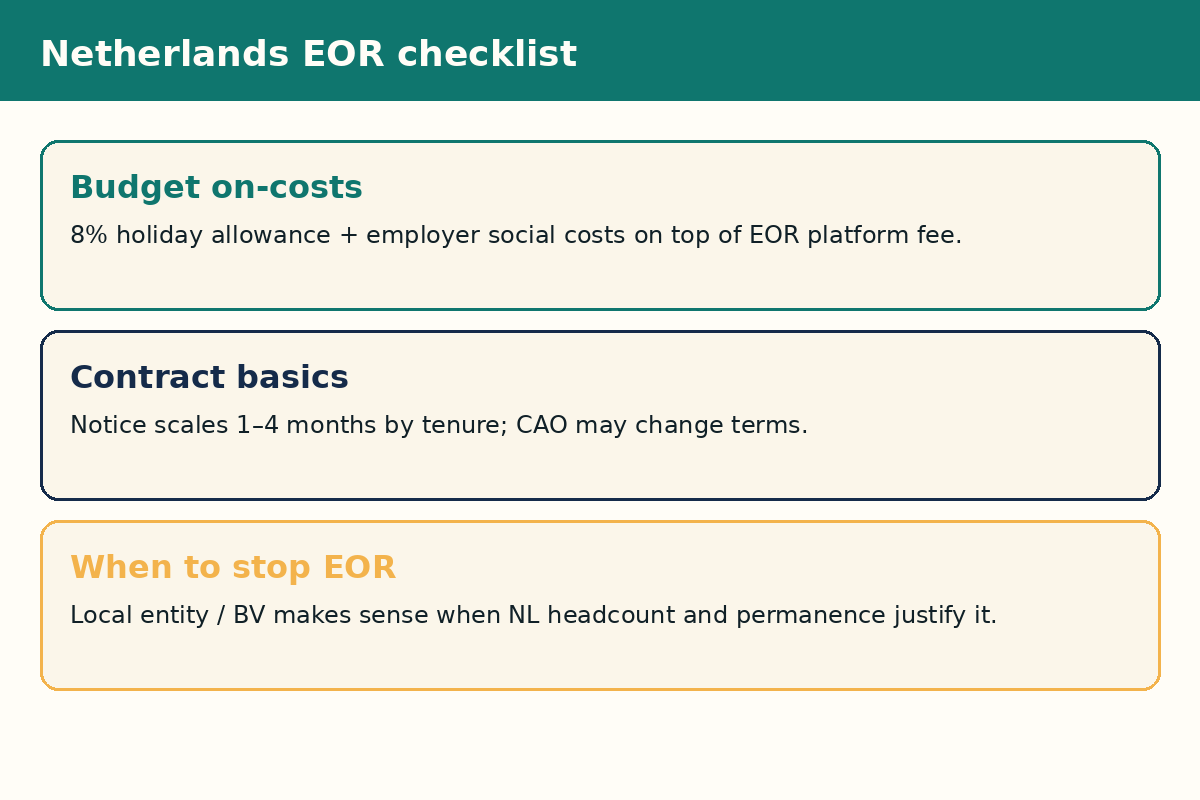
Takeaway: Quote total employer cost as gross salary + holiday allowance + employer social/insurance items + EOR fee + FX—not the seat fee alone.
Foreign founders most often under-budget these Netherlands lines:
- Holiday allowance (vakantiegeld): Dutch government guidance states employees are entitled to at least 8% holiday allowance on gross annual salary for the past year (for example May–May). It is usually paid once a year in May or June unless the employee agrees in writing to another schedule. Source: business.gov.nl — Paying holiday allowance (Ministry of Social Affairs and Employment).
- Statutory leave: Employees are entitled to statutory leave of at least four times their weekly working hours (for example 160 hours/year on a 40-hour week). Source: business.gov.nl — Holiday entitlement.
- Employer social / insurance contributions: On top of gross pay you fund employer-side employee insurance and related levies. Exact percentages depend on contract type, employer size, and year—ask your EOR for a line-item estimate for the role’s salary band rather than copying a blog average.
- Pension / CAO extras: Some sectors require pension contributions or other CAO terms. If a CAO applies, your EOR should say so before the offer letter goes out.
- FX and deposits: Oyster’s pricing FAQ notes a refundable deposit for EOR team members; Remote discusses reserves only in rare high-risk cases. Confirm cash timing.
Business.gov.nl’s personnel-cost overview also groups mandatory wage costs as gross wage + holiday pay + CAO costs, plus employer payroll taxes—useful vocabulary when you read an EOR quote. Source: Overview of personnel costs.
Sample cost sketch (illustrative only)
Takeaway: Build a spreadsheet with EUR salary rows and USD platform fees; never ship an offer from the seat-fee column alone.
Illustrative structure for a hypothetical €6,000 monthly gross offer (numbers for layout only—replace with your EOR quote):
- Gross monthly salary: €6,000
- Holiday allowance accrual: ~8% of eligible gross over the accrual year (often paid as a May/June lump sum rather than tiny monthly cash to the employee—confirm presentation with the EOR)
- Employer social / insurance lines: EOR quote itemizes these for the salary band and contract type
- Platform fee: e.g. $599–$699 USD / month converted at the vendor’s billing FX
- Optional benefits package: private health top-ups, equipment, learning stipends if you elect them
Finance should approve the annualized version (12× monthly employer cost + expected May holiday payout pattern + deposits) before recruiting starts. If the candidate negotiates a 13th month or CAO extras, rebuild the sheet—do not “absorb” surprises into the EOR fee.
Minimum wage floor (first half of 2026)
Takeaway: Offers must clear the statutory minimum hourly wage for age 21+—€14.71 gross for the first half of 2026—plus holiday allowance rules.
According to business.gov.nl — Statutory minimum wage, for employees aged 21 and up a fixed minimum wage per hour applies: €14.71 gross for the 1st half of 2026, adjusted every six months (1 January and 1 July). Youth rates differ by age. Minimum wage must be paid by bank transfer. Your EOR should refuse (or redesign) an offer that would underpay.
Contracts, notice periods, and offboarding basics
Takeaway: Netherlands notice scales with tenure for employers; budget offboarding before you celebrate a fast EOR start date.
From business.gov.nl — Notice period (permanent contracts):
- Employers give notice before the end of the calendar month unless agreed otherwise in writing.
- Statutory employer notice is at least 1 month, extended by 1 month after every 5 years of service, up to a maximum of 4 months.
- Employee statutory notice is generally 1 month unless a different period is agreed; if the employee’s notice is longer than 1 month, the employer’s notice must be at least twice as long (employee maximum 6 months).
- Fixed-term contracts generally end on the agreed date; early termination needs an interim notice clause. Written notice about renewal/non-renewal still matters for longer fixed-term contracts—follow current government guidance and your EOR’s process.
- Trial period, summary dismissal, and settlement agreements have separate rules—do not improvise these without counsel/EOR guidance.
Dismissal in the Netherlands also involves grounds and procedures (UWV or court routes in many cases). Treat that as a specialist topic: your EOR and Dutch counsel own the process; this guide only flags that “at-will” US assumptions do not travel.
One planning note founders from the US often miss: Dutch sick-pay obligations for employers are comparatively long and process-heavy relative to many other markets. Your EOR will explain the operational path for a specific case; do not assume short US-style sick policies apply. Ask the vendor how sick leave, reintegration duties, and insurance interact for EOR employees in the Netherlands before you finalize headcount plans.
Provider fit checklist for a first Dutch hire
Takeaway: Pick the EOR that can employ this role on your timeline with a written all-in quote—not the brand with the flashiest global map.
| Check | Why it matters |
|---|---|
| Country coverage + entity model | Confirm Netherlands employment is available now; ask whether the local employing entity is owned or partnered. |
| All-in quote | Salary, 8% holiday allowance treatment, employer contributions, benefits, platform fee, FX, deposit. |
| CAO / sector flags | Some roles inherit collective terms that change pay or leave. |
| IP / equity path | Invention assignment and equity grants for EOR employees need explicit handling if you are a US C-Corp. |
| Offboarding playbook | Notice math, garden leave options, final holiday-allowance payout. |
| Support model | Who answers the employee in Dutch during payroll or sick-leave questions? |
Shortlist construction: start from the public fees above, then run the same role through two vendors. Cross-check product positioning in Deel vs Remote vs Gusto.
When an EOR stops making sense (BV / entity trigger)
Takeaway: EOR is a speed tool; a Dutch entity becomes rational when NL headcount, benefits complexity, and permanence stack up.
Write a trigger before hire #1, for example:
- You expect 5+ Netherlands employees within 12–18 months, or
- You need local commercial contracts, banking, or customer proximity that already imply a durable NL presence, or
- Your fully loaded EOR premium (platform fees × headcount × months) exceeds a sober BV + local payroll + advisory budget over the same horizon.
EOR and entity are not mutually exclusive forever: many teams start on EOR, then migrate employees after the BV and local payroll are live. Migration still needs notice planning and employee communication—budget counsel time.
Step-by-step: first Netherlands hire via EOR
Takeaway: Sequence quotes → offer → contract → payroll calendar; do not announce a start date before the EOR clears compliance checks.
- Define the role (title, seniority, remote vs hybrid Dutch address expectations, salary band in EUR).
- Get two EOR quotes for the Netherlands with identical inputs.
- Confirm worker type with counsel if classification is ambiguous (EOR vs CoR).
- Issue a contingent offer pending EOR onboarding and right-to-work checks.
- Approve the Dutch contract and benefits package; verify how the 8% holiday allowance appears (accrual vs May payout).
- Set payroll funding and FX; calendar deposit refunds if any.
- Onboard tools/access on your side the same week payroll identity is created.
- Log the BV trigger in your compliance checklist for quarterly review.
Common mistakes on Netherlands EOR deals
Takeaway: Most pain is budgeting and classification—not the logo on the EOR invoice.
- Quoting a monthly salary that quietly excludes the 8% holiday allowance conversation.
- Assuming US at-will termination culture applies to Dutch permanent contracts.
- Parking a full-time Dutch engineer on a contractor agreement to “avoid EOR.”
- Comparing only $599 vs $699 seats while ignoring deposits and employer contributions.
- Hiring three people on EOR with no written entity trigger, then panicking at month eighteen.
FAQ: Employer of record Netherlands
Do I need a Dutch BV to hire an employee in the Netherlands?
No. An EOR can employ the person through its local employment structure while you lack a BV. You still need a lawful hiring plan, budget, and usually immigration/right-to-work clearance for the candidate.
How much does an employer of record cost in the Netherlands?
Public platform fees in October 2026 include Deel $599, Remote $699 list (annual often $599 per Remote FAQ), and Oyster $699 per employee/month. Add salary, employer contributions, benefits, FX, and any deposit.
What is the 8% holiday allowance?
Dutch rules entitle employees to at least 8% holiday allowance on gross annual salary for the past year, typically paid in May/June unless another schedule is agreed in writing. Source: business.gov.nl.
What notice period applies if we part ways?
For permanent contracts, employer statutory notice starts at 1 month and can rise to 4 months with long service; employees generally give 1 month unless agreed otherwise. Source: business.gov.nl notice period.
What is the Dutch minimum wage in early 2026?
For age 21+, €14.71 gross per hour in the first half of 2026, adjusted every six months. Source: business.gov.nl minimum wage.
Is EOR better than hiring a Dutch contractor?
Only if the role is truly employment. Misclassification risk is its own problem—start with EOR vs Contractor of Record.
When should we form a BV instead?
When NL headcount, permanence, and total EOR premiums outweigh entity + local payroll costs. Write a numeric trigger before hire #1.
Which EOR should I pick—Deel, Remote, or Oyster?
Run the same Netherlands role through two quotes. Use Deel vs Remote vs Gusto for platform positioning, then decide on support quality, deposit terms, and all-in cost—not marketing country counts alone.
Bottom line for 2026
An employer of record Netherlands path is the practical way for many SaaS teams to land a first Dutch employee without incorporating yet. Budget the platform fee (roughly $599–$699/mo among Deel, Remote, and Oyster public pages) and Dutch realities: 8% holiday allowance, employer contributions, leave, and notice rules from business.gov.nl. Keep EOR as a speed layer, not a permanent substitute for a BV once your Netherlands pod is clearly durable.
Next step: Compare platform fit in Deel vs Remote vs Gusto, clarify structures in EOR vs Contractor of Record, then map the hire into your SaaS founder compliance checklist and Start here hub.