Security · Last reviewed September 28, 2026
Sprinto vs Vanta for SaaS Founders
Sprinto and Vanta both automate SOC 2 readiness—evidence collection, continuous monitoring, policies, risk workflows, and auditor collaboration. Neither publishes a full public rate card; quotes scale with headcount, frameworks, and add-ons. Third-party 2026 buyer guides often place Sprinto’s small-team single-framework entry lower than Vanta’s (roughly mid-four-figures vs low-to-mid five-figures per year—estimates, not list prices). Vanta typically leads on integration breadth and market recognition; Sprinto often competes on bundled implementation help and total cost for lean first-time buyers. Neither tool replaces your independent auditor.
Sprinto vs Vanta: quick comparison table (2026)
Takeaway: Compare quote total cost of ownership (platform + add-ons + internal time + auditor) against your stack—not a single “winner” badge.
| Topic | Sprinto | Vanta |
|---|---|---|
| Primary job | Compliance automation / GRC for cloud-native teams | Trust / compliance automation platform |
| Common frameworks | SOC 2, ISO 27001, HIPAA, GDPR, PCI DSS, and more (confirm current catalog) | SOC 2, ISO 27001 family, HIPAA, GDPR, PCI DSS, NIST, and more (confirm current catalog) |
| Integrations (vendor claims) | Large native library (Sprinto materials commonly cite 200–300+; confirm in demo) | Vanta markets 400+ integrations and 1,400+ automated tests |
| Pricing model | Quote-based; Sprinto often positions all-inclusive packaging (few à-la-carte modules) | Quote-based personalized plans (Vanta pricing page); tiers / add-ons vary by package |
| 2026 entry price signal (third-party) | Often cited ~$5k–$7k/yr for small single-framework deals | Often cited ~$10k–$15k/yr for small single-framework deals |
| Support / onboarding feel | Frequently described as higher-touch / bundled expert help | Strong self-serve + partner/auditor network; premium support may be tiered |
| Trust Center / questionnaires | Trust Center and questionnaire automation marketed on Sprinto site | Vanta Trust Center widely used in US startup sales motions |
| Best-fit sketch | Cost-conscious first SOC 2; wants guided implementation | Wants deepest ecosystem, brand familiarity with buyers/auditors |
| Replaces auditor? | No | No |
Price bands above are third-party market signals, not Sprinto or Vanta list prices. Both require demos. Always separate platform subscription from audit firm fees (Vanta’s own SOC 2 cost explainer commonly cites audit fees in the tens of thousands depending on scope).
What these platforms actually do (and do not)
Takeaway: Automation platforms collect evidence and track controls; a CPA firm still issues the SOC 2 report.
Both Sprinto and Vanta sit in the “compliance automation” category. In practice that means connecting cloud, identity, HRIS, code, and device systems; mapping controls to frameworks; collecting screenshots/API evidence on a schedule; managing policies and employee tasks; monitoring drift; and giving auditors a cleaner evidence room. Many teams also use Trust Center pages and security-questionnaire helpers to speed enterprise sales.
What they do not do: invent a perfect security program without engineering work, guarantee a clean audit opinion, or substitute for access reviews, vulnerability remediation, or vendor due diligence your team still owns. Budget engineering remediation time—often larger than the SaaS invoice.
If you are still deciding when to start Type 1 vs Type 2, read SOC 2 Type 1 vs Type 2 before you buy annual software you will underuse.
2026 pricing signals: how to compare quotes fairly
Takeaway: Force both vendors onto the same scope spreadsheet—headcount band, frameworks year 1, Trust Center, vendor risk, SSO, and renewal caps.
Vanta’s public pricing page routes buyers to personalized quotes. Sprinto likewise sells via demo. That opacity is normal in this category. Third-party roundups in 2026 repeatedly describe Sprinto as meaningfully cheaper at small single-framework scopes (often summarized as roughly 40–60% below larger brands, or ~$5k–$7k vs ~$10k–$15k entry). Treat those numbers as negotiation priors, not invoices.
When quotes arrive, normalize:
- Employees in scope (and what happens at the next headcount tier).
- Frameworks in year 1 vs year 2 (SOC 2 only vs SOC 2 + ISO 27001).
- Trust Center, vendor risk, AI features, and premium support—bundled or add-on?
- Implementation fees, partner hours, and whether a compliance manager is included.
- Renewal uplift caps in writing.
- Auditor partner discounts or preferred-firm introductions (nice-to-have, not decisive alone).
For a three-way market view that includes Drata and Secureframe, see Vanta vs Drata vs Secureframe.
Where Sprinto usually fits
Takeaway: Sprinto is often the rational pick when quote + guided onboarding beat ecosystem prestige for a first certification.
Choose Sprinto when:
- You are a lean SaaS team buying your first SOC 2 automation seat and total cash matters.
- You want higher-touch implementation rather than assembling the program alone.
- Your stack is mainstream cloud/SaaS (AWS/GCP, Google Workspace or Microsoft 365, GitHub, Okta/SSO, HRIS) and demo integrations cover the critical path.
- You value bundled modules (risk, Trust Center, questionnaires) over à-la-carte shopping.
- Your buyers care that you have a credible program and report—not which brand logo sits in the Trust Center footer.
Watch-outs: confirm auditor familiarity in your geography, validate any niche integrations, and still run a readiness gap analysis—automation does not delete missing logging or messy access reviews. Use SOC 2 readiness checklist for SaaS startups before kickoff.
Where Vanta usually fits
Takeaway: Vanta is often the rational pick when integration depth, auditor/partner ecosystem, and buyer recognition justify a higher quote.
Choose Vanta when:
- Enterprise prospects already ask “Are you on Vanta?” or recognize the Trust Center pattern.
- You need a very broad integration surface (Vanta publicly emphasizes 400+ integrations and 1,400+ automated tests).
- You expect to stack frameworks quickly and want a mature multi-framework workflow.
- Your security lead prefers a large partner/auditor network and polished self-serve UX.
- Budget can absorb a higher platform fee if it reduces questionnaire and evidence toil during a heavy sales year.
Watch-outs: scrutinize add-ons (Trust Center, vendor risk, AI packs) so year-2 price is not a surprise; negotiate renewal caps; do not buy “enterprise everything” if you only need Security TSC for Type 2.
Integrations, continuous monitoring, and Trust Center
Takeaway: Win the demo with your critical systems connected—not with a marketing integration count.
Bring a one-page stack list to both demos: cloud accounts, IdP, endpoint management, code host, ticketing, HRIS, vulnerability scanner, and any weird legacy SaaS that holds customer data. Ask each vendor to show live evidence pulls and failing-control alerts for those systems. A platform with 400 integrations that misses your MDM is worse than a smaller library that covers your actual blast radius.
Trust Center and questionnaire automation matter once security reviews block revenue. Both vendors market these motions; evaluate turnaround time on a real questionnaire sample and whether NDA / gated document sharing fits your sales process.
Also ask how custom or private integrations work when a critical system is missing. APIs, CSV uploads, and “manual evidence” workflows are fine in moderation; they become a hidden headcount cost if half your controls are screenshots forever. Have each vendor estimate what percentage of your in-scope controls will be continuously tested versus manually attested after go-live.
Decision tree: Sprinto vs Vanta by stage
Takeaway: Sequence Type 1/Type 2 timing, then pick the platform that matches cash, stack, and sales pressure.
- No customer demanding SOC 2 yet: Finish the readiness checklist and basic hygiene before annual software. You may still buy a platform early if fundraising or a design partner is imminent—just be honest about utilization.
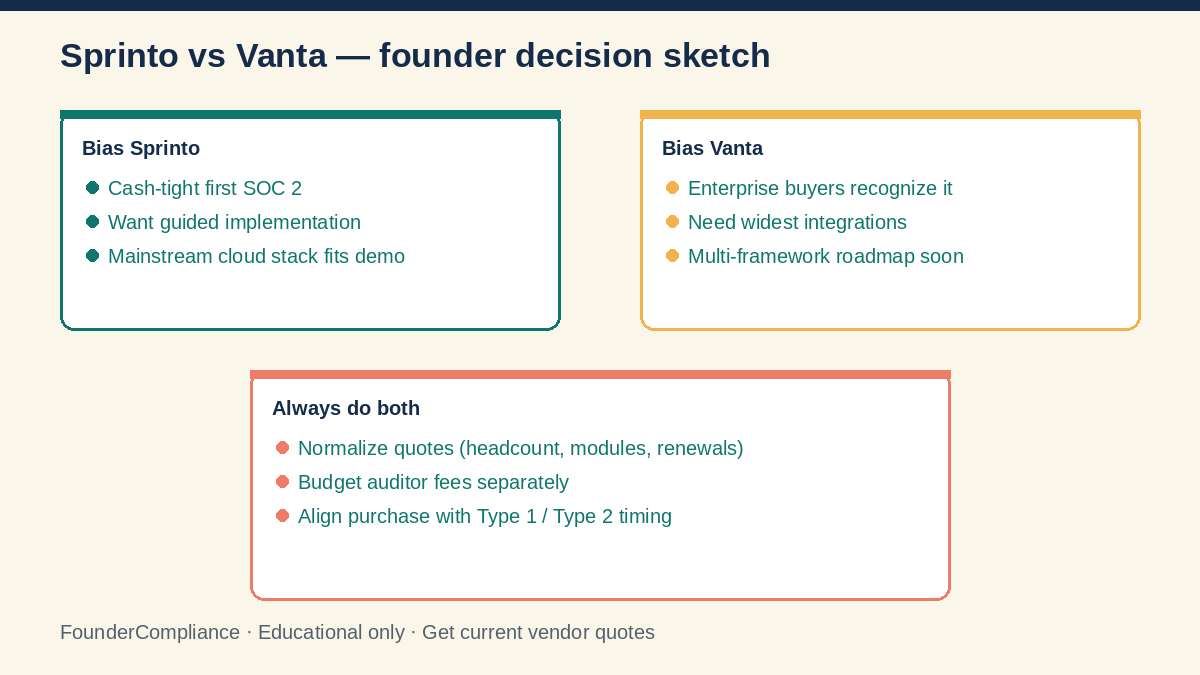
- First report, cash-tight, mainstream stack: Bias Sprinto if the quote and onboarding plan are clearer. Parallel-quote Vanta anyway so you have a ceiling.
- Heavy enterprise pipeline, brand/integration sensitivity: Bias Vanta if the delta is justified by sales cycle compression and stack coverage.
- Still choosing among Vanta / Drata / Secureframe: Read the three-way comparison; use this Sprinto vs Vanta page when Sprinto is the cost disruptor on your shortlist.
- Type 1 vs Type 2: Platforms help both, but Type 2 needs observation-period discipline. Align purchase date with the window in Type 1 vs Type 2.
Demo checklist (print this)
Takeaway: Same script for both vendors—score them side by side within 48 hours.
- Connect your top 8 systems; screenshot evidence freshness and ownership assignment.
- Walk a failed control → ticket → remediation loop.
- Export / share a Trust Center view the way a prospect would see it.
- Run one sample security questionnaire end-to-end.
- Meet (or review) an auditor partner who has completed a report on that platform for a company your size.
- Get a written quote with frameworks, headcount tiers, add-ons, implementation, and renewal terms.
- Ask what is manual despite automation—every platform has gaps.
Platform fee vs audit fee: budget both
Takeaway: A “cheap” platform that leaves you unprepared can still produce an expensive audit redo—model all-in year-one cash.
Vanta’s public SOC 2 cost guidance puts many audit engagements in roughly the $10,000–$50,000 range before you add internal remediation, with all-in first-year programs often cited much higher depending on scope. Your automation invoice sits beside that—not instead of it. Sprinto’s lower platform quote only wins if you still reach a clean observation period on time.
Practical budgeting for a first Type 2:
- Platform subscription (normalized quote).
- Auditor engagement letter (Type 1 and/or Type 2).
- Pen test / vulnerability scanning if your auditor or customers require it.
- Engineering weeks for logging, SSO, backup tests, and access reviews.
- Policy legal review if templates need counsel eyes for your industry.
If cash is the constraint, sequence readiness work first, buy the lighter platform quote second, and lock the auditor third—not the reverse.
Common mistakes when choosing Sprinto or Vanta
Takeaway: Most regret comes from scope mismatch and ignoring audit fees—not from picking the “wrong” logo.
- Buying multi-framework enterprise packs before a customer asked for ISO/HIPAA.
- Forgetting the auditor invoice (often comparable to or larger than year-1 platform fees).
- Skipping readiness work, then blaming the tool for noisy failing controls.
- Choosing solely on brand because a Twitter thread said so.
- Ignoring international entity / data-residency constraints your auditor will scope.
- Not assigning an internal owner (usually Eng/Ops + a part-time security lead).
FAQ: Sprinto vs Vanta
Is Sprinto cheaper than Vanta?
Often, according to third-party 2026 buyer guides for small single-framework deals—but both are quote-based. Compare normalized quotes for your headcount and modules.
Does Vanta or Sprinto replace a SOC 2 auditor?
No. They prepare evidence and monitoring; a licensed CPA firm issues the report.
Which is better for a first SOC 2 Type 2?
The one whose integrations match your stack and whose quote + onboarding you can execute during the observation period. Sprinto often wins on cost/guidance; Vanta on ecosystem breadth.
How many integrations do I need?
Enough to cover systems in audit scope. Marketing totals matter less than whether your cloud, IdP, MDM, and code host connect cleanly.
Should I evaluate Drata or Secureframe too?
If your shortlist is wider than two, yes—start with Vanta vs Drata vs Secureframe, then add Sprinto quotes.
When should I buy the platform relative to Type 1 vs Type 2?
Buy when you can staff remediation and evidence hygiene. Type 2 needs a clean observation window—see Type 1 vs Type 2.
Do these tools help with security questionnaires?
Both market questionnaire / Trust Center workflows. Test with a real prospect questionnaire in the demo.
What else belongs on a SaaS compliance roadmap?
Formation, tax, payments, privacy, and security sit together—use the SaaS founder compliance checklist and Start here.
Bottom line
Takeaway: Sprinto vs Vanta is a quote-and-fit decision: Sprinto for lean guided first SOC 2 economics; Vanta for ecosystem depth and buyer familiarity—always budget the auditor separately.
Run two demos in the same week, score the checklist above, and only then sign. Pair the tool with readiness work so you are not paying for a dashboard of red controls you already knew about.
Next step
Map readiness with the SOC 2 readiness checklist, confirm timing via SOC 2 Type 1 vs Type 2, and if your shortlist includes Drata or Secureframe, read Vanta vs Drata vs Secureframe. For the wider stack, return to Start here and the tools hub.