Payments · Last reviewed September 29, 2026
Polar vs Paddle for Indie SaaS Founders
Polar and Paddle are both Merchants of Record (MoR): they typically sit as the seller of record, collect eligible indirect taxes, and pay you net of their fees. For indie SaaS, the 2026 public pricing story is simple at the sticker and nuanced in the ladder. Paddle lists pay-as-you-go Checkout at 5% + 50¢ per transaction with no monthly fee on that page (custom paths for volume, invoicing, and under-$10 products). Polar starts new orgs on Starter at 5% + 50¢, then publishes paid plans that trade a monthly fee for a lower variable rate (Pro $20/mo → 3.8% + 40¢, Growth $100/mo → 3.6% + 35¢, Scale $400/mo → 3.4% + 30¢ per Polar’s fees docs). Pick Polar when the ladder + developer/GitHub-shaped workflow fits; pick Paddle when you want a more established MoR surface for billing support, broader commercial SaaS motions, or custom invoicing paths.
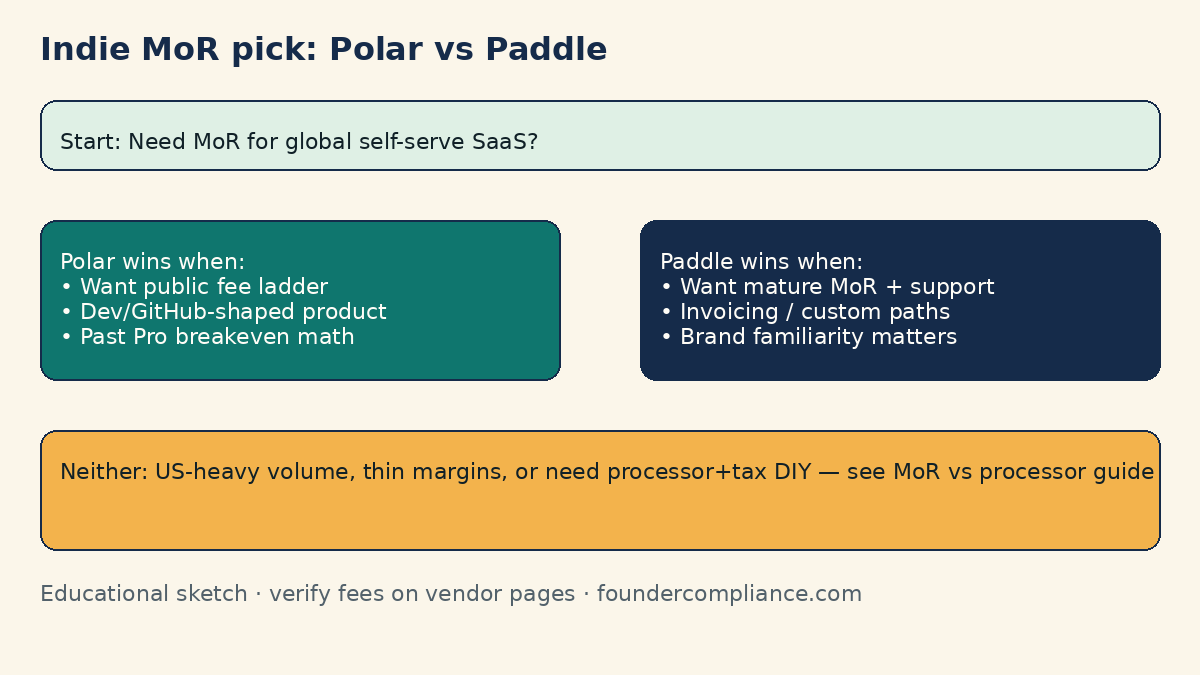
Polar vs Paddle: quick comparison (2026)
Takeaway: Same MoR category; different fee shape and product maturity for indie workflows.
| Topic | Polar | Paddle |
|---|---|---|
| Role | Merchant of Record | Merchant of Record |
| Public headline fee | Starter 5% + 50¢; paid ladder lowers variable rate | Pay-as-you-go 5% + 50¢ per Checkout transaction |
| Monthly platform fee | $0 on Starter; $20 / $100 / $400 on Pro / Growth / Scale | None on public pay-as-you-go page |
| Intl card add-on (Polar docs) | +1.5% non-US cards on top of plan rate | Marketed as all-inclusive Checkout rate—still verify FX/payout treatment |
| Indie-shaped strengths | Transparent ladder; developer/open-source & GitHub-adjacent workflows | Mature MoR ops, buyer payment support, broader SaaS billing posture |
| Watch-outs for indies | Refunds: network fees not returned to you; confirm billing depth for complex B2B | Custom pricing for under-$10 SKUs / invoicing; less “public ladder” than Polar |
| Best-fit sketch | Solo/devtool SaaS wanting predictable self-serve MoR math | Indie-to-growth SaaS wanting established MoR + support surface |
For a three-way view that also includes Lemon Squeezy, see Paddle vs Lemon Squeezy vs Polar. For the ownership model itself, read Merchant of Record vs payment processor.
What MoR means when you are indie
Takeaway: MoR trades a higher take-rate for tax/compliance operational load—not for “set and forget forever.”
As an indie founder you still own product, refunds policy design, chargeback hygiene, and customer success. The MoR typically becomes the merchant on the receipt, calculates and remits many indirect taxes in markets it supports, and runs checkout/billing rails. That is why sticker fees sit near ~5% + 50¢ instead of classic Stripe US card rates near 2.9% + 30¢ plus your own tax stack.
MoR is usually attractive when you sell globally to self-serve buyers and do not want to register/file VAT/GST/sales tax in every place you have a customer. It is less attractive when nearly all volume is domestic US cards, margins are thin, or you need exotic B2B procurement workflows the MoR cannot host. Stripe DIY (and Stripe Managed Payments) comparisons live in Stripe vs Paddle vs Lemon Squeezy and Stripe Managed Payments vs Paddle.
2026 fees: Paddle’s flat rate vs Polar’s ladder
Takeaway: At low volume the stickers match; Polar’s paid plans can win on math after clear breakeven thresholds.
Paddle (pricing page): pay-as-you-go 5% + 50¢ per Checkout transaction; no monthly fee on that public plan; custom pricing for rapidly scaling businesses; note that products under $10 or invoicing needs may require contacting Paddle.
Polar (merchant-of-record fees docs, reviewed September 2026):
- Starter: free monthly · 5% + 50¢
- Pro: $20/mo · 3.8% + 40¢
- Growth: $100/mo · 3.6% + 35¢
- Scale: $400/mo · 3.4% + 30¢
Polar also documents approximate breakeven sales vs Starter: Pro ~$1,379/mo, Growth ~$5,634/mo, Scale ~$19,048/mo. Organizations created before May 27, 2026 may remain on Early Member (4% + 40¢ plus +0.5% subscription fee per those docs) until they leave that rate—new orgs start on Starter.
Additional Polar fees to model: +1.5% international (non-US) cards; dispute/chargeback fee documented at $15; payout rails can include Stripe payout fees (Polar states it does not add markup on those). Polar’s refunds docs state initial transaction fees are not returned on refund because networks/PSPs still charged them.
Worked fee sketches (illustrative)
Assume a $49 US-card subscription charge (ignore tax for the fee line; tax handling differs by MoR and buyer location):
- Paddle @ 5% + 50¢ ≈ $2.95 fee
- Polar Starter @ 5% + 50¢ ≈ $2.95 fee
- Polar Pro @ 3.8% + 40¢ ≈ $2.26 fee (+ $20/mo platform)
At ~100 such charges/month (~$4,900 sales), Pro’s variable savings vs Starter are roughly $69 before the $20 platform fee—so Pro can pay. At 20 charges/month, Starter (or Paddle’s flat plan) usually wins. Always rebuild with your AOV, refund rate, and international mix (+1.5% on Polar for non-US cards).
Product fit: checkout, subscriptions, GitHub, B2B
Takeaway: Fee math is useless if the billing product cannot express how you sell.
Polar is frequently chosen by developer-tool and open-source-adjacent indies who want a modern MoR with public fee docs and GitHub-shaped monetization motions. Validate in a sandbox: seat upgrades, trials, discount codes, customer portal, and tax-inclusive display for your top countries.
Paddle is frequently chosen when you want a longer-running MoR brand, 24/7-style buyer payment support positioning, subscription billing plus optional invoicing/custom paths, and a checkout you can embed with less worry about “will this MoR still be here?” For complex net terms, PO-driven B2B, or under-$10 catalog quirks, expect a sales conversation on Paddle rather than a self-serve toggle.
If your product is mostly US B2B with heavy invoicing and procurement, neither “indie MoR default” may win versus a processor-plus-tax stack—re-read the MoR vs processor guide before you migrate customers.
Payouts, refunds, and disputes
Takeaway: Model refund rates and dispute fees; they move indie margins more than a 0.2% headline difference.
- Payouts: Polar documents manual withdrawals and pass-through Stripe payout fees ($2/mo active payouts, 0.25% + $0.25 per payout, plus cross-border FX bands). Confirm Paddle payout timing/currency options for your entity country in their docs/dashboard.
- Refunds: Polar states transaction fees are not refunded to you on customer refunds. Community and secondary writeups often contrast that with Paddle absorbing more of the processing-fee pain on full refunds—verify both vendors’ current refund fee policies in writing for your account, because this is a live margin lever for trial-heavy indie products.
- Disputes: Polar documents $15 per dispute. High dispute rates can threaten MoR accounts industry-wide—design dunning and clarity into checkout regardless of vendor.
When Polar wins for indie SaaS
Takeaway: Polar wins when transparent ladder math + indie/dev workflow beat MoR brand gravity.
- You are solo or tiny, selling self-serve software, and want published plan math you can spreadsheet.
- Your AOV and monthly sales clear (or will clear) Polar’s Pro/Growth breakeven bands while international share is understood.
- GitHub/open-source or developer-buyer motions matter more than enterprise invoicing.
- You prefer upgrading/downgrading MoR fee tiers without a custom quote just to see the rate card.
- You accept verifying tax-jurisdiction coverage and billing feature gaps before moving production volume.
When Paddle wins for indie SaaS
Takeaway: Paddle wins when MoR maturity, buyer support, and commercial billing paths matter more than a public fee ladder.
- You want an established MoR with strong buyer-facing payment support positioning while you stay in the IDE.
- You expect to need invoicing, under-$10 SKU handling, or volume/custom pricing conversations soon.
- Your churn/dunning and subscription edge cases need a battle-tested billing stack more than a newer ladder.
- Finance advisors or future acquirers already recognize Paddle payouts and reporting patterns.
- You value “all-inclusive” Checkout messaging and will still verify FX, payout, and refund specifics in the contract/help center.
When to choose neither
Takeaway: MoR is optional—thin margins and US-heavy card volume often favor processor + tax tools.
- Almost all revenue is US cards and you already tolerate sales-tax software ops.
- Your AOV cannot absorb ~5% + 50¢ economics even with Polar’s ladder.
- You need deep marketplace, platform, or marketplace-of-sellers mechanics outside MoR SKUs.
- You are still validating pricing with pocket change—delay MoR migration until checkout is stable.
EU VAT/OSS context for US SaaS still matters conceptually even under MoR (know what you outsourced): VAT OSS for US SaaS companies.
Switching notes (without a migration novel)
Takeaway: Migrate subscriptions with a written cutover; never dual-charge.
If you move from Stripe→Polar, Stripe→Paddle, or Polar↔Paddle, inventory active subs, trials, tax-inclusive prices, and coupon liabilities first. Run a week of shadow reconciliation (MoR dashboard vs bank vs GL). On the books side, map MoR fees and net deposits cleanly—see deferred revenue for SaaS in QuickBooks if annual plans create liability schedules.
Indie decision checklist (print this)
Takeaway: Score both vendors on the same eight questions before you migrate a single subscriber.
- What is my median AOV and monthly successful charge count?
- What % of cards are non-US (Polar +1.5% intl)?
- What is my trailing refund rate, and can my margin absorb non-refunded processing fees?
- Do I need invoices / net terms / under-$10 SKUs in the next 12 months?
- Does either sandbox show my exact trial→paid and seat-change paths?
- Which countries drive >80% of revenue, and has the MoR confirmed coverage for those tax regimes?
- Who answers buyer “why was I charged?” emails—me or the MoR support surface?
- Can my CPA recognize the payout reports without a science project?
If you cannot answer (1)–(3) with numbers, stay on your current stack for another month and instrument billing first. MoR migrations amplify messy metrics; they do not invent them.
Early Member and “I signed up before May 2026”
Takeaway: Polar’s grandfathered Early Member rate is a real edge—until you leave it.
Polar’s fees docs state organizations created before May 27, 2026 can stay on Early Member (4% + 40¢ with a +0.5% subscription fee) indefinitely. Upgrading to a paid plan retires Early Member for that org; dropping back later lands on Starter (5% + 50¢), not Early Member. Indies who still hold Early Member should spreadsheet “stay put” against Pro/Growth carefully—sometimes the grandfathered variable rate beats a shiny paid tier until volume is large.
FAQ: Polar vs Paddle for indie SaaS
Is Polar cheaper than Paddle?
At Starter vs Paddle pay-as-you-go, public stickers often match at 5% + 50¢. Polar can be cheaper after Pro/Growth/Scale breakeven if your sales volume and card mix fit. Rebuild with international share and refund rates.
Are both Merchants of Record?
Yes. Both market MoR models. Always confirm product eligibility and territory coverage for your catalog.
When should an indie upgrade Polar from Starter?
When monthly sales approach Polar’s published breakevens (~$1.4k for Pro, ~$5.6k for Growth, ~$19k for Scale) and support priority matters—verify with your AOV spreadsheet.
How do refunds differ?
Polar documents that initial transaction fees are not returned on refunds. Confirm Paddle’s current refund fee treatment for your account; do not rely on secondary blogs alone for production margin math.
What if my product is under $10?
Paddle’s pricing page directs under-$10 and invoicing cases to custom conversations. Model whether MoR economics still make sense at low AOV.
Is Polar only for open-source?
No, but Polar is popular with developer/open-source-adjacent products. Ordinary indie SaaS can use it if checkout/subscription features fit—validate in demo.
Should I compare Lemon Squeezy too?
Yes if you want a three-way MoR shortlist. Use Paddle vs Lemon Squeezy vs Polar; this page stays two-way for indie Polar vs Paddle decisions.
Does MoR remove all tax work?
It reduces many indirect-tax registrations/filings for supported flows, but you still handle entity, income tax, and correct bookkeeping. Pair with the SaaS founder compliance checklist.
Bottom line
Polar vs Paddle for indie SaaS is rarely about who “wins MoR.” It is about whether you want Polar’s public fee ladder and indie/dev workflow, or Paddle’s flatter public Checkout rate plus deeper commercial MoR surface. Spreadsheet your AOV, international mix, refund rate, and the billing features you cannot fake. Then pick one MoR and invest in clean payout→GL mapping instead of perpetual tool hopping.
Next step: Read the three-way Paddle vs Lemon Squeezy vs Polar guide and the ownership primer MoR vs payment processor. Soft index: tools · start here.