Legal & Privacy · Last reviewed October 8, 2026
GDPR Compliance Software: What Small SaaS Actually Needs
GDPR compliance software is a category label, not a single product. For a small SaaS selling to EU/UK users, the practical stack usually covers five jobs: cookie/consent management (CMP), data subject access request (DSAR) intake, an Article 30 record of processing activities (RoPA), vendor DPA/subprocessor tracking, and—if enterprise buyers already demand it—trust automation alongside SOC 2. Buy for the gap you have today. A $20/month banner tool will not replace RoPA discipline, and a five-figure trust platform will not fix an unblocked marketing pixel.
What GDPR tooling actually covers
Takeaway: Name the job before you shortlist vendors—CMP, DSAR, RoPA, vendor contracts, and trust evidence are different products that sometimes share a logo.
| Job | What “done” looks like | Typical early SaaS tool |
|---|---|---|
| CMP / cookie consent | Banner + preference center; scripts blocked until lawful basis; consent logs | Termly, iubenda, Osano Free/Plus |
| DSAR / subject rights | Intake form, identity checks, 30-day workflow, export/delete evidence | Osano Subject Rights, OneTrust DSR, trust-platform modules |
| RoPA (Art. 30) | Living inventory of purposes, categories, recipients, retention, transfers | Spreadsheet → platform RoPA builders / privacy suites |
| DPA / subprocessors | Signed processor terms; public subprocessor list; change notices | Contract templates + vendor portals; suite vendors add tracking |
| Trust automation | Mapped controls, evidence collection, customer questionnaires | Vanta, Drata, Secureframe (often with SOC 2) |
Official context: the GDPR text is on EUR-Lex (Regulation (EU) 2016/679). Article 30 covers records of processing; Articles 12–23 cover data-subject rights; Articles 28 and 32 cover processors and security. Software helps you operate those duties—it does not “make you GDPR certified” by itself.
Who this roundup is for
Takeaway: Optimize for a 2–20 person SaaS with EU customers and limited legal bandwidth—not for a Fortune 500 privacy office.
If you already run a dedicated privacy team, OneTrust-class suites may be the right conversation. If you only need a marketing-site banner and a privacy policy, start with a lightweight CMP. If enterprise RFPs want SOC 2 and GDPR evidence in one portal, evaluate trust platforms that map GDPR as an additional framework. For document baselines (privacy policy, DPA, ToS), pair this article with the SaaS legal documents checklist.
Capability map: build a stack, not a logo collection
Takeaway: Most early teams need CMP + policy hygiene first; add DSAR automation when request volume or sales diligence rises; add trust platforms when SOC 2 is already budgeted.
- Week 0–2: Inventory personal data you collect (product, marketing site, support, billing). Draft or update privacy notice and cookie disclosures.
- Week 1–3: Deploy a CMP that blocks non-essential tags until consent (or another valid basis) and stores logs.
- Ongoing: Maintain a RoPA (even a careful spreadsheet beats folklore). Keep signed DPAs and a public subprocessor page.
- When volume hits: Move DSAR intake off shared inboxes into a tracked workflow with deadlines.
- When buyers demand trust: Prefer frameworks you already need (often SOC 2) and confirm what GDPR modules actually automate.
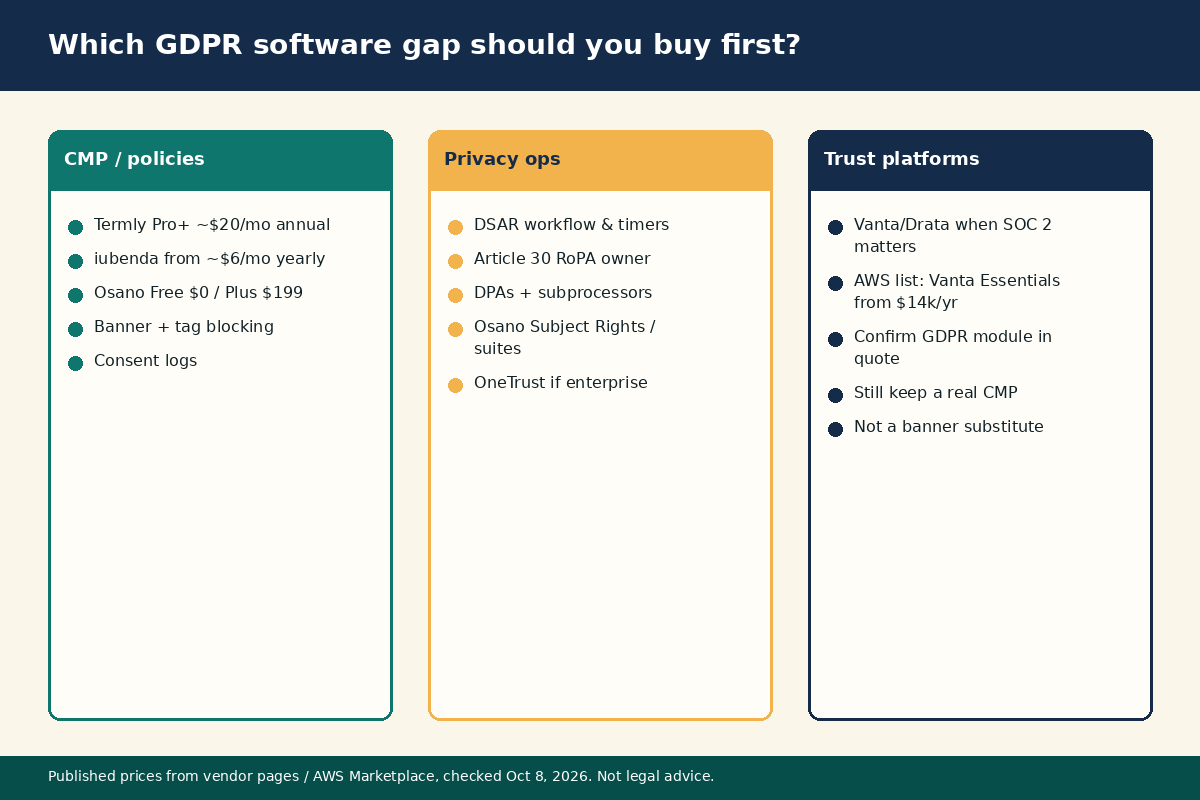
GDPR compliance software compared (2026)
Takeaway: Lightweight CMPs publish self-serve prices; enterprise privacy suites and trust platforms are mostly quote-based—use published figures only where vendors show them.
| Tool | Best fit | Published pricing signal (checked Oct 8, 2026) | Watch-outs |
|---|---|---|---|
| Termly | SMB CMP + policy generators | Pro+ listed at $20 on Termly’s pricing page (annual billing toggle); Free/Starter with banner-view limits | Strong on policies/banners; not a full enterprise privacy ops suite |
| iubenda | CMP + legal docs for sites/apps | Essentials about $5.99–$6.99/site/mo (yearly vs monthly); Advanced about $24.99–$27.99; Ultimate about $99.99–$119.99 (pageview tiers) | Confirm pageview quotas; add-ons for some consent proofs |
| Osano | SMB CMP with path to broader privacy | Cookie Consent Free $0 (1 user, 1 domain, 5,000 monthly visitors); Plus $199/mo (2 users, 3 domains, 30,000 visitors) on Osano plans pages | Subject Rights / higher privacy tiers move to custom quotes |
| OneTrust | Enterprise privacy program (consent, DSR, assessments, vendor risk) | Custom / quote-based (OneTrust pricing page: solution packages metered by users, assets, visitors) | Powerful but heavy; overkill for pre-product-market-fit SaaS |
| Vanta | Trust automation when SOC 2 (and related frameworks) already matter | Direct pricing is quote-based on vanta.com; AWS Marketplace lists Essentials from $14,000/12 months for 1–20 employees (Plus $21,500; Professional $23,000)—confirm whether GDPR is in your package | Do not buy a trust platform solely for a cookie banner |
For deeper CMP feature tradeoffs, see Termly vs iubenda vs Termageddon. For SOC 2 platform tradeoffs, see Vanta vs Drata vs Secureframe and Sprinto vs Vanta.
Termly and iubenda: start here for most marketing sites
Takeaway: If your immediate risk is a non-compliant banner and missing policies, a lightweight CMP usually beats a $10k+ privacy suite.
Termly positions itself as an all-in-one SMB compliance kit (policies, cookie scans, CMP). Its public pricing page (October 2026) shows a Free tier with limited banner views and a popular Pro+ tier at $20 under annual billing, with unlimited policies/banner views and Consent Mode / TCF features listed for that tier. iubenda similarly bundles privacy/cookie policies with consent banners and geo rules; paid Essentials/Advanced/Ultimate tiers scale mainly by pageviews and document depth.
Neither product replaces counsel for novel processing (health data, children’s data, large-scale profiling). They do reduce the “forgotten cookie script” failure mode that shows up in sales diligence and customer complaints.
Osano: CMP with a clearer upgrade path into privacy ops
Takeaway: Osano’s published Free and Plus plans are useful CMP starting points; treat Subject Rights and full privacy suites as separate buying decisions.
Osano’s cookie-consent plans page publishes Free at $0 and Plus at $199/month with the visitor and domain limits noted above (verified October 8, 2026 via Osano plans/cookie-consent). Osano also markets Subject Rights, vendor risk, data mapping, and assessments. Those modules are the right conversation when DSAR volume or vendor diligence outgrows a shared inbox—not when you only need a banner on a docs site.
OneTrust: when a full privacy program platform is justified
Takeaway: Choose OneTrust when privacy operations are a dedicated function—not when you need a $20 banner.
OneTrust’s public pricing page emphasizes solution packages (consent, privacy automation, and related suites) with usage meters such as admin users, privacy assets, and visitors. It does not publish a simple SMB sticker price. Third-party procurement databases sometimes cite five-figure annual deals; treat those as market anecdotes, not quotes. For a small SaaS, the honest trigger is usually: multiple products/domains, high DSAR volume, complex vendor inventories, or a customer that mandates an enterprise privacy platform.
Vanta (and peers): GDPR as a framework on a trust platform
Takeaway: Trust platforms help when you already need continuous control evidence for buyers; they are a poor substitute for CMP basics.
Vanta’s marketing includes GDPR among frameworks and discusses RoPA/DSAR-style workflows in its educational content. Commercially, vanta.com pricing is demo/quote based. A concrete public list signal is the Vanta listing on AWS Marketplace, which shows Essentials starting at $14,000 per 12 months for 1–20 employees (Plus $21,500; Professional $23,000), with separate modules for Trust Center and questionnaire automation. Confirm in writing whether GDPR coverage, RoPA, and DSAR features are included in the package you are quoted—and whether you actually need them if your EU footprint is still tiny.
Drata and Secureframe sit in the same “trust automation” lane. If SOC 2 is not on the 12-month roadmap, put CMP + RoPA + DPA hygiene first and revisit platforms later.
Decision tree: which GDPR software to buy first
Takeaway: Match spend to the failure mode buyers or regulators would notice first.
- Only a marketing site + few EU leads: Termly or iubenda (or Osano Free) for CMP + policies.
- Product processes EU personal data, low DSAR volume: CMP + maintained RoPA + signed DPAs; DSAR via intake form + tracked tickets.
- Rising DSARs or privacy questionnaires: Dedicated subject-rights workflow (Osano Subject Rights class or suite module).
- Enterprise sales needing SOC 2 + privacy evidence: Trust platform (Vanta/Drata/etc.) plus a real CMP—do not assume one license covers both well.
- Multi-brand enterprise privacy team: Evaluate OneTrust / peer suites with counsel and procurement.
Implementation checklist (first 30 days)
Takeaway: Software without owners and inventories becomes shelfware.
- Assign one privacy ops owner (founder/ops) and one technical owner (eng).
- List systems that store personal data (app DB, analytics, CRM, support, billing, email).
- Publish an accurate privacy notice and cookie policy; link them from the CMP.
- Configure Consent Mode / tag blocking so non-essential tags wait for consent where required.
- Create a DSAR intake path with identity verification and a 30-day timer.
- Start an Article 30 record (purpose, categories, recipients, retention, transfers).
- Collect DPAs from material processors; publish subprocessors.
- Calendar a quarterly review of vendors, cookies, and retention.
Common buying mistakes
Takeaway: Overbuying enterprise suites and underbuying consent enforcement are the twin failure modes.
- Buying OneTrust-class software before you have a RoPA owner
- Installing a banner that does not block tags
- Assuming SOC 2 evidence equals GDPR operational readiness
- Copying a competitor’s privacy policy without matching your processing
- Ignoring UK GDPR / other regimes when you sell there (tooling may help, counsel still decides)
- Skipping subprocessors until a customer security review asks for them
UK GDPR and multi-regime reality
Takeaway: If you sell into the UK as well as the EU, treat UK GDPR as a parallel compliance track—many tools support both, but your notices and transfer language still need a human review.
Post-Brexit, the UK runs UK GDPR alongside the Data Protection Act 2018. CMP vendors often ship region rules and ICO-oriented templates, which helps with banners and preference centers. That does not automatically fix international transfer clauses, UK representative questions, or product-side retention. When your customer base spans EU and UK, keep one inventory of processing activities and mark which disclosures apply where, rather than maintaining two contradictory privacy policies.
Subprocessors, DPAs, and customer trust pages
Takeaway: A public subprocessor list plus signed Article 28 terms closes more enterprise deals than another unused dashboard seat.
Enterprise buyers routinely ask: who touches personal data, where is it hosted, and how will you notify changes? Your answer is mostly process: maintain a living list (Stripe, AWS, email provider, support desk, analytics—whatever you actually use), link DPAs, and define a change-notification method. Some privacy suites and trust platforms help track vendors; a well-kept Notion/Google Sheet with owners and renewal dates is still acceptable at seed stage if it is accurate. Pair that operational hygiene with the document set in the legal documents checklist.
Trust Centers (Vanta and peers sell modules here) become useful when security questionnaires repeat weekly. Until then, a clean PDF packet—SOC 2 if you have it, architecture overview, subprocessor list, DPA—often clears the first diligence pass.
How to evaluate a vendor demo without getting sold a cathedral
Takeaway: Ask which of the five jobs the SKU automates on day 30—and who on your team will click the buttons every week.
- Does the CMP block tags by default, or only display a banner?
- Can you export consent logs for a date range?
- For DSAR: intake, verification, tasking to system owners, and an audit trail within 30 days?
- For RoPA: can you version records and show last review date?
- For trust platforms: which GDPR controls are tests vs manual uploads?
- Pricing: what meter (pageviews, domains, employees, assets, DSRs) will blow up next year?
Write the answers in a one-page scorecard. If the vendor cannot show a concrete workflow for your stack (for example, deleting a user across app DB + HubSpot + Intercom), keep shopping.
FAQ: GDPR compliance software
Is there one best GDPR compliance software for SaaS?
No. Best fit depends on whether your bottleneck is consent, rights requests, processing records, or buyer trust questionnaires.
Do I need software if I already hired a lawyer?
Counsel drafts and advises; software operates banners, logs, tickets, and inventories at product speed. Most teams need both at different intensities.
Is a cookie banner enough for GDPR?
Usually not. Banners address parts of electronic communications/consent UX. You still need lawful bases, notices, security measures, processor contracts, and rights handling for personal data in the product.
Can Vanta or Drata replace Termly/iubenda?
Not as a default. Trust platforms focus on control evidence and program management. Keep a purpose-built CMP unless your vendor explicitly covers equivalent consent enforcement for your sites.
How much should an early SaaS budget?
Many teams start at CMP list prices in the tens of dollars per month (Termly/iubenda class) or Osano Free/Plus. Privacy suites and trust platforms commonly move into four- to five-figure annual quotes—buy those when the sales motion requires them.
Does GDPR software make us “certified”?
No. GDPR does not work like a SOC 2 Type 2 attestation. Software supports ongoing compliance work; certification marketing claims are a red flag.
What official pages should we bookmark?
EUR-Lex GDPR text, your supervisory authority guidance (for example ICO for UK), and EDPB guidelines relevant to your processing.
Where do DPAs and legal docs fit?
Use your counsel-approved templates and the operational checklist in our legal documents checklist; tooling tracks them, it does not invent them.
Bottom line
Takeaway: Treat “GDPR compliance software” as a stack map—CMP first for most small SaaS, then DSAR/RoPA discipline, then suite or trust automation only when volume or enterprise sales justify the spend.
Re-check vendor pricing pages before you sign; list prices and package names change. Prefer tools your team will actually update every quarter over shelfware with impressive logos.
Next step
Compare lightweight CMPs in Termly vs iubenda vs Termageddon, tighten document coverage with the SaaS legal documents checklist, and if SOC 2 is already on the roadmap, read Vanta vs Drata vs Secureframe. New here? Start at Start here or Tools. Questions about your stack? Use the contact form.