Security & Trust · Last reviewed October 10, 2026
Vanta vs Drata vs Secureframe for SaaS Founders
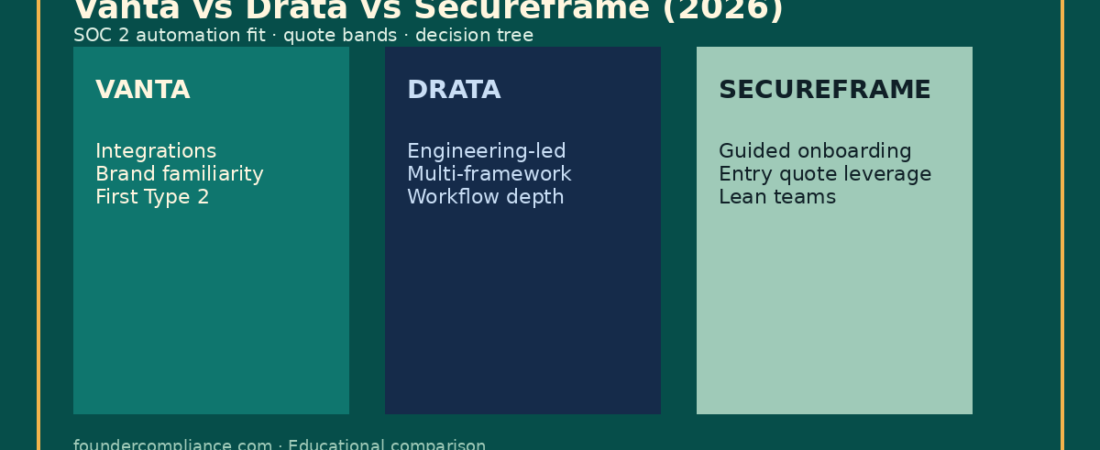
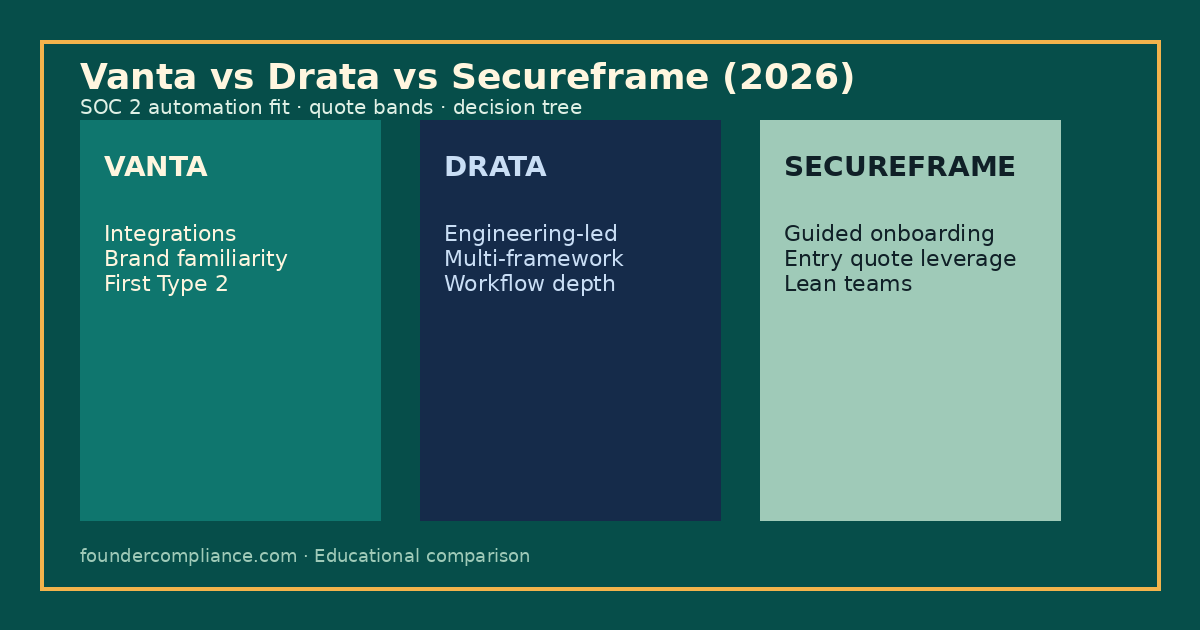
Vanta vs Drata vs Secureframe is a choice among three SOC 2 compliance automation platforms that collect evidence, map controls, and support auditor workflows. None of them publish a complete public rate card for every deal in 2026—quotes scale with headcount, frameworks, and add-ons such as Trust Center or questionnaire automation. For a first SOC 2 Type 2, pick the platform whose integrations match your stack and whose all-in quote you can defend: Secureframe often competes aggressively on entry price, Vanta on onboarding polish and integration breadth, and Drata on deeper multi-framework and engineering-led workflows. The licensed CPA firm that issues your report is always a separate bill.
Quick comparison: Vanta vs Drata vs Secureframe (2026)
Takeaway: All three automate evidence for SOC 2; differentiate on quote aggressiveness, integration breadth, multi-framework depth, and how much guided implementation you need.
| Factor | Vanta | Drata | Secureframe |
|---|---|---|---|
| Primary fit | First SOC 2 with broad stack coverage and buyer-familiar brand | Engineering-led teams and multi-framework roadmaps | Lean teams that want guided onboarding and competitive entry quotes |
| Published list price? | Mostly quote-based; some AWS Marketplace SKUs (e.g., Essentials band) | Mostly quote-based; AWS Marketplace platform + framework SKUs | Some public entry framing (e.g., Fundamentals); also Marketplace SKUs |
| Integrations (vendor claims) | Very large library (often cited 400+) | Large library; strong CI/CD and monitoring emphasis | Large library (often cited 300+) |
| Trust Center / questionnaires | Mature trust + questionnaire workflows (packaging varies by tier) | Strong trust/workflow tooling for growing GTM security load | Trust and questionnaire support; check tier packaging in demos |
| Auditor relationship | Broad partner ecosystem | Audit Alliance / partner network | Audit partner network |
| Also compare | Sprinto and others for budget/region fit — see Sprinto vs Vanta | ||
Before you buy any platform, skim the SOC 2 readiness checklist for SaaS startups so you have owners and a system boundary—not only a demo calendar.
What these platforms actually do (and do not)
Takeaway: Platforms collect and organize evidence; a CPA firm still issues the SOC 2 report buyers request under NDA.
Vanta, Drata, and Secureframe sit in the “continuous compliance / GRC automation” category. In practice for an early SaaS team they usually:
- Connect to cloud, identity, code, HR, and device tools to pull control evidence.
- Map automated and manual tests to frameworks such as SOC 2 (and often ISO 27001, HIPAA, and others depending on SKU).
- Track failing tests, assign owners, and export evidence packages for auditors.
- Optionally power a Trust Center and help answer security questionnaires.
They do not replace management responsibility, invent missing controls, or act as your auditor. Per the AICPA & CIMA SOC 2 overview, SOC 2 is an attestation examination against the Trust Services Criteria performed by a licensed CPA firm. Customers ask for that report—not a green dashboard screenshot.
If you still need Type 1 vs Type 2 timing clarified, read SOC 2 Type 1 vs Type 2 before locking a platform SKU.
2026 pricing signals: platform fee vs total program cost
Takeaway: Treat public numbers as quote anchors—budget platform + CPA audit (+ often pen test) separately, and model year-two renewals.
None of the three vendors publishes a single transparent rate card that covers every headcount, framework count, and add-on. That is why pairwise searches like drata vs vanta and secureframe vs vanta (or “… pricing”) keep ranking as comparison pages rather than price sheets.
Useful 2026 signals (always re-verify on the vendor site and any AWS Marketplace listing before you negotiate):
| Signal type | Vanta | Drata | Secureframe |
|---|---|---|---|
| Buyer-reported platform bands (illustrative, <~50 employees, one framework) | Often discussed roughly in the low-to-mid five figures USD/year (wide spread by deal) | Similar wide band; multi-framework deals climb faster | Often cited as aggressive on startup entry quotes within a similar overall market band |
| AWS Marketplace list SKUs (published list prices—not your negotiated price) | Example signal: Essentials-style package listed around ~$14,000/year for a small-employee band (confirm current listing) | Example signal: platform fee listed around ~$25,000/year (100-FTE capacity framing) + ~$7,500/framework (confirm current listing) | Example signal: platform ~$7,500 + first framework ~$7,500 for up to ~100 employees (confirm current listing); platform alone is not a full SOC 2 program |
| What list SKUs miss | Private offers, startup programs, Trust Center / questionnaire modules, professional services, and renewal uplifts—get competing quotes in writing | ||
Labeling note: Marketplace list prices and third-party “Vendr-style” medians are research anchors checked around mid/late 2026 industry write-ups—not FounderCompliance quotes and not guarantees. Your signed order form wins.
Total first-year program cost for many seed/Series A SaaS teams is platform + CPA examination (commonly another five-figure line depending on firm and scope) + optional penetration test. Optimizing only the platform line while under-scoping the auditor is a false economy.
Where Vanta usually fits
Takeaway: Choose Vanta when integration breadth, onboarding polish, and buyer familiarity matter as much as the sticker on the quote.
Vanta is frequently shortlisted because security reviewers and investors already recognize the brand, and because its public materials emphasize a very large integration catalog and fast path to first evidence automation. That helps teams whose stack spans common cloud, IdP, and SaaS tools and who want fewer custom collectors on day one.
Watch for: tier packaging (Essentials vs higher plans), which Trust Center / questionnaire features are included vs add-ons, and renewal pricing once your program is built around the platform. Run a live integration proof against your actual AWS/GCP, Okta/Google Workspace, and GitHub/GitLab before you crown a winner.
Where Drata usually fits (Drata vs Vanta)
Takeaway: Prefer Drata when engineering wants deeper automation hooks and you expect multi-framework growth beyond a single SOC 2.
Drata vs Vanta is less about “who is SOC 2 capable” (both are) and more about operating style. Drata’s public positioning leans engineering-aligned continuous monitoring, workflow control, and multi-framework scale (ISO 27001, HIPAA, and adjacent programs depending on SKU). Teams that already live in CI/CD and want compliance tests next to delivery pipelines often prefer that posture.
On pricing, Marketplace list signals have sometimes shown a higher platform list fee for Drata’s published SKU structure than Secureframe’s entry list math—but negotiated quotes and private offers can close gaps. Do not assume Drata is always more expensive than Vanta until you have like-for-like quotes (same headcount, same frameworks, same add-ons).
Choose Vanta over Drata when your priority is maximum integration coverage and a familiar buyer narrative on a first Type 2 with a lean ops owner. Choose Drata over Vanta when multi-framework depth and workflow configurability will matter within 12–18 months.
Where Secureframe usually fits (Secureframe vs Vanta)
Takeaway: Prefer Secureframe when you want guided implementation and a competitive entry quote for a first SOC 2 Type II.
Secureframe vs Vanta often comes down to support model and price aggression for startups. Secureframe’s public materials highlight in-house compliance expertise during onboarding and broad framework coverage. Buyers who lack an internal GRC hire frequently value that guided path. Entry packaging (including Fundamentals-style framing and Marketplace platform + framework SKUs) is commonly used as a negotiation lever against Vanta and Drata quotes.
Secureframe is not automatically “the cheap one forever.” Confirm employee bands, framework fees, and which questionnaire/Trust Center capabilities sit behind which tier. Also confirm auditor partner fit for the firm you already prefer.
Choose Vanta over Secureframe when brand familiarity with enterprise reviewers and integration breadth dominate. Choose Secureframe over Vanta when hands-on onboarding and a sharper first-year quote matter more than logo recognition.
What to compare in demos (practical checklist)
Takeaway: Score demos on your stack, failing-test ownership, auditor portal workflow, and written quote line items—not slideware.
- Integrations that matter: cloud IAM, IdP, code host, device/MDM, HRIS—prove each connection.
- Failing tests: who clears them weekly? Is ownership assignable without Slack archaeology?
- Auditor workflow: portal access, evidence export, and whether your preferred CPA firm already works smoothly with the tool.
- Trust Center & questionnaires: included vs paid modules; turnaround for common security questionnaires.
- Framework roadmap: SOC 2-only this year vs ISO/HIPAA next year—price both scenarios.
- Quote hygiene: platform, frameworks, add-ons, services, renewal terms, and any headcount true-ups—in writing.
- Exit risk: can you export control mappings and evidence history if you switch later?
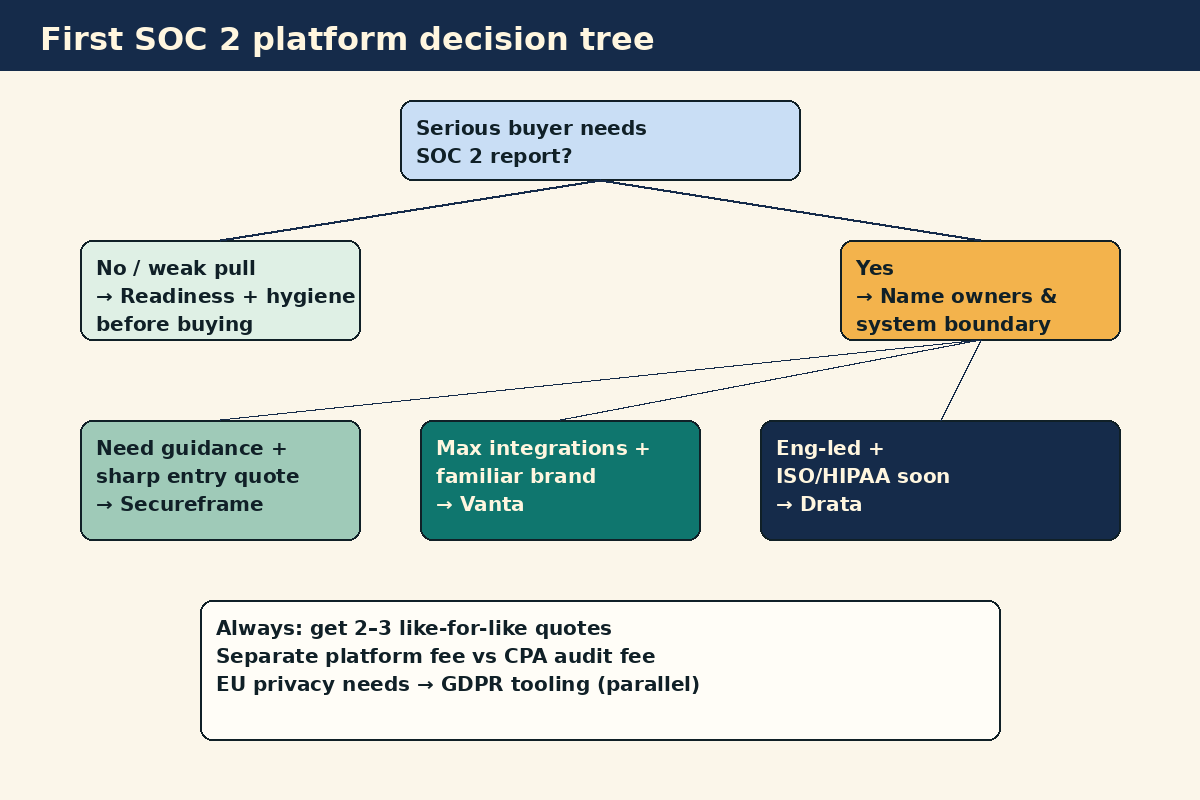
Founder-stage decision tree
Takeaway: Start from buyer pressure and readiness, then pick the platform; do not buy automation to invent missing controls.
- No serious buyer asking for SOC 2 yet: finish security hygiene and the readiness checklist; delay platform spend if runway is tight.
- First Type 2, lean team, need guidance + sharp quote: shortlist Secureframe (and one competitor for leverage).
- First Type 2, common US SaaS stack, want max integrations + familiar brand: shortlist Vanta.
- Engineering-led, planning ISO/HIPAA soon: shortlist Drata; still get a Vanta/Secureframe quote for negotiation.
- EU customer privacy program is a parallel track: SOC 2 automation is not a GDPR program. Pair this comparison with GDPR compliance software so privacy tooling and security attestation do not get conflated in sales decks.
- Budget-sensitive / region-specific alternatives: also evaluate Sprinto-class tools via Sprinto vs Vanta rather than forcing a three-vendor bake-off if it does not fit.
How platforms interact with Type 1 vs Type 2 timelines
Takeaway: Automation helps either report type; Type 2 still needs a clean observation window with owners and logs.
Platforms accelerate evidence collection for both Type 1 (design as of a date) and Type 2 (operating effectiveness over a period). They do not compress calendar reality if access reviews and change management are still broken. Align platform kickoff with the report path explained in Type 1 vs Type 2, and keep legal/privacy docs from the SaaS legal documents checklist consistent with questionnaire answers.
Platform fee vs auditor fee: a simple budget worksheet
Takeaway: Put three columns on one page—platform, CPA, and security testing—before you accept any “SOC 2 in X weeks” sales claim.
Use this worksheet in the same spreadsheet for every vendor so demos stay comparable:
- Platform year-1: base SKU + each framework + Trust Center + questionnaire automation + onboarding services.
- Platform year-2: renewal quote or contract uplift language; ask what happens at headcount thresholds.
- CPA examination: Type 1 and/or Type 2 fee, travel/remote premiums, and whether bridge letters are included.
- Independent testing: penetration test scope and retest; vulnerability scanning if not already covered.
- Internal time: hours/week for the control owner clearing failing tests (this is real cash even if it never appears on an invoice).
Founders who only optimize the platform line often discover the auditor invoice and the engineering time dwarf a $2,000–$5,000 difference between Vanta, Drata, and Secureframe quotes. Keep the comparison honest: identical frameworks, identical employee band, identical add-ons, and the same preferred audit firm if you already have one.
If EU or UK buyers are also asking about privacy program maturity, keep that budget on a separate line. SOC 2 Security-only reports and GDPR operational tooling answer different questionnaires—see GDPR compliance software rather than stuffing privacy modules into a SOC 2 bake-off.
Common mistakes
Takeaway: Most failures are ownership and scope mistakes dressed up as tooling problems.
- Buying a platform before naming evidence owners and writing a system boundary.
- Comparing sticker quotes without matching frameworks, headcount bands, and add-ons.
- Assuming Marketplace list SKUs equal your negotiated price.
- Treating the dashboard as the customer deliverable instead of the CPA report.
- Starting a Type 2 clock while MFA, logging, and offboarding are incomplete.
- Promising GDPR/privacy outcomes from a SOC 2 tool alone.
- Ignoring renewal uplifts after year one.
FAQ: Vanta vs Drata vs Secureframe
1) Do these tools make us “SOC 2 certified”?
No. They help you prepare evidence. A licensed CPA firm issues a SOC 2 report after an examination. Marketing language that says “certified” is informal—buyers want the report.
2) How much should a seed-stage SaaS budget all-in?
Plan for platform subscription plus auditor fees (and often a pen test). Platform-only quotes in the low-to-mid five figures USD/year are commonly discussed for small teams on one framework, but your deal will differ. Get three written quotes and a CPA estimate before you commit GTM dates.
3) Drata vs Vanta pricing — who is cheaper?
Neither publishes a universal public rate card. Some published Marketplace list structures have shown higher platform list fees for Drata’s listed SKUs than for Secureframe’s entry math, while Vanta’s small-team Essentials-style list signal sits in a different banding. Negotiated quotes can reorder the ranking. Compare identical scope only.
4) Secureframe vs Vanta pricing — who is cheaper?
Secureframe is often the more aggressive entry quote for startups, and its published Fundamentals / Marketplace platform+framework framing is frequently used as leverage. Vanta may still win on integration coverage or buyer familiarity even at a higher platform fee. Price is one column in the decision table.
5) Can we switch platforms mid Type 2 observation?
Possible but painful: evidence continuity, auditor habits, and control mappings all move. Prefer switching between report cycles unless the vendor relationship is failing badly.
6) Do we need Type 1 before Type 2 if we buy a platform?
Not necessarily. Some teams go straight to Type 2 when calendar and buyer pressure allow. Platforms support both paths; the report type decision is commercial and readiness-driven. See Type 1 vs Type 2.
7) What about Sprinto, Thoropass, or other tools?
They can be rational alternatives depending on budget, region, and support model. This page focuses on the three most common US SaaS shortlists; start pairwise research with Sprinto vs Vanta if that is your fourth contender. A broader “Vanta alternatives” roundup is intentionally separate so this comparison stays decision-ready.
8) Is this compliance or security advice?
No. It is educational product research for founders. Engage a CPA firm for the examination and qualified advisors for security and legal decisions.
Bottom line
For most first-time SaaS SOC 2 programs, Vanta vs Drata vs Secureframe is a fit-and-quote problem: Secureframe for guided onboarding and competitive entry pricing, Vanta for integration breadth and familiar buyer narrative, Drata for engineering-led multi-framework depth. Separate platform fees from auditor fees, negotiate with Marketplace list signals and competing quotes as anchors, and do not confuse SOC 2 automation with a GDPR privacy program—use GDPR compliance software when EU buyer requirements are in play.
Next step: run the SOC 2 readiness checklist, confirm Type 1 vs Type 2 timing, then book two demos with identical scope questions and written quotes. For the wider company view, see the SaaS founder compliance checklist, Tools, and Start here.