
Formation · Last reviewed September 27, 2026
ITIN vs EIN for Foreign Founders
An EIN identifies your business to the IRS; an ITIN identifies you as an individual who cannot get a Social Security number but has a US tax purpose. Most foreign founders forming a US LLC need an EIN early—for banking, processors, and information returns such as the Form 5472 path for foreign-owned disregarded entities. You generally do not need an ITIN before the EIN: Form SS-4 practice allows entering “foreign” when the responsible party has no SSN/ITIN, and the IRS online EIN tool is unavailable without an SSN/ITIN (use phone, fax, or mail instead). Get an ITIN (Form W-7) when you must file a personal US return or meet another IRS-stated purpose—often with a tax return attached.
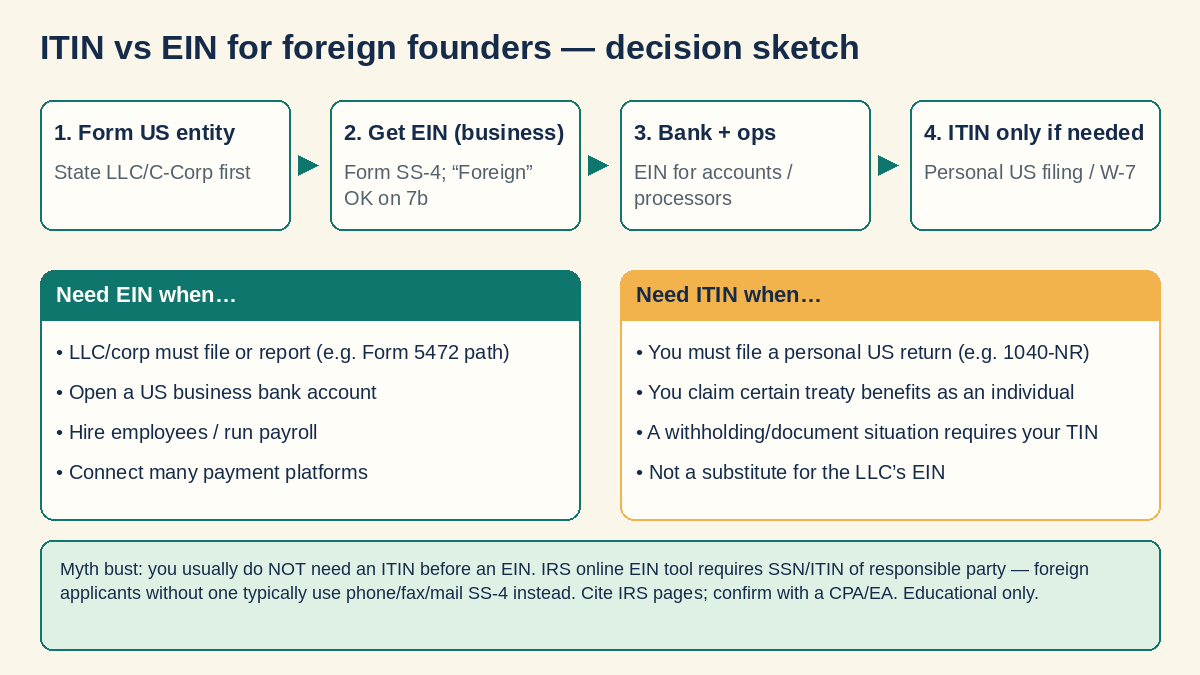
What is an EIN vs an ITIN?
Takeaway: EIN = business taxpayer ID; ITIN = individual taxpayer ID for people who need a US TIN but cannot get an SSN.
Per the IRS overview of taxpayer identification numbers (TIN), the family includes SSN, EIN, ITIN, ATIN, and PTIN. For founders:
- EIN (Employer Identification Number): Identifies a business entity (and some trusts/estates) for federal tax administration. Issued by the IRS after Form SS-4 (online when eligible, or phone/fax/mail).
- ITIN (Individual Taxpayer Identification Number): A nine-digit number beginning with 9, formatted like an SSN, for certain nonresident and resident aliens (and eligible family members) who must have a TIN but cannot obtain an SSN. Applied for on Form W-7.
- SSN: Issued by the Social Security Administration for people eligible for Social Security numbers—not a substitute topic for most non-resident founders reading this page.
An ITIN does not authorize work in the US and does not replace an EIN for a company. An EIN does not identify you personally on a Form 1040-NR.
ITIN vs EIN: decision table for foreign founders
Takeaway: Plan on an EIN for almost every operating US LLC; add an ITIN only when a personal US filing or document requirement appears.
| You need to… | EIN (company) | ITIN (you) |
|---|---|---|
| File Form 5472 + pro-forma Form 1120 for a foreign-owned disregarded LLC | Yes — LLC needs its EIN | Usually no for that filing alone (owner foreign tax ID themes—confirm with preparer) |
| Open a US business bank account | Almost always required | Bank-dependent for personal KYC; not a substitute for business EIN |
| Connect Stripe/PayPal/processors as a business | Typically yes | Platform-dependent; W-8BEN is a separate withholding form story |
| Hire US employees / run payroll | Yes | No (payroll uses employee SSNs) |
| File a personal Form 1040-NR | No | Yes (if you cannot get an SSN) |
| Claim certain individual treaty benefits requiring a TIN | No | Often yes — fact-specific |
| Form the LLC at the state level | Not required to file Articles in most states | Not required for formation itself |
Foreign-owned single-member LLC reporting is covered in depth in Form 5472 for foreign-owned US LLCs. Formation domicile tradeoffs sit in Wyoming LLC vs Delaware LLC and LLC vs C Corporation for SaaS.
Do you need an ITIN before an EIN?
Takeaway: Usually no—this myth burns months. Foreign responsible parties without SSN/ITIN typically cannot use the online EIN tool and should apply by phone, fax, or mail with “foreign” on the TIN line as instructed.
The IRS page Get an employer identification number states you can use the online tool only if (among other conditions) you have the responsible party’s SSN or ITIN, and you cannot use it if the principal place of business is outside the US. In those cases the IRS directs applicants to phone, fax, or mail. SS-4 instructions and long-standing IRS international guidance allow applicants without an SSN/ITIN to enter “foreign” (wording varies by instruction year) rather than inventing a personal TIN.
Practical order for many non-resident LLC owners:
- Form the LLC (or C-Corp) with the state.
- Apply for the EIN on Form SS-4 via an allowed international channel.
- Open banking and connect payments with the EIN.
- Apply for an ITIN later if a personal return or exception category requires it.
Formation helpers (Atlas, doola, Firstbase, and similar) sometimes bundle EIN assistance—compare process and counsel fit in Stripe Atlas vs doola vs Firstbase. Bundles do not change the legal distinction between company and personal TINs.
How foreign applicants get an EIN in 2026
Takeaway: Online EIN is fastest when you qualify; most pure foreign responsible parties should budget time for phone, fax, or mail and keep the CP 575 confirmation letter.
Educational checklist (verify live IRS instructions before you file):
- Form the entity with the state before applying when the IRS says delays happen if the entity is not formed yet.
- Complete Form SS-4 with accurate legal name, responsible party, and entity type.
- If no SSN/ITIN, follow the SS-4 instructions for foreign applicants on the responsible-party TIN line—do not leave it blank if the form requires a value.
- International phone line referenced on IRS TIN pages for foreign entities (for example, 267-941-1099 appears on IRS international TIN materials—confirm on the live page; it is not toll-free).
- Fax/mail per current Form SS-4 instructions; keep transmission proof.
- Store the EIN letter; you will reuse the same EIN when filing obligations arise later.
Third-party sites that charge for “getting an EIN” are unnecessary for the IRS fee itself—the IRS emphasizes EIN issuance is free. Paying a preparer for help filling SS-4 is a service choice, not an IRS requirement.
When does a foreign founder need an ITIN?
Takeaway: Need follows a tax purpose—commonly a personal return—not the mere existence of a US LLC.
IRS materials on how to apply for an ITIN (page last reviewed or updated 22-Feb-2026 per IRS) describe a package that generally includes Form W-7, a US federal income tax return (Form 1040 or 1040-NR as applicable), and supporting identity/foreign-status documents—unless you qualify for a listed exception to attaching a return. Processing guidance on that page cites about 7 weeks in many cases, and 9–11 weeks in tax season or for overseas applications.
Common founder situations that trigger a closer look with a tax advisor (examples, not a complete list):
- You have US-source income that requires a personal nonresident return
- You need to claim certain treaty benefits as an individual and a TIN is required on the withholding certificate path
- A specific bank or counterparty demands a personal US TIN beyond the company’s EIN (policy varies—ask before assuming)
Situations that usually do not by themselves justify a speculative early ITIN: “I might raise VC someday,” “I want a US credit card,” or “I heard Stripe needs it”—verify the actual form the platform requests (often W-8BEN and/or the entity EIN).
How to apply for an ITIN (high level)
Takeaway: Form W-7 + documentation + usually a tax return; mail to the IRS ITIN Operation or use an Acceptance Agent / Taxpayer Assistance Center path.
Per IRS how-to guidance:
- Complete Form W-7 for each applicant.
- Attach the federal return when required, leaving SSN areas blank for ITIN applicants as instructed.
- Provide proof of identity and foreign status (passport and other acceptable documents per W-7 instructions).
- Mail to the Austin ITIN Operation addresses published by the IRS, or apply in person through an IRS Taxpayer Assistance Center with ITIN services, a qualifying VITA site, or an Acceptance Agent / Certifying Acceptance Agent.
- Watch for IRS notices (for example CP565 assigned, CP566 more information, CP567 rejected—names as used in IRS taxpayer communications).
Do not send original passports casually without reading current W-7 instructions and Acceptance Agent options—document return timing is specified by the IRS. Certifying Acceptance Agents can authenticate many documents so you keep originals.
Form 5472, banking, and payment platforms
Takeaway: The LLC’s EIN is the workhorse ID for foreign-owned disregarded LLC reporting and most business onboarding; your ITIN is a separate personal track.
Foreign-owned US disregarded entities have information-return duties that hinge on having an EIN and filing Form 5472 with a pro-forma Form 1120 in the IRS’s prescribed way. Penalties for failure can be severe—treat deadlines as real. Details and educational framing: Form 5472 guide.
Banks want KYC on beneficial owners plus the entity’s EIN. Processors want business identity documents that match your formation papers. Mixing personal ITIN into the company profile incorrectly creates support tickets; missing EIN blocks onboarding. Keep a one-page identity map: legal name, state file number, EIN, responsible party passport country, and registered agent.
Order of operations checklist
Takeaway: State entity → EIN → bank/payments → bookkeeping → personal ITIN only if a filing purpose exists.
- Pick domicile and entity type (WY vs DE, LLC vs C-Corp) with counsel if stakes are high.
- File formation documents; obtain certified copies if your bank requires them.
- Apply for EIN via the correct channel for foreign applicants.
- Open the business account; deposit formation capital per your operating agreement advice.
- Connect payments and record who the seller of record is (processor vs MoR).
- Calendar Form 5472 / BOI / state annual report duties that apply to you.
- If a CPA says you need a personal US return or other W-7 purpose, start ITIN with adequate document time.
Stage overview: SaaS founder compliance checklist and Start here.
EIN, ITIN, and W-8BEN: do not mix the forms
Takeaway: W-8BEN (and related withholding certificates) are about claiming status/treaty rates for the person or entity named on the form—they are not “the EIN application” and not a substitute TIN.
Foreign founders often see a payment platform request a W-8BEN or W-8BEN-E during onboarding. That package may ask for a US TIN if you are claiming certain benefits; the IRS TIN overview notes a TIN must appear on a withholding certificate in specific benefit/exemption situations. Whether the correct identifier is an EIN (entity) or ITIN/SSN (individual) depends on who the beneficial owner is and how the account is structured. Guessing “ITIN” into an entity field—or leaving required TINs blank when claiming treaty benefits—creates preventable rejects.
Educational rule of thumb before your tax advisor customizes it:
- Operating LLC account → expect to use the EIN on business tax/onboarding documents
- Personal contractor income as an individual → personal TIN path (SSN or ITIN) may apply
- Treaty claims → read the form instructions; do not invent a number
Multi-member LLCs, partnerships, and C-Corps
Takeaway: More owners means more personal K-1 / withholding complexity—EIN still belongs to the entity; ITINs follow each person’s filing needs.
A multi-member LLC taxed as a partnership generally needs an EIN. Distributive share reporting can create personal US filing questions for nonresident members when there is effectively connected income or other taxable US-source items—facts your CPA must classify. A C-Corp has its own EIN and files corporate returns; shareholders still track their own dividend/withholding facts separately.
If you expect venture financing, Delaware C-Corp norms may dominate domicile choice even when Wyoming looks cheaper for a bootstrap LLC. That is an entity strategy decision layered on top of TIN mechanics—not a reason to collect ITINs for every co-founder on day one without a filing purpose.
Common mistakes
Takeaway: Waiting on an unnecessary ITIN, using online EIN when ineligible, and treating ITIN as work authorization are the frequent traps.
- Delaying banking for months while chasing an ITIN you do not need yet
- Leaving SS-4 line 7b blank instead of following foreign-applicant instructions
- Paying random websites for a “premium EIN” thinking the IRS charges
- Assuming an ITIN replaces beneficial ownership reporting or Form 5472
- Using a personal ITIN as if it were the company’s federal EIN on W-9/W-8 packages
- Ignoring state foreign qualification when you actually operate in another state
FAQ: ITIN vs EIN for foreign founders
Is an EIN the same as a US tax ID for my LLC?
Yes—EIN is the federal employer identification number used as the business’s TIN on many federal forms.
Can I get an EIN without an ITIN or SSN?
Often yes for foreign responsible parties, via non-online SS-4 channels and entering “foreign” as instructed. You generally cannot complete the IRS online EIN assistant without an SSN/ITIN.
Does forming a Wyoming or Delaware LLC require an ITIN?
State formation itself typically does not require an ITIN. Banking, federal filings, and platforms have their own ID requirements afterward.
How long does an ITIN take?
IRS how-to guidance cites about 7 weeks for notification in many cases, and 9–11 weeks during peak season or for overseas applications. Plan ahead of filing deadlines.
Do I need both numbers?
Many foreign LLC owners operate with an EIN and never need an ITIN. Others eventually need both when a personal US tax purpose appears. They never substitute for each other.
What about C-Corps and Stripe Atlas?
C-Corps also use EINs. Personal ITIN questions still follow your individual filing facts. Compare formation helpers separately from TIN mechanics.
Is an ITIN work authorization?
No. IRS materials frame ITIN as a tax processing number. Immigration status is a different legal regime.
Where do I read official instructions?
Start at IRS TIN overview, EIN online eligibility, Form SS-4 instructions, Form W-7 instructions, and the ITIN how-to page linked in this article.
Bottom line
Takeaway: Get the EIN for the company first; treat ITIN as a personal, purpose-driven application—not a formation prerequisite.
If you are building the rest of the foreign-founder stack, read Form 5472 next, then domicile and entity choice guides. Keep identifiers, formation docs, and registered-agent contacts in one secure folder your accountant can access at tax time.
Next step
Continue with Form 5472 for foreign-owned US LLCs, compare Wyoming vs Delaware, and map stages on the compliance checklist. New to the site? Begin at Start here.