Payments · Last reviewed October 2, 2026
Paddle vs Lemon Squeezy vs Polar for SaaS Teams
Paddle, Lemon Squeezy, and Polar are all true Merchants of Record (MoRs): they resell your digital product, appear as the seller on the transaction, and typically calculate, collect, file, and remit VAT/GST/sales tax in supported markets. As of October 2026 their headline pay-as-you-go rates converge near 5% + $0.50 per transaction—so the decision is less “who is cheapest on the sticker” and more fit: Polar for developer-native products and a public plan ladder (new orgs start on Starter; Early Member rates apply only to organizations created before 27 May 2026), Lemon Squeezy for fast indie storefronts and digital goods, and Paddle for deeper SaaS billing recovery and a scaling path.
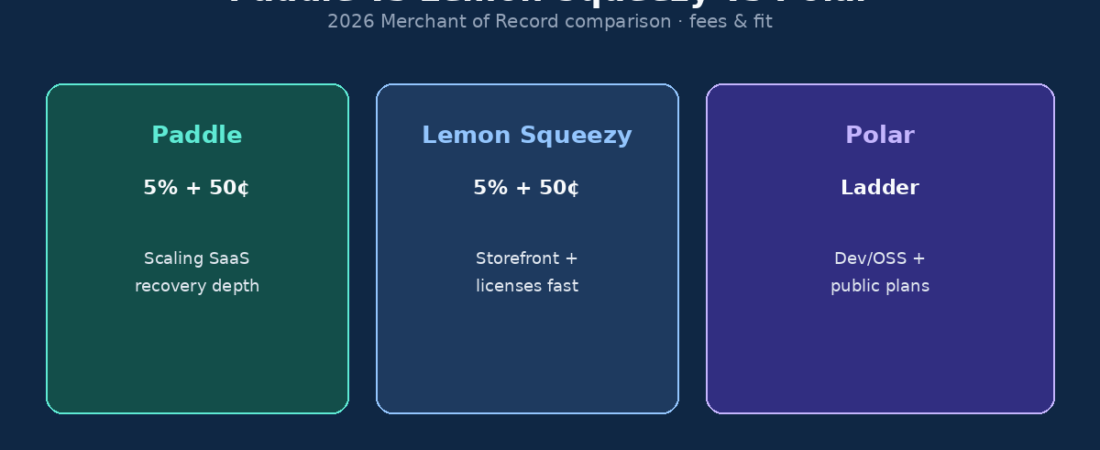
Quick comparison: Paddle vs Lemon Squeezy vs Polar
Takeaway: Same MoR ownership model; different stage fit, surcharge stacks, and subscription depth.
| Dimension | Paddle | Lemon Squeezy | Polar |
|---|---|---|---|
| True Merchant of Record | Yes | Yes | Yes |
| Headline fee (Oct 2026 public) | 5% + 50¢ per Checkout transaction (pay-as-you-go); custom for volume / sub-$10 products | 5% + 50¢ platform fee + documented surcharges | Starter: 5% + 50¢; paid plans lower the variable rate; Early Member only if org created before 27 May 2026 |
| Common add-ons | All-in messaging on pricing page; FX/conversion margins can appear in independent breakdowns—confirm your contract | +1.5% international cards; +1.5% PayPal; +0.5% subscriptions; marketing recovery fees (e.g. abandoned cart) | +1.5% international cards; Early Member only: +0.5% subscriptions; $15 per dispute |
| Setup / approval vibe | Often days–weeks (model verification) | Often hours–days; strong no-code path | Developer-oriented onboarding; GitHub-native flows |
| Storefront / no-code selling | Checkout-centric (embed / hosted) | Strong storefront + license keys + digital downloads | Product/checkout + benefits delivery; OSS-friendly |
| Subscription / recovery depth | Strong SaaS billing + revenue recovery tooling (e.g. Retain positioning) | Solid basics + cart/failed-payment recovery features | Improving; paid plans unlock preview billing behaviors |
| Ownership / ecosystem (2026) | Independent MoR focused on software | Acquired by Stripe (July 2024); brand continues while infrastructure migrates toward Stripe | Independent developer MoR with public fee ladder |
| Best-fit default | Scaling SaaS, complex renewals, enterprise path | First product, creators, digital goods + simple SaaS | Developer tools, open-source monetization, transparent pricing |
Fee rows cite Paddle Pricing, Lemon Squeezy Pricing, Lemon Squeezy Fees docs, and Polar MoR Fees (reviewed October 2, 2026). Product-fit rows summarize vendor positioning and common founder workflows—not audited benchmarks.
What “Merchant of Record” means in this comparison
Takeaway: You are comparing who is the legal seller, not just who processes the card.
Paddle’s own explainer states that a Merchant of Record is the legal entity responsible for selling to the end customer, managing payments, and taking on associated liabilities such as sales-tax collection, PCI scope, refunds, and chargebacks. In the MoR model there are effectively two sales: customer → MoR, and MoR → you (as supplier). The MoR’s name typically appears on the customer’s statement for covered transactions.
That is why this article sits next to our ownership guide Merchant of Record vs payment processor. Classic Stripe (processor mode) usually leaves you as the seller and tax-liable party—even if you add Avalara, TaxJar, or Stripe Tax for calculation help. Paddle, Lemon Squeezy, and Polar compete in the MoR lane. If you need the processor-plus-tax stack instead, start with when a SaaS startup needs sales tax software, the Stripe-inclusive Stripe vs Paddle vs Lemon Squeezy pillar, or the newer Stripe Managed Payments vs Paddle comparison.
Pricing and surcharge reality in 2026
Takeaway: Stickers converged near 5% + 50¢; all-in cost still depends on cards, PayPal, subscriptions, and plan tier.
Official headline rates (checked October 2, 2026)
- Paddle: Pay-as-you-go listed at 5% + 50¢ per Checkout transaction, with no monthly fee on that page; custom pricing for rapidly scaling businesses; products under $10 or invoicing needs may require bespoke pricing (Paddle Pricing).
- Lemon Squeezy: Platform fee listed at 5% + 50¢ per transaction with $0/mo ecommerce features; docs explicitly add surcharges for some payments (LS Pricing; LS Fees).
- Polar: Public ladder — Starter free at 5% + 50¢; Pro $20/mo at 3.8% + 40¢; Growth $100/mo at 3.6% + 35¢; Scale $400/mo at 3.4% + 30¢. Organizations created before 27 May 2026 can stay on Early Member 4% + 40¢ (+0.5% subscriptions) indefinitely unless they leave that rate. Organizations created on or after 27 May 2026 start on Starter (Polar Fees; Polar Pricing).
For a two-way deep dive on Polar’s ladder versus Paddle’s flat Checkout rate for indie teams, see Polar vs Paddle for indie SaaS.
Worked example (illustrative)
Polar’s docs walk a $30 product + 25% VAT = $37.50 total paid with an international card. On Starter they show transaction fee $2.38 + international $0.56 = $2.94 total fees on that $37.50 charge. Lemon Squeezy’s docs use a similar France VAT example on a $20 product ($24 total) and show platform fee including the international adder. Use these as method examples—recompute with your AOV, mix of US vs international cards, and PayPal share before you “optimize” on sticker alone.
Polar paid-plan breakevens (official)
| Polar plan | Monthly fee | Per transaction | Breakeven vs Starter (Polar docs) |
|---|---|---|---|
| Starter | $0 | 5% + 50¢ | — |
| Pro | $20 | 3.8% + 40¢ | ~$1,379 /mo sales |
| Growth | $100 | 3.6% + 35¢ | ~$5,634 /mo sales |
| Scale | $400 | 3.4% + 30¢ | ~$19,048 /mo sales |
That public breakeven table is rare among MoRs and is a genuine information gain versus opaque “contact sales for volume.” If you are above those thresholds and Polar’s product fit is good, the paid ladder can beat Starter—and sometimes beat a flat 5% + 50¢ competitor—before you negotiate custom Paddle or LS volume pricing. One trade-off Polar documents clearly: leaving Early Member for a paid plan retires Early Member for that organization; downgrading later lands you on Starter (5% + 50¢), not the old Early Member rate.
Lemon Squeezy surcharge stack (official)
Per Lemon Squeezy Fees docs (reviewed October 2, 2026):
- +1.5% for international (outside US) transactions
- +1.5% for PayPal transactions
- +0.5% for subscription payments
- Marketing: +5% on payments recovered through abandoned-cart emails; affiliate program fees as documented
Paddle’s public pricing page markets an all-inclusive 5% + 50¢ Checkout rate. Still verify FX/payout treatment and any contract riders for your currency mix—independent 2026 writeups often call out conversion margins even when the headline fee looks flat.
Product fit: storefront, licenses, subscriptions, recovery
Takeaway: Match the product surface you need this quarter, not the brand you remember from Twitter.
- Lemon Squeezy wins many first launches because storefront, license keys, digital downloads, coupons, and email-adjacent marketing sit in one indie-friendly UI. If your first $1–$10k is a theme, course, icon pack, or simple SaaS checkout link, LS is usually the lowest-friction MoR.
- Paddle leans into SaaS checkout, subscriptions, localized payments, tax remittance, fraud tooling, and revenue recovery. Founders who already feel dunning, failed-payment recovery, and multi-currency SaaS pain tend to prefer Paddle once MRR is real—even if onboarding takes longer.
- Polar positions as developer- and open-source-native MoR with transparent fees, benefits delivery, and GitHub-adjacent monetization patterns. It is often the right shortlist item for CLI tools, OSS sponsorships-turned-products, and teams that want plan math in public docs.
None of the three is a full replacement for every enterprise procurement workflow (net terms, complex PO invoicing, usage-based packaging). If buyers require heavy B2B contracting, treat MoR as the self-serve engine and plan a parallel sales-assisted path—or confirm the vendor’s invoicing/custom-pricing options before you promise legal that “MoR covers everything.”
Tax, payouts, and operational ownership
Takeaway: MoR reduces tax ops; it does not delete finance, refunds strategy, or product eligibility review.
As MoR, each platform generally calculates and remits indirect tax on covered sales under its registrations. That is the core reason founders pay a higher all-in take rate than classic 2.9% + 30¢ processing. You still own:
- Product eligibility and prohibited-items compliance
- Customer product support (billing support is often shared with the MoR)
- Refund policy design that keeps dispute rates healthy (Polar lists $15 per dispute; card networks still punish high chargeback rates)
- Accounting recognition of MoR payouts vs gross sales (talk to your bookkeeper—see also SaaS accounting software by stage)
Payout mechanics differ (bank rails, PayPal options, cross-border payout fees). Lemon Squeezy documents payout fees via Stripe or PayPal depending on region; Polar documents Stripe-driven payout fees without Polar markup. Build a one-page “money movement” map before launch so cash timing surprises do not look like “lost revenue.”
Stripe’s Lemon Squeezy acquisition — what founders should watch
Takeaway: LS remains a usable MoR brand in 2026, but roadmap and infrastructure are Stripe-influenced—plan for change, not freeze.
Stripe acquired Lemon Squeezy in July 2024. The Lemon Squeezy brand and MoR product continue, while public commentary and vendor materials describe migration toward Stripe-managed payments infrastructure. For founders that usually means:
- Short term: keep using LS if the storefront/license UX is your bottleneck.
- Medium term: watch feature parity, fee schedule stability, and any migration prompts toward Stripe Managed Payments / related MoR-style products.
- Decision hygiene: do not pick LS solely because “Stripe owns it now,” and do not avoid it solely for the same reason—pick on today’s fee stack + UX + migration export quality.
If your real choice is between Stripe’s MoR-style product and Paddle’s mature MoR surface, use Stripe Managed Payments vs Paddle rather than forcing Lemon Squeezy into that comparison.
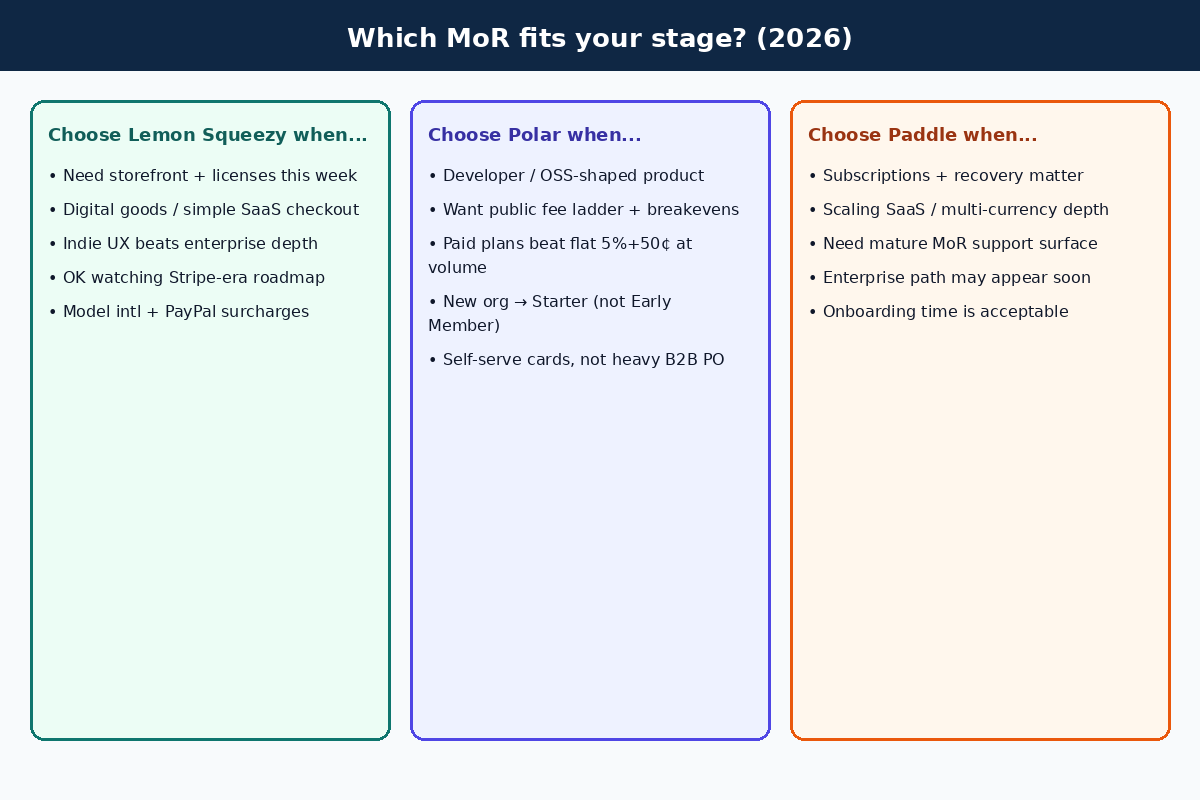
Decision tree: which MoR by stage
Takeaway: Optimize for launch speed early; optimize for recovery and B2B depth as renewals dominate.
- Pre-revenue / first 30 days: Prefer Lemon Squeezy or Polar. Choose LS if you need a storefront and license keys this week. Choose Polar if you are shipping a developer tool and want public fee ladders + GitHub-native monetization. Assume Starter pricing for any Polar org created after 27 May 2026.
- ~$10k–$50k ARR: Re-run the fee model with your real international and PayPal mix. If LS surcharges dominate and Polar’s product covers your billing needs, Polar’s paid plans may win on math. If failed payments already hurt, shortlist Paddle.
- ~$50k–$500k ARR: Prioritize subscription tooling, recovery, multi-currency conversion, and support SLAs. Paddle often becomes the default for SaaS renewals; Polar paid tiers compete when DX and fee transparency matter more than enterprise sales features.
- $500k+ or enterprise-heavy: Talk to Paddle (and LS/Polar sales if volume-eligible) with a written requirements list: invoicing, tax evidence packs, data export, migration assistance, and dispute handling. Do not assume self-serve MoR alone will satisfy every procurement questionnaire.
Switching cost is real: customer payment methods, tax invoices historically issued by the MoR, license entitlements, and analytics all move. Budget engineering and customer-comms time whenever you plan a migration—not just the fee delta.
When to stay on classic Stripe instead
Takeaway: MoR is optional; processor + tax stack can still win when control and unit economics dominate.
Stay (or start) as your own merchant of record with a processor when:
- You already have tax registrations and a filing process that works
- Your AOV and margin cannot absorb ~5% + 50¢ all-in MoR economics
- You need exotic billing (complex usage, marketplace splits, unusual settlement) that MoRs reject or price poorly
- Enterprise buyers require your entity on the invoice as seller of record
In that case, use our MoR vs processor guide first, then compare tax engines in Avalara vs TaxJar vs Stripe Tax. The Stripe-inclusive comparison remains Stripe vs Paddle vs Lemon Squeezy.
Common mistakes founders make
Takeaway: Most MoR regret comes from ignoring surcharges, eligibility, or migration—not from picking the “wrong logo.”
- Comparing only the 5% + 50¢ sticker while 40%+ of volume is international or PayPal.
- Assuming MoR means zero tax work forever—finance still reconciles payouts, refunds, and revenue recognition.
- Launching prohibited or borderline products without reading each MoR’s acceptable-use rules.
- Skipping export tests (customers, subscriptions, license keys) before you depend on a vendor.
- Staying on an early-stage MoR past the point where failed-payment recovery and B2B invoicing cost more than a planned migration.
- Quoting Polar Early Member pricing for a new organization created after the 27 May 2026 cutoff (new orgs start on Starter at 5% + 50¢).
FAQ: Paddle vs Lemon Squeezy vs Polar
Takeaway: Short answers you can reuse in sales or investor docs—always re-check vendor pages before you quote fees.
Are Paddle, Lemon Squeezy, and Polar all Merchants of Record?
Yes. Each positions as MoR for eligible digital/software sales: they act as the reseller and take on substantial payment and indirect-tax operational liability compared with a classic payment processor.
What is the 2026 headline fee for each?
Paddle lists 5% + 50¢ per Checkout transaction on pay-as-you-go. Lemon Squeezy lists 5% + 50¢ platform fee. Polar Starter lists 5% + 50¢ for new organizations; older orgs may still be on Early Member 4% + 40¢ if created before 27 May 2026. Always confirm on the live pricing pages linked above.
Does Lemon Squeezy charge more than 5% + 50¢?
It can. Official fees docs list +1.5% international, +1.5% PayPal, +0.5% subscriptions, plus marketing recovery and affiliate-related fees in defined cases.
Is Polar still cheaper than Paddle?
Not automatically for new organizations. New Polar orgs start on Starter at the same 5% + 50¢ headline; savings usually come from paid Polar plans above documented breakevens, Early Member grandfathering (legacy orgs only), or a better fit that reduces operational cost—not from a guaranteed lower sticker.
Which is best for a first indie SaaS launch?
Lemon Squeezy for storefront/license speed; Polar for developer-tool and OSS-adjacent products. Paddle is often overkill on day one but strong once subscriptions and recovery matter.
Which is best for scaling B2B SaaS?
Paddle is the common shortlist leader for deeper SaaS billing and recovery. Re-evaluate Polar paid tiers if your buyers are developers and your billing is still mostly self-serve cards.
Can I migrate later?
Yes, but plan it. Export customers and entitlements, communicate invoice-name changes, and budget engineering time. MoR migrations are product projects, not checkbox settings.
Should I use an MoR or Stripe Tax with a processor?
Use MoR when you want to outsource seller-of-record tax remittance ops and accept higher take rate. Use processor + tax software when you need to remain the seller, control invoicing identity, or protect unit economics. See MoR vs processor.
Bottom line
Takeaway: In 2026, pick on stage and product surface—fees alone rarely decide Paddle vs Lemon Squeezy vs Polar.
Choose Lemon Squeezy to sell a first digital product or simple SaaS quickly with storefront and license tooling (and monitor Stripe-era roadmap changes). Choose Polar when developer experience and public fee ladders matter—especially if paid-plan math works after the Starter baseline. Choose Paddle when subscription recovery, global SaaS payments depth, and a scaling path outweigh slower onboarding.
Next step: Map your next 90 days on the decision tree above, then read Merchant of Record vs payment processor to confirm you actually want MoR economics. For an indie two-way, use Polar vs Paddle for indie SaaS. For the Stripe-inclusive view, use Stripe vs Paddle vs Lemon Squeezy or Stripe Managed Payments vs Paddle. Broader ops context sits in the SaaS founder compliance checklist, Start here, and Tools hubs.
Primary sources reviewed October 2, 2026: Paddle Pricing; Paddle — What is a Merchant of Record; Lemon Squeezy Pricing; Lemon Squeezy Fees; Polar MoR Fees; Polar Pricing. Ownership note: Stripe’s July 2024 acquisition of Lemon Squeezy (contemporary press coverage).