Payments / MoR · Last reviewed September 23, 2026
Stripe Managed Payments vs Paddle for SaaS Founders
Stripe Managed Payments is Stripe’s merchant-of-record layer for eligible digital products: Stripe handles indirect tax compliance (sales tax, VAT, GST) in many countries plus fraud, disputes, and transaction support, and charges 3.5% per successful Managed Payments transaction in addition to standard Payments fees (stripe.com/pricing, September 2026). Paddle is a standalone Merchant of Record with a published all-in checkout fee of 5% + $0.50 (paddle.com/pricing). Choose Managed Payments if you are already deep in Stripe and want MoR without replatforming; choose Paddle if you want one inclusive MoR fee and will move billing off Stripe. Many early teams should stay on plain Stripe + Stripe Tax until cross-border tax operations hurt.
Quick comparison table (2026)
Takeaway: Managed Payments is an MoR add-on on top of Stripe Payments; Paddle is an all-in MoR fee that replaces a processor + tax + much of billing ops stack.
| Dimension | Stripe Managed Payments | Paddle |
|---|---|---|
| Model | Merchant of Record layer inside Stripe (customer sees Link as seller surface) | Standalone Merchant of Record |
| Published fee shape | 3.5% in addition to Payments fees | 5% + $0.50 per Checkout transaction (all-in on published page) |
| Illustrative US card all-in | ~6.4% + $0.30 if Payments is 2.9% + $0.30 (plus Billing and other add-ons if used) | 5% + $0.50 (custom pricing for products under $10 / high volume) |
| Tax posture | Indirect tax compliance in 75+ / 80+ countries per Stripe pricing/docs wording | Paddle registers, collects, remits as MoR (global software focus) |
| Checkout path | Checkout / Payment Links with Managed Payments enabled; custom domains not supported on MP checkouts | Paddle Checkout / billing |
| Best when | Already on Stripe; want MoR without rewriting billing | Want one MoR vendor and accept leaving Stripe billing |
| Watch-outs | Fee stacking; Connect unsupported; eligibility limits | Migration cost; products under $10 need custom pricing |
For the broader three-way fees landscape (including Lemon Squeezy), see Stripe vs Paddle vs Lemon Squeezy. For the conceptual split, read Merchant of Record vs payment processor.
What Stripe Managed Payments actually is
Takeaway: Managed Payments makes Stripe the merchant of record for covered digital sales—tax remittance and dispute/support workflows shift toward Stripe/Link, while you keep Stripe APIs for eligible Checkout and Payment Links flows.
According to Stripe’s Managed Payments docs, the product targets digital goods such as SaaS, software, and digital downloads. Stripe describes handling of:
- Sales tax, VAT, and GST compliance in more than 80 countries (pricing page also references 75+ for remittance wording—verify the live page for your account)
- Fraud prevention and dispute handling for Managed Payments transactions
- Transaction-level customer support via Link, with product-level support still on you
- Checkout optimizations (Link, Adaptive Pricing defaults)
Important constraints from the same docs family: Managed Payments does not support Stripe Connect marketplace/platform patterns, and several advanced invoicing/subscription patterns outside Checkout/Payment Links are unsupported. Custom domains are not supported on Managed Payments checkouts. Existing subscriptions generally cannot simply “turn on” MoR—new Managed Payments Checkout purchases are the path Stripe documents.
What Paddle actually is
Takeaway: Paddle sells you an all-in MoR operating system—payments, tax, buyer support, and much of subscription billing—under one published checkout fee.
Paddle’s public pricing page states 5% + 50¢ per Checkout transaction with no monthly fee on the pay-as-you-go story, and notes custom pricing for products under $10 and for larger businesses. As MoR, Paddle is the legal seller to the end customer for covered transactions. That is a platform swap relative to “Stripe processor + you as merchant,” not a toggle inside your existing Stripe account.
Fee math: worked examples (illustrative)
Takeaway: Compare all-in take-home on the same invoice—not headline percentages alone—and include Billing or international add-ons if you use them.
Assumptions for the table: US domestic card; Stripe Payments list rate 2.9% + $0.30; Managed Payments +3.5%; no Stripe Billing percentage layered unless noted; Paddle 5% + $0.50. Tax amounts withheld for remittance are separate from platform fees—do not confuse tax with MoR fee.
| Invoice total (ex-tax illustration) | Plain Stripe Payments fee | Stripe + Managed Payments (3.5% + Payments) | Paddle (5% + $0.50) |
|---|---|---|---|
| $49.00 | $1.72 (2.9%+$0.30) | $1.72 + $1.72 ≈ $3.44 (~7.0%) | $2.95 (~6.0%) |
| $99.00 | $3.17 | $3.17 + $3.47 ≈ $6.64 (~6.7%) | $5.45 (~5.5%) |
| $299.00 | $8.97 | $8.97 + $10.47 ≈ $19.44 (~6.5%) | $15.45 (~5.2%) |
If you also pay Stripe Billing (~0.7% of billing volume on common public packaging), Managed Payments all-in rises further. International cards, FX, and local payment methods can change both stacks. Re-run the math on your mix before you migrate.
Tax, liability, and support differences
Takeaway: Both products aim to reduce your direct sales-tax filing burden for covered transactions; they are not identical on checkout branding, buyer support, or migration cost.
- Who is merchant of record: Under Managed Payments, Stripe’s MoR solution applies and customers interact with Link as the seller surface for covered flows. Under Paddle, Paddle is MoR on covered checkout sales.
- Tax: Stripe documents calculation/collection/remittance for many countries under Managed Payments; outside covered countries you may still need Stripe Tax or other tooling. Paddle markets global MoR tax handling inside its fee—confirm product eligibility for your offer.
- Disputes/fraud: Managed Payments shifts much dispute handling to Stripe for those transactions (dispute received fees can still apply). Paddle likewise absorbs MoR operational burden inside its model, with its own chargeback fee schedule on public reviews—verify on Paddle’s current terms.
- Sales-tax specialists: If you stay merchant of record on plain Stripe, you may still need Stripe Tax, Anrok, Avalara, or TaxJar—see Anrok vs Avalara and Avalara vs TaxJar vs Stripe Tax.
When plain Stripe + Stripe Tax is still enough
Takeaway: Do not buy MoR fees to solve a spreadsheet problem you have not measured—start with nexus and filing load, then escalate.
- Most revenue is domestic and your accountant already files a manageable state set
- You need Connect, complex invoicing, or embed patterns Managed Payments does not support
- Your average order value is low and the fixed MoR cents matter less than keeping processor rates
- You are pre-product-market fit and still changing pricing weekly
Use when a SaaS startup needs sales tax software to decide whether tax software or MoR is the next lever.
When Managed Payments fits
Takeaway: Prefer Managed Payments when Stripe is already your system of record and MoR coverage is worth the stacked percentage.
- Checkout or Payment Links can be the commercial path for new MoR sales
- Engineering cost to leave Stripe is high (entitlements, customer portal, metering)
- You want one dashboard for processor and MoR transactions
- You accept ~6.4%+$0.30-class US all-in as the price of staying put
When Paddle fits
Takeaway: Prefer Paddle when you want a mature all-in MoR fee and are willing to migrate billing.
- You want predictable all-in MoR pricing without stacking Stripe add-ons
- Buyer support and tax ops capacity on your team is thin
- Your catalog fits Paddle’s software/digital rules and pricing (watch sub-$10 SKUs)
- You are comparing MoR peers (Polar, Lemon Squeezy) anyway—see Paddle vs Lemon Squeezy vs Polar
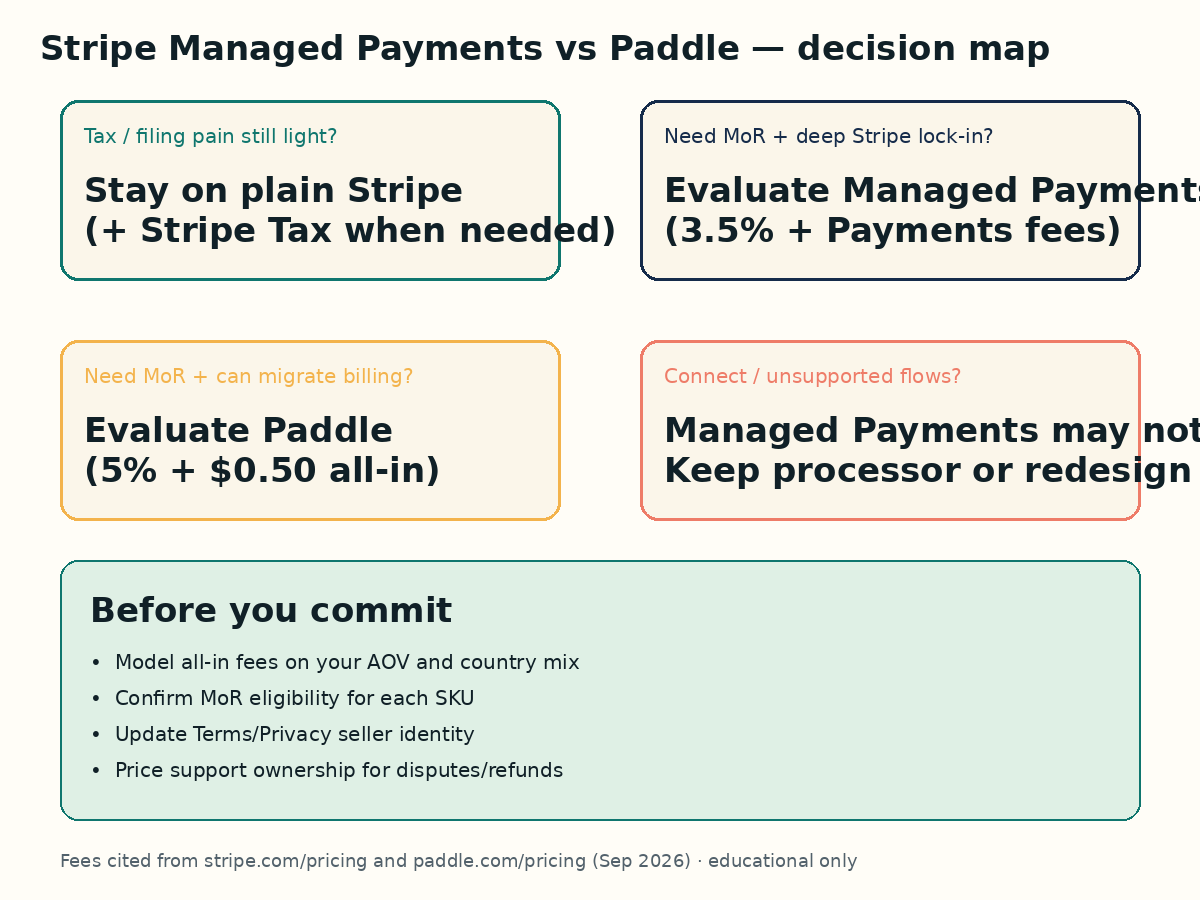
Founder decision tree
Takeaway: Lock the merchant model first (you vs MoR), then pick the vendor—do not pick a brand and reverse-engineer the model.
- If tax/filing load is still light → stay on plain Stripe; add Stripe Tax or a tax specialist when nexus spreads.
- If you need MoR and cannot leave Stripe APIs soon → evaluate Managed Payments eligibility and fee stack.
- If you need MoR and can migrate checkout → compare Paddle’s 5%+$0.50 against Polar/LS peers on features you actually use.
- If Connect/marketplace or unsupported invoice patterns are core → Managed Payments may be a non-starter; stay processor or redesign.
- Price a real month of volume on both fee schedules before you commit.
Migration and operational checklist
Takeaway: MoR switches fail on entitlements, tax-inclusive price presentation, and dunning—not on the marketing page.
- Map every SKU for MoR eligibility (services/coaching often fail digital MoR rules)
- Decide tax-inclusive vs exclusive price presentation
- Plan subscription migration windows (Managed Payments docs emphasize new Checkout purchases for MoR enablement)
- Update Terms/Privacy seller identity where MoR changes the legal seller
- Re-test failed-payment emails, refunds, and customer support ownership
- Re-run revenue recognition notes with your accountant (MoR gross vs net reporting)
Side-by-side: who owns the customer billing relationship
Takeaway: MoR changes who the customer thinks sold them the product—update Terms, receipts expectations, and support macros before you flip the switch.
On plain Stripe, your brand is usually the merchant; Stripe is the processor. On Managed Payments, Stripe documents Link as the merchant-of-record surface customers see for covered checkouts (“Sold through Link” style presentation in Stripe’s how-it-works docs). On Paddle, Paddle is the seller of record on covered transactions. That shift affects:
- Statement descriptors and receipt branding
- Who answers “why was I charged?” tickets first
- How refunds and tax-inclusive totals appear
- Whether your Privacy Policy still accurately describes the payment seller
Founders who treat MoR as “just a tax plugin” discover the support and brand implications during the first dispute week. Budget time for macros and help-center updates, not only API work.
Indie founder scenarios (educational)
Takeaway: Volume mix and engineering lock-in matter more than Twitter consensus about which MoR is “best.”
Scenario A — $8k MRR, 90% US cards, already on Stripe Billing. Measure hours spent on sales-tax filings first. If filings are still light, stay on Stripe + Tax. If MoR becomes attractive and Connect is unused, model Managed Payments all-in versus a Paddle migration weekend.
Scenario B — Global PLG with many sub-$30 seats. Fixed per-transaction cents and MoR eligibility rules matter. Paddle’s sub-$10 custom-pricing note is a real diligence item; Managed Payments still stacks percentages on every seat renewal.
Scenario C — Marketplace or Connect-based SaaS. Managed Payments documentation lists Connect as unsupported. Do not plan an MoR toggle that your architecture cannot use—evaluate processor+tax or a different commercial design.
Scenario D — Considering Polar or Lemon Squeezy instead. Keep Paddle in the shortlist, but score checkout UX, payout timing, and catalog rules against peers using the cluster comparison posts rather than a two-vendor tunnel.
What to verify on vendor pages before you commit
Takeaway: Public list prices are a starting point—screenshot the live fee schedule and eligibility list the day you decide.
- Stripe Pricing → Managed Payments line: confirm the 3.5% add-on wording still matches
- Stripe Managed Payments docs → product eligibility, country coverage, unsupported integrations
- Paddle Pricing → 5% + 50¢ and any custom-pricing thresholds
- Your own last 90 days of card-country mix and average order value
- Whether Billing, Radar, or FX fees apply on your Stripe account today
Common mistakes
Takeaway: The costly mistake is comparing 3.5% to 5% without adding Stripe’s underlying Payments fee—or buying MoR before tax pain is real.
- Treating Managed Payments’ 3.5% as all-in
- Ignoring Billing, Radar, or FX add-ons in Stripe TCO
- Enabling MoR for product types the provider will reject
- Promising custom-domain checkout on Managed Payments
- Migrating to Paddle without a support/ownership runbook for billing tickets
FAQ: Stripe Managed Payments vs Paddle
1) Is Stripe Managed Payments a true Merchant of Record?
Stripe documents Managed Payments as its merchant-of-record solution for eligible digital products, with Link as the customer-facing seller surface on those flows. Confirm eligibility for your offer in Stripe’s docs and Dashboard.
2) How much does Stripe Managed Payments cost?
Stripe’s pricing page states 3.5% per successful Managed Payments transaction in addition to Payments fees. US domestic cards commonly start from 2.9% + $0.30, so a simple all-in illustration is about 6.4% + $0.30 before other Stripe products.
3) How much does Paddle cost?
Paddle’s public pay-as-you-go price is 5% + $0.50 per Checkout transaction. Products under $10 and larger businesses may get custom pricing.
4) Which is cheaper for a $99 SaaS subscription?
On the public US-card assumptions above, Paddle’s illustrative fee (~$5.45) is lower than Managed Payments stacked on Payments (~$6.64). Your mix, FX, and add-ons can flip the ranking—model your own volume.
5) Can I use Managed Payments with Stripe Connect?
Stripe’s Managed Payments documentation lists Connect / marketplace-style integrations as unsupported. If Connect is core, plan a different path.
6) Should indie hackers default to Paddle?
Only if MoR tax/support relief is worth the fee and migration. Many indies stay on Stripe longer; others prefer Paddle/Polar-class MoR peers. Compare features you will actually use.
7) Does MoR replace Stripe Tax?
For covered Managed Payments or Paddle transactions, the MoR handles much of the indirect tax workflow those products advertise. Outside coverage—or if you remain merchant of record—you still need tax tooling and filings.
8) How does Lemon Squeezy or Polar change the decision?
They are alternative MoR-style stacks with their own fee bands and product constraints. Use the cluster guides on this site rather than treating Paddle as the only non-Stripe option.
Bottom line
Stripe Managed Payments keeps you inside Stripe at a stacked MoR percentage (3.5% plus Payments). Paddle charges a published all-in 5% + $0.50 as a standalone MoR. Pick Managed Payments for Stripe lock-in with MoR needs; pick Paddle for all-in MoR with a platform move; pick neither until tax and support pain justify MoR fees.
Next step: Compare the wider fee landscape in Stripe vs Paddle vs Lemon Squeezy, clarify the model in Merchant of Record vs payment processor, then browse Start Here or the tools hub.